


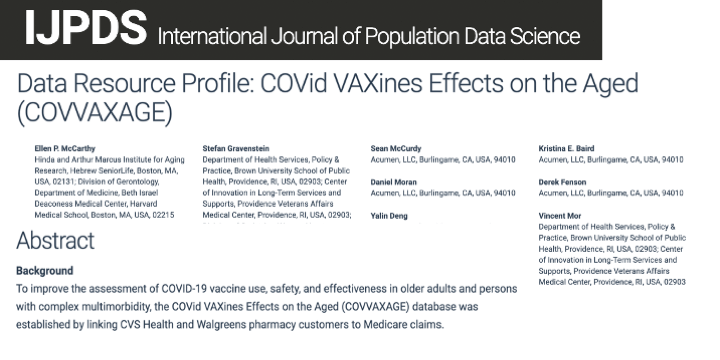
Data Resource Profile: COVid VAXines Effects on the Aged (COVVAXAGE)
October 18, 2023
A data resource profile was published in the International Journal of Population Data Science (IJPDS) about a supplemental IMPACT study resulting in a vast national database of older adult COVID-19 data. IMPACT multiple principal investigator Vincent Mor, PhD, and IMPACT executive director, Ellen McCarthy, PhD, MPH, collaborated with a team of researches including researches from CVS Health and Walgreens, to create the COVid VAXines Effects on the Aged (COVVAXAGE) database to understand vaccine effectiveness in older adults, especially those with dementia.
The COVVAXAGE database contains previously collected data from more than 38 million people insured by Medicare. The aims of the project are to examine the uptake, safety, and effectiveness of COVID-19 vaccines in older adults. Investigators funded by the National Institute on Aging (NIA) who establish relevant data use agreements can access these data.
Abstract
Background
To improve the assessment of COVID-19 vaccine use, safety, and effectiveness in older adults and persons with complex multimorbidity, the COVid VAXines Effects on the Aged (COVVAXAGE) database was established by linking CVS Health and Walgreens pharmacy customers to Medicare claims.
Methods
We deterministically linked CVS Health and Walgreens customers who had a pharmacy dispensation/encounter paid for by Medicare to Medicare enrollment and claims records. Linked data include U.S. Medicare claims, Medicare enrollment files, and community pharmacy records. The data currently span 01/01/2016 to 08/31/2022. “Research-ready” files were created, with weekly indicators for vaccinations, censoring, death, enrollment, demographics, and comorbidities. Data are updated quarterly.
Results
As of November 2022, records for 27,086,723 CVS Health and 23,510,025 Walgreens unique customer IDs were identified for potential linkage. Approximately 91% of customers were matched to a Medicare beneficiary ID (95% for those aged 65 years or older). In the final linked cohort, there were 38,250,873 unique beneficiaries representing ~60% of the Medicare population. Among those alive and enrolled in Medicare as of January 1, 2020 (n = 33,721,568; average age = 73 years, 74% White, 51% Medicare Fee-for-Service, and 11% dual-eligible for Medicaid), the average follow-up time was 130 weeks. The cohort contains 16,021,055 beneficiaries with evidence a first COVID-19 vaccine dose. Data are stored on the secure Medicare & Medicaid Resource Information Center Health & Aging Data Enclave.
Data access
Investigators with funded or in-progress funding applications to the National Institute on Aging who are interested in learning more about the database should contact Dr. Vincent Mor and Dr. Kaleen Hayes. A data dictionary can be provided under reasonable request.
Conclusions
The COVVAXAGE cohort is a large and diverse cohort that can be used for the ongoing evaluation of COVID-19 vaccine use and other research questions relevant to the Medicare population.