


September 11, 2023
There is little data on patient and public involvement (PPI) in pragmatic trials, including methods and outcomes. IMPACT member Monica Taljaard, PhD and a team of authors describe the prevalence and nature of PPI within pragmatic trials including the variations in PPI across trial characteristics. They also compared the prevalence of PPI reported by trial authors to that reported in primary trial publications and found gaps in how often PPI is used and how often it is reported. They found that PPI was used more commonly than expected but is underreported by peer-review manuscripts. The authors make recommendations to strengthen trials that use PPI.
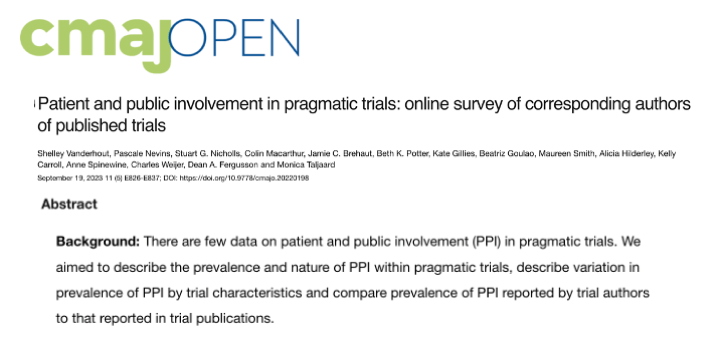
Abstract
Background:
There are few data on patient and public involvement (PPI) in pragmatic trials. We aimed to describe the prevalence and nature of PPI within pragmatic trials, describe variation in prevalence of PPI by trial characteristics and compare prevalence of PPI reported by trial authors to that reported in trial publications.
Methods:
We applied a search filter to identify pragmatic trials published from 2014 to 2019 in MEDLINE. We invited the corresponding authors of pragmatic trials to participate in an online survey about their specific trial.
Results:
Of 3163 authors invited, 2585 invitations were delivered, 710 (27.5%) reported on 710 unique trials and completed the survey; 334 (47.0%) conducted PPI. Among those who conducted PPI, for many the aim was to increase the research relevance (86.3%) or quality (76.5%). Most PPI partners were engaged at protocol development stages (79.1%) and contributed to the co-design of interventions (70.9%) or recruitment or retention strategies (60.5%). Patient and public involvement was more common among trials involving children, trials conducted in the United Kingdom, cluster randomized trials, those explicitly labelled as “pragmatic” in the study manuscript, and more recent trials. Less than one-quarter of trials (22.8%) that reported PPI in the survey also reported PPI in the trial manuscript.