

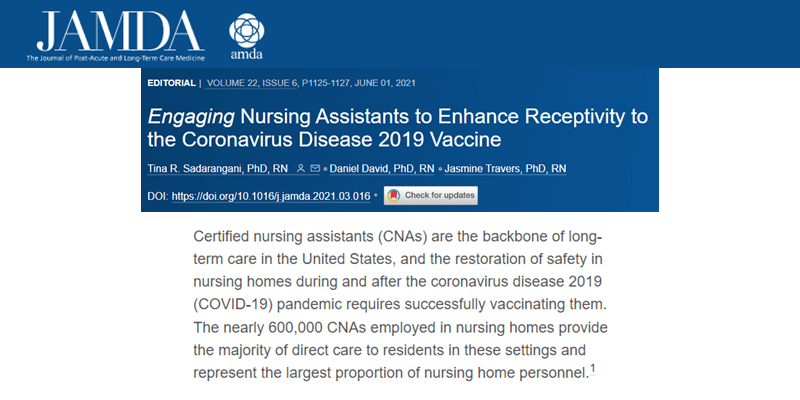
Engaging Nursing Assistants to Enhance Receptivity to the Covid-19 Vaccine
June 1, 2021
Tina Sadarangani, PhD, RN, 2020 IMPACT Career Development Awardee, and Jasmine Travers, PhD, RN, 2021-2022 IMPACT Faculty Scholar, are authors of editorial on engaging CNAs to enhance COVID-19 vaccine receptivity.
Excerpt
Certified nursing assistants (CNAs) are the backbone of long-term care in the United States, and the restoration of safety in nursing homes during and after the coronavirus disease 2019 (COVID-19) pandemic requires successfully vaccinating them. The nearly 600,000 CNAs employed in nursing homes provide the majority of direct care to residents in these settings and represent the largest proportion of nursing home personnel.1 However, despite having what has been called, “the most dangerous job in America” during the COVID-19 pandemic,2 CNAs experience high levels of vaccine hesitancy. In a study of nursing home and assisted living staff in Indiana,3 62% of CNAs reported they were unwilling to receive the vaccine as soon as it was available; 44% of the overall sample reported they would consider receiving the vaccine at a future point in time. This is consistent with a national study that broadly sampled health care workers, including CNAs.4 In that study, 56% of respondents stated they would wait for a future point in time to be vaccinated. Unfortunately, waiting to vaccinate nursing home staff is a dangerous proposition. In nursing homes, vaccines are essential tools for protecting vulnerable individuals and reducing the spread of the pandemic. To ensure a safe, healthy, and vaccinated workforce and resident population, it is critical that vaccine hesitancy in CNAs is both understood and mitigated.