

June 9, 2022
IMPACT Implementation Core postdoc, Zachary Baker, PhD, is among authors who published an article proposing a strategy wherein researchers in High Income Countries (HICs) might create interventions in partnership with stakeholders from Low and Middle-Income Countries (LMICs) to speed the adoption of these interventions in both countries. The authors present consideration and opportunities germane to cultural context, involving LMIC stakeholders, equity, transnational aging, accelerating the research pipeline, and incentives for successful intervention development collaboration between HICs and LMICs.
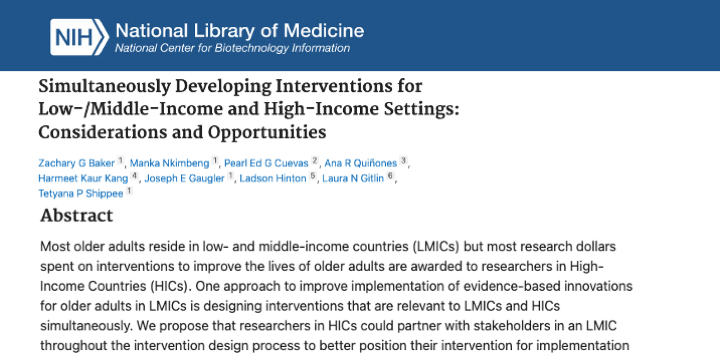
Abstract
Most older adults reside in low- and middle-income countries (LMICs) but most research dollars spent on interventions to improve the lives of older adults are awarded to researchers in High-Income Countries (HICs). One approach to improve implementation of evidence-based innovations for older adults in LMICs is designing interventions that are relevant to LMICs and HICs simultaneously. We propose that researchers in HICs could partner with stakeholders in an LMIC throughout the intervention design process to better position their intervention for implementation in that LMIC. We provide an example study from an adaptation of the Resources for Enhancing Caregiver Health (REACH) II in Vietnam, which did not use this strategy but may have benefited from this strategy. We then turn to several considerations that are important for researchers to contemplate when incorporating this strategy. Finally, we explore incentives for creating interventions that are relevant to both HICs and LMICs for funders, intervention designers, and intervention receivers. Although this is not the only strategy to bring interventions to LMICs, it may represent another tool in researchers’ toolboxes to help expedite implementation of efficacious interventions in LMICs.