


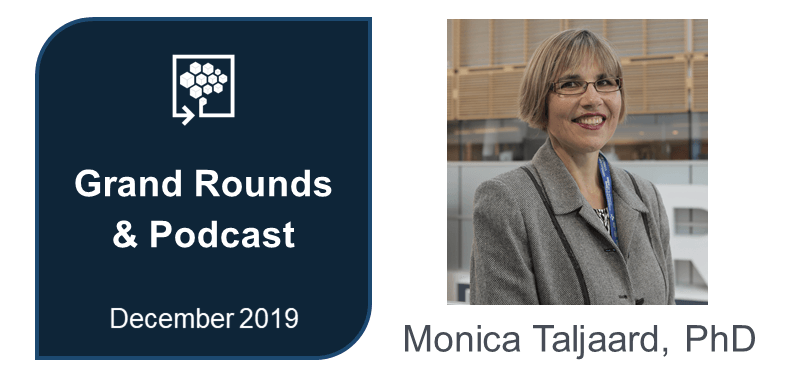
December 2019 – In Grand Rounds 2, Dr. Taljaard describes the use of stepped wedge design in cluster randomized trials (SW-CRT), a novel research design embraced by clinical researchers.
Speaker

Learning Objectives
- Describe the key characteristics and main types of stepped wedge cluster randomized trials (SW-CRTs) with examples.
- Explain the main approach to analysis and sample size calculation for SW-CRTs.
- Discuss what is an appropriate justification for using a SW-CRTs.
Related Articles and Resources
- Kasza J1, Taljaard M2,3, Forbes AB1 Information content of stepped-wedge designs when treatment effect heterogeneity and/or implementation periods are present https://www.ncbi.nlm.nih.gov/pubmed/31321806
- Teerenstra S, Taljaard M, Haenen A, Huis A, Atsma F, Rodwell L, Hulscher M. Sample size calculation for stepped-wedge cluster-randomized trials with more than two levels of clustering. Clinical Trials. 2019; 16(3):225-236. doi: 10.1177/1740774519829053.
- R package ‘swCRTdesign’ http://faculty.washington.edu/jphughes/pubs.html
- R-Shiny (Hemming & Kasza) https://clusterrcts.shinyapps.io/rshinyapp/