


October 6, 2022
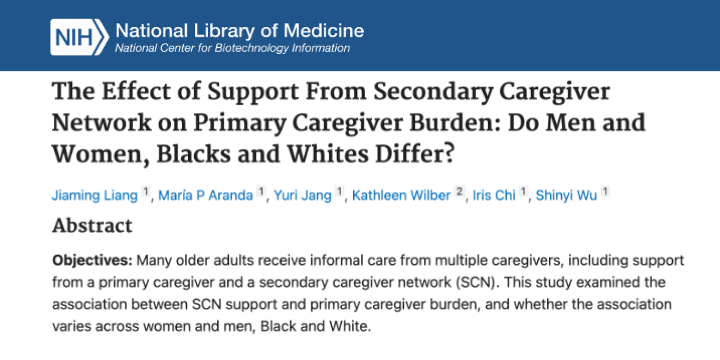
IMPACT HET member Maria Aranda, PhD, MSW, MPA, LCSW, co-authored an article examining associations between secondary caregiver network (SCN) support and primary caregiver burden, and whether the association varies across women and men, Black and white individuals.
Abstract
Objectives: Many older adults receive informal care from multiple caregivers, including support from a primary caregiver and a secondary caregiver network (SCN). This study examined the association between SCN support and primary caregiver burden, and whether the association varies across women and men, Black and White.
Methods: Data came from the 2015 National Health and Aging Trend Study and the National Study of Caregiving, including non-Hispanic White and Black men and women who were identified as primary caregivers (n = 967) and their secondary caregivers (n = 2,253). SCN support was indicated by (a) care domain overlap and (b) proportion of caregiving by SCN. Multiple regression models were estimated for the analyses.
Results: Both SCN support variables were found to reduce primary caregiver burden, and the effect of proportion of caregiving by SCN was found to vary by gender-race groups. With the increase of the proportion of caregiving by SCN, both Black and White women caregivers tend to experience faster decrease in caregiver burden than Black men.