

October 6, 2022
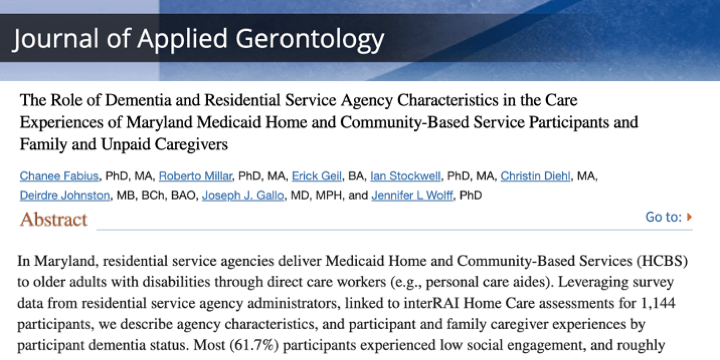
Health Equity Team member, Chanee Fabius, PhD, is among authors of an article exploring dementia care through a study of personal care aides in Maryland.
Abstract
In Maryland, residential service agencies deliver Medicaid Home and Community-Based Services (HCBS) to older adults with disabilities through direct care workers (e.g., personal care aides). Leveraging survey data from residential service agency administrators, linked to interRAI Home Care assessments for 1,144 participants, authors describe agency characteristics, and participant and family caregiver experiences by participant dementia status. Most (61.7%) participants experienced low social engagement, and roughly 10.0% experienced a hospitalization or emergency room visit within 90 days. Few (14.4%) participants were served by agencies requiring dementia-specific direct care worker training, and most were served by agencies offering supplemental services, or in which direct care workers helped with health information technology (81.2% and 72.8%, respectively). Few caregivers reported negative care experiences. Participants with dementia and those served by agencies with training and supports more often reported negative care experiences. Findings lay the foundation for future longitudinal and embedded interventions within Medicaid HCBS.