

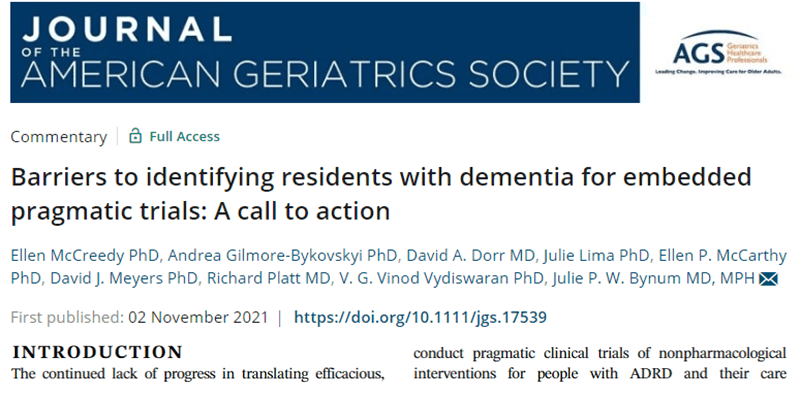
Barriers to identifying residents with dementia for embedded pragmatic trials: A call to action
November 2, 2021
IMPACT members Ellen McCreedy, PhD, MPH, David Dorr, MD, MS, Julie Lima, PhD, MPH, Ellen McCarthy, PhD, MPH, David Meyers, PhD, MPH, Richard Platt, MD, MSc, V.G. Vinod Vydiswaran, PhD, and Julie Bynum, MD, MPH, are among authors of an article summarizing three major barriers to identifying people with Alzheimer’s disease or other dementias (ADRD). These barriers need to be addressed to equitably and accurately determine patients’ eligibility and facilitate enrollment in future clinical trials of nonpharmacological interventions.
Introduction
The continued lack of progress in translating efficacious, evidence-based interventions into real-world settings has been an area of increasing focus over the last 10 years. This implementation gap is also found in the translation of nonpharmacological interventions for people living with Alzheimer’s disease or other dementias (ADRD) and their care partners.1 While efficacious interventions exist, few have demonstrated effectiveness or sustainability under real-world testing. In response, the National Institute on Aging (NIA) has made a significant investment in bridging the implementation gap by funding the IMbedded Pragmatic Alzheimer’s disease and AD-Related Dementias Clinical Trials (IMPACT) Collaboratory.2 The mission of the IMPACT Collaboratory is to build national capacity to conduct pragmatic clinical trials of nonpharmacological interventions for people with ADRD and their care partners.
One key feature of embedded pragmatic trials is to enroll all participants who are likely to be recommended to receive the intervention when it becomes part of usual care. To enroll participants in large pragmatic trials, we first need to be able to accurately identify the target population. Adequate screening optimally relies on use of available data sources as reliance on clinician or researcher screening is frequently infeasible at scale. In October 2020, the NIA IMPACT Collaboratory Technical Data Core sponsored a virtual workshop entitled “Future Priorities for Identifying People with Dementia from Digital Health Data for Embedded Pragmatic Clinical Trials.”3 Over 50 research and policy experts convened to share best-practice, validated algorithms for identifying people with ADRD and their limitations. The goals of the workshop were to assess the current state of the field, clarify directions for future work, and prioritize immediate and long-term goals. In this call to action, we summarize three major barriers to identifying people with ADRD that need to be addressed to equitably and accurately target eligibility and enrollment for future pragmatic trials.