

November 2, 2021
IMPACT Executive Committee and Health Equity Team member Ladson Hinton, MD and Implementation Core leader, Laura Gitlin, PhD, FGSA, are among authors that published a comprehensive scoping review of caregiver support interventions for people living with dementia in Latin America. Dementia prevalence in Latin America (LATAM) is rapidly increasing, contributing to significant family burden. Eight databases were searched for nonpharmacological intervention studies published up to July 2021 in LATAM reporting at least one caregiver outcome. A qualitative synthesis examines study designs, participants, and outcome characteristics.
Abstract
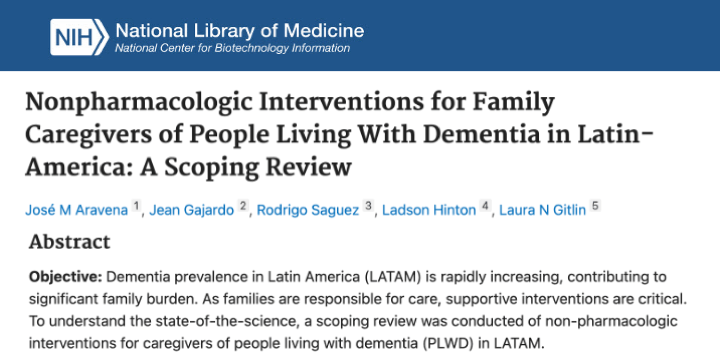
Objective: Dementia prevalence in Latin America (LATAM) is rapidly increasing, contributing to significant family burden. As families are responsible for care, supportive interventions are critical. To understand the state-of-the-science, a scoping review was conducted of non-pharmacologic interventions for caregivers of people living with dementia (PLWD) in LATAM.
Design: Eight databases were searched (PubMed, Embase, PsycINFO, Scopus, Scielo, Lilacs, Redalyc, Google Scholar) for nonpharmacological intervention studies published up to July, 2021 in LATAM reporting at least 1 caregiver outcome. A qualitative synthesis examined study designs, participants, and outcomes characteristics.
Results: Forty-five studies were identified from 25.8% (n = 8/31) of LATAM countries (28 = Brazil, 4 = Chile, 4 = Cuba, 4 = México, 2 = Colombia, 1 = Perú, 1 = Ecuador, 1 = Argentina): 29% (n = 17) were randomized clinical trials (RCT), 7% (n = 3) nonrandomized comparison trials, 42% (n = 19) pre-post trials, 9% (n = 4) postintervention analyses, and 4% (n = 2) single case studies, comprising a total of 1,171 caregivers and 817 PLWD. For 20 RCT and nonrandomized comparison trials, 31 interventions were tested of which 48.4% (n = 15) targeted caregivers and 32.3% (n = 10) dyads. Most studies involved daughters with less than 12 years of education and tested multicomponent interventions involving disease education (90%), and cognitive behavioral coping (45%). Half of interventions (51.6%; n = 16/31) tested were adapted from other countries, and reported benefits for caregiver depression, quality of life, and burden.
Conclusion: Studies were conducted in a limited number of LATAM countries and few were RCTs. Results of RCTs showed benefits for socially vulnerable caregivers on psychosocial outcomes. There is an urgent need to rigorously evaluate more country/culturally specific interventions addressing unmet familial needs beyond psychosocial support.