

December 29, 2021
Members of the NIA IMPACT Collaboratory found that Adult Day Care Centers (ADCs) can be resources for important information for primary care providers (PCPs) about people living with dementia (PLWD), but communication barriers and complicated communication workflows frequently prevent the exchange of information.
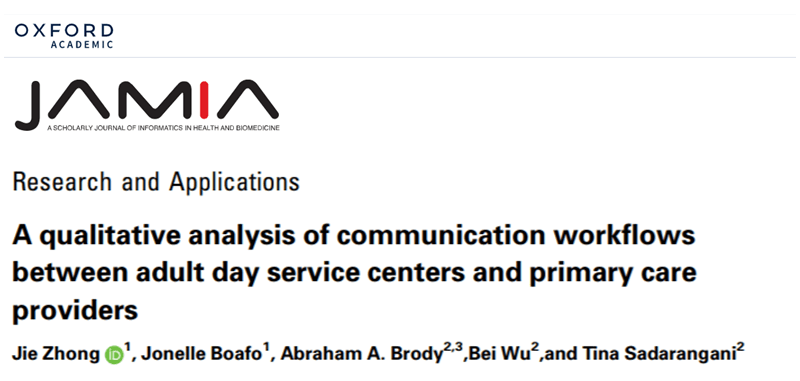
Ab Brody, PhD, RN, FAAN, Leader of the IMPACT Pilot Studies Core, and Tina Sadarangani, PhD, RN, ANP-BC, GNP-BC, IMPACT Faculty Scholar and recipient of a 2020 Career Development Award, were co-authors on the study published in the December 29 issue of the Journal of the American Medical Informatics Association. The research team conducted six focus groups with ADC staff and individual semistructed interviews with PCPs in California and used the eHealth Enhanced Chronic Care Model to frame the directed qualitative content analysis.
Stakeholders who participated in the study reported current communication as infrequent, delayed, incomplete, unreliable, irrelevant and generic. They also reported use of antiquated technologies, such as fax, slowed down communication exchanges about PLWD.
The authors suggest integrating community-based services into the health care continuum to elevate the standard of care for PLWD. They also acknowledge that interoperable electronic health records may not be possible, but suggest exploration of other options, such as mobile health, to improve the exchange of information about PLWD between ADCs and PCPs.