

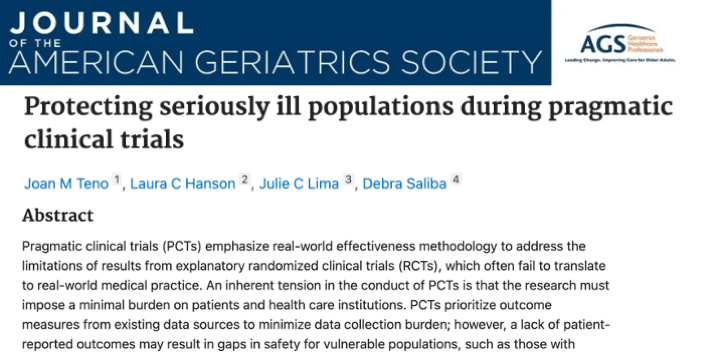
Protecting seriously ill populations during pragmatic clinical trials
March 22, 2023
Current and former IMPACT members Debra Saliba, MD, MPH, Joan Teno, MD, MS, Julie Lima, PhD, MPH, and Laura Hanson, MD, MPH authored an article about the effects of pragmatic clinical trials on vulnerable populations. Using the Readiness Assessment for Pragmatic Trials (RAPT) model to assesses outcomes, they suggest that certain risks warrant additional data collection to ensure the safety of patients in PCTs.
IMPACT members recommend a risks-based approach for end-of-life care patients participating in pragmatic clinical trials
Abstract
Pragmatic clinical trials (PCTs) emphasize real-world effectiveness methodology to address the limitations of results from explanatory randomized clinical trials (RCTs), which often fail to translate to real-world medical practice. An inherent tension in the conduct of PCTs is that the research must impose a minimal burden on patients and health care institutions. PCTs prioritize outcome measures from existing data sources to minimize data collection burden; however, a lack of patient-reported outcomes may result in gaps in safety for vulnerable populations, such as those with serious illnesses. One proposed standard for judging the readiness of a study for a pragmatic trial is a ranking system that assigns PCTs a lower rank if they impose additional data collection burdens. However, this results in the wide use of measures of health care utilization and costs while patient experience measures, which could capture adverse unintended consequences, are omitted. In this article, the authors make the case for a risk-based approach to imposing additional data collection in PCTs to capture potential safety and patient experience outcomes, using examples from “real life” implemented interventions to improve end-of-life care through the Liverpool Pathway and through the implementation of Physician Orders for Life Sustaining Treatment (POLST) in Oregon.
Intervention scientists have turned to pragmatic clinical trials (PCTs) as realistic solutions to closing the gap between proven efficacious interventions and actual practice. PCTs that are embedded within existing health care practices offer the potential advantage of accelerating the adoption of efficacious interventions into clinical practice. Ideally, pragmatic trials test and disseminate interventions that are feasible under existing practice conditions and that can be implemented in short time periods. The Readiness Assessment for Pragmatic Trials (RAPT) model is an assessment that examines whether a proposed PCT is ready for effectiveness testing. RAPT is composed of nine domains: implementation protocol, evidence, risk, feasibility, measurement, costs, acceptability, alignment, and potential impact. The RAPT model aims to help funders and interventionists judge whether a PCT is ready for potential funding; high scores indicate greater readiness.
This article focuses on the measurement domain of the RAPT assessment and on potential gaps in safety in PCTs for vulnerable populations, such as those with advanced dementia or other serious illnesses. In the RAPT measurement domain, study designs are given a lower rating if they impose additional data collection requiring modification to systems or increased staff time compared to study designs that use measures that are already captured in electronic medical records or administrative claims databases, for example. These lower ratings may affect the likelihood of funding. Authors make the case that additional data collection is warranted in some instances and suggest a risk-based approach to scoring the measurement domain when additional data collection in PCTs is needed to capture potential safety and patient experience outcomes. The authors first provide examples of two PCTs enrolling vulnerable populations, and how the RAPT model would score the potential additional data collection of implementing a survey to capture the patient or their proxy experience with communication and decision making. Next, because there are very few published PCTs enrolling populations with serious illness, they provide published examples of potential harm from real-world implementation studies in the USA and UK evaluating interventions in the care of the seriously ill and dying. While these latter examples are not PCTs, they provide evidence of potential harm that provided the basis for our proposed framework when a PCT should impose additional data collection.