
August 26, 2023 Continue reading
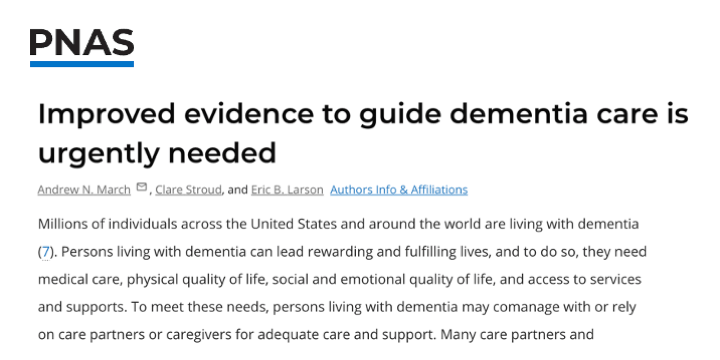
A new publication co-authored by IMPACT member Eric Larson, MD, MPH, reflects on the importance of non-pharmacological interventions that promote the wellbeing of people living with dementia and their care partners as integral to dementia care. Authors comment on the contributions made by IMPACT Collaboratory on insights into real-world implementation of dementia care interventions through multiple mechanisms. The article emphasizes the need for comprehensive dementia care beyond pharmaceutical solutions, considering patients, caregivers, and care partners.
Abstract
Millions of individuals across the United States and around the world are living with dementia. Persons living with dementia can lead rewarding and fulfilling lives, and to do so, they need medical care, physical quality of life, social and emotional quality of life, and access to services and supports. To meet these needs, persons living with dementia may comanage with or rely on care partners or caregivers for adequate care and support. Many care partners and caregivers report positive benefits from assuming that role. However, the potential for negative consequences for their health, relationships, and finances necessitates a system of supports and services for the care partner and caregiver as well.
The approvals of the drugs aducanumab in 2021 and lecanemabin in 2023 for the treatment of Alzheimer’s disease have garnered a great deal of attention within the dementia community. Press releases highlighting other drugs in development aiming to reduce amyloid plaques—which are thought to contribute to dementia symptoms—such as donanemab continue to raise hope for more curative treatments. The arrival of these new drugs continues the decades-long process in search of treatments and cures for Alzheimer’s disease and related dementias. However, available treatments have the potential to cause serious side effects, and it remains unclear whether a causal relationship exists between dementia symptoms and the amyloid plaques that the drugs target.
With recent advances in research methods and infrastructure, a future in which people can live well with dementia is coming into sharper focus.
The Health Care Systems (HCS) Scholars Program offers researchers an opportunity to partner with healthcare systems to develop embedded pragmatic clinical trials (ePCTs) focused on improving care for people living with dementia (PLWD) and their care partners (CPs). The program funds researchers to partner with HCS (or organization) for 12 months to:
The IMPACT Collaboratory will fund one researcher for a maximum of $120,000 in direct costs. Applicants are expected to apply with a HCS partner and should hold a faculty or research scientist position at an academic institution or work within a HCS. Applicants from under-represented racial and ethnic groups and individuals with disabilities are encouraged to apply.
Priority will be given to applications including scholar institutions and HCSs that are new to the IMPACT Collaboratory and have not already partnered with our network. Questions about whether a HCS is new to the IMPACT Collaboratory should be emailed to Rachel Hays at Rachel.J.Hays@kp.org.
Informational Webinar
An optional informational webinar will be hosted to provide investigators with an overview of application details and an opportunity to ask questions. Pre-registration is required using the link below.
Wednesday, August 23, 2023 @ 11:30 AM ET
Registration closed.
Letters of Intent (LOI) – Required
Interested applicants are required to submit a LOI.
LOIs are accepted on a rolling basis through September 26, 2023 @5 PM ET.
Full Proposals (By invitation only)
Applications selected for further consideration will be invited to submit a full proposal due:
November 29, 2023 @5 PM ET.
Read the Full RFA here.
Learn more about our previous Health Care Systems Scholar Awardees here.
If you have any questions about this funding opportunity, please refer to our Frequently asked questions (FAQ) or email .
IMPACT multiple principal investigator Vincent Mor, PhD, along with colleagues Steven George, PT, PhD and Angelo Volandes, MD, discussed the complexities of intervention delivery in pragmatic clinical trials during an interview at this year’s NIH Pragmatic Trials Collaboratory Steering Committee annual meeting. The group explained that delivery complexities impact researchers’ ability to discern trial results and should be addressed early for pragmatic trials.
The session, titled “Lessons on Intervention Delivery and Complexity,” was held on August 8, 2023. An excerpt of Mor’s interview is published on the NIH Collaboratory website.
IMPACT funded investigator Tina Sadarangani, PhD, RN, ANP-BC, GNP-BC, was selected as one of 20 finalists for the 2023 NIA Start-Up Challenge and Accelerator: Fostering Entrepreneurial Diversity. The project is a mobile app that facilitates communication among family members, loved ones, and health care providers, and community-based caregivers like adult day centers around the day-to-day care of older adults. Learn more about the app at www.CareMobi.org.
Learn more about the finalists and the 2023 NIA Start-Up Challenge.