
Home Time as a Patient-Centered Outcome in Pragmatic Trials: Promise, Pitfalls, and the Path Forward

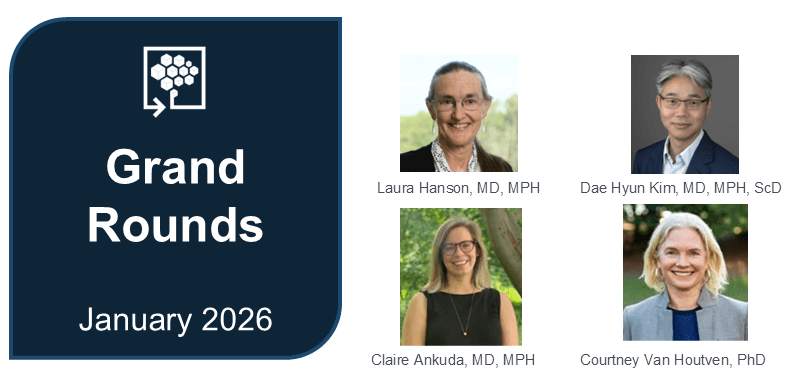
January 2026 – Grand Rounds 62, Drs. Hanson, Kim, Ankuda, and Van Houtven discuss home time as a patient-centered outcome in pragmatic trials.

Webinar Slides

Laura Hanson, MD, MPH

Professor, Division of Geriatric Medicine and Director, UNC Palliative Care Program, University of North Carolina School of Medicine


Claire Ankuda, MD, MPH

Associate Professor, Icahn School of Medicine at Mount Sinai

Dae Hyun Kim, MD, MPH, ScD

Associate Director of Marcus Institute for Aging Research, Associate Professor of Medicine, Harvard Medical School

Courtney Van Houtven, PhD

Professor, Population Health Sciences, Duke University School of Medicine and Duke-Margolis Institute for Health Policy

Learning Objectives

  • Understand the concept of home time as a patient‑centered, system‑relevant outcome measure and how it is operationalized across different clinical contexts.
  • Recognize the limitations, measurement challenges, and equity concerns associated with using home time as an outcome or performance metric in pragmatic clinical trials.
  • Reflect on emerging evidence and future directions for developing more person‑centered home time measures that better capture quality of life for older adults and caregivers.

The IMPACT Collaboratory Lived Experience Panel: Reflections on Accomplishments and Recommendations for Continued Work

This extended summary report, authored by Yaideliz M. Romero-Ramos, a Brown University graduate student and Health Equity Scholar, describes feedback from Lived Experience Panel members about their involvement with the panel to date and recommendations for future work. The report details discussions from a series of meetings where members revisited and shared perspectives on previously discussed topics. Additionally, the report highlights members' reflections on their experience with the panel and their suggestions for future initiatives.

Read the full report here.

2023-2024 LEP Report Reflections (1)

Citation: Yaideliz M. Romero-Ramos, Carolyn A. Malone, Kerry Finegan, Willetha Barnette, Bart Brammer, Katie Brandt, Roberta Cruz, Monica Downer, Darrell Foss, Ying-Ling Jao, LuPita Gutierrez-Parker, Freddye G. James, Joan Monin, Emily Mroz, Maria Mora Pinzon, Judith S. Rocha, Lauren Stratton, Mark Toles, Anthony Wagner, Monica Moreno, Gary Epstein-Lubow. The IMPACT Collaboratory Lived Experience Panel: Reflections on Accomplishments and Recommendations for Continued Work. NIA IMPACT Collaboratory; 2024.

The 2023-2024 Lived Experience Panel Report: Perspectives on Evaluating and Measuring Goal-Concordant Care for People Living with Dementia

July 10, 2024

Authors: Joshua Niznik, PharmD, PhD, Antonia Bennett, PhD, Natalie C. Ernecoff, PhD, MPH, Sheryl Zimmerman, PhD, Kathryn Wessell, MPH, Laura Hanson, MD, Gary Epstein-Lubow, MD, MPH, Carolyn Malone, MPH, Willetha Barnette, Bart Brammer, Katie Brandt, Roberta Cruz, Monica Downer, Darrell Foss, LuPita Gutierrez-Parker, Freddye G. James, Judith S. Rocha, Anthony Wagner

Description: This report describes the major lessons learned from a series of discussions between people living with dementia, care partners, researchers, healthcare providers, and other community members about ways to improve the quality of healthcare for people living with dementia. The main topic of these discussions was ‘goal-concordant care’ which means ensuring that healthcare treatments and decisions are in line with what matters most to patients and families. Panel members were asked to discuss their experiences talking about goals with their healthcare providers and how thinking about their goals could help with making healthcare decisions. Some key takeaway points are:

  1. Decision-making for people living with dementia is more often driven by needs and priorities, than by healthcare “goals.”
  2. Decision-making for people living with dementia involves many people, which is not often reflected in research.
  3. It can be difficult for people living with dementia and care partners to feel actively involved in healthcare decision-making.

Further study is needed to identify strategies to ensure that people living with dementia and care partners are actively involved in decision-making and in identifying the best ways to measure whether the needs and priorities of people living with dementia and care partners are being met.

Read the full report here.

Citation: Niznik J, Bennett A, Ernecoff NC, Zimmerman S, Wessell K, Hanson L, Epstein-Lubow G, Malone C, Barnette W, Brammer B, Brandt K, Cruz R, Downer M, Foss D, Gutierrez-Parker L, James FG, Rocha JS, Wagner A. 2023-2024 Lived Experience Panel Report: Perspectives on Evaluating and Measuring Goal-Concordant Care for People Living with Dementia. NIA IMPACT Collaboratory; 2024. doi: 10.58234/35429703
Click to view LEP Report | PCRO Goal-Concordant Care

The GUIDE Model: A CMS payment model test to support people living with dementia and their family caregivers

May 2024 – In Grand Rounds 47, Drs. Epstein-Lubow and Lees-Haggerty, along with Tonya Saffer, Director of the Division of Healthcare Payment Models with the Centers for Medicare & Medicaid Services (CMS), share the GUIDE Model. GUIDE is a CMS payment model that tests whether dementia care programs can improve quality of life for people living with dementia and their caregivers.

Download Webinar Slides

Headshot photo of Dr. Gary Epstein-Lubow


Gary Epstein-Lubow, MD
Team Lead, Engaging Partners Team
Distinguished Medical Scholar, EDC
Associate Professor, Brown University

Headshot photo of Dr. Kristin Lees-Haggerty


Kristin Lees-Haggerty, PhD
Project Director
Natl. Collaboratory to Address Elder Mistreatment
Education Development Center

Headshot photo of Tonya Saffer


Tonya Saffer, MPH
Director
Division of Healthcare Payment Models
Centers for Medicare & Medicaid Services

Learning Objectives

  • Review the historical context of the CMS GUIDE Model and its potential for transforming the delivery, quality and outcomes of dementia care in the United States.
  • Learn the requirements for participating health systems regarding care delivery and outcomes reporting.
  • Understand how the GUIDE Model requirements align with evidence-based comprehensive dementia care, including new opportunities and challenges for pragmatic evaluation of dementia service delivery related to GUIDE-participating health systems.

Guidance for Proxy Data and Dyadic Analysis

May 17, 2024

Authors: Katie Newkirk, PhD and Joan Monin, PhD

Description: This document provides guidance on what dyadic data is, how it is different from proxy data, and what information can be gained by collecting and analyzing dyadic data compared to proxy data when conducting embedded pragmatic clinical trials (ePCTs) that include people living with dementia and care partners. Topic covered:

  • Dyadic Data
  • Proxy Data
  • Constructs Often Measured for Both People Living with Dementia and Care Partners
  • Analyzing Dyadic Data
  • When Data Don’t Require Dyadic Analysis
  • Proxy Data
  • Do I Have Dyadic Data?
Citation: Newkirk K, Monin J. Guidance for Proxy Data and Dyadic Analysis. NIA IMPACT Collaboratory; 2024. doi: 10.58234/236781742
Click to view PDF of Guidance for Proxy Data and Dyadic Analysis
Graphic with headshot of Dr. Julie Bynum from the shoulders up, next to the words "Grand Rounds & Podcast March 2024"

Diagnosed Dementia in Medicare: Benchmarking for Study Planning and Equity

March 2024 – In Grand Rounds 45, Dr. Bynum shares the pros and cons of using healthcare-generated data, such as Medicare Fee-for-Service and Medicare Advantage, to identify people living with Alzheimer's disease and related dementias (ADRD), as well as the use of population benchmarks in study planning and integrating health equity.


Speaker

Dr. Julie BynumJulie Bynum, MD, MPH

Margaret Terpenning Collegiate Professor of Internal Medicine

Division of Geriatric & Palliative Medicine

University of Michigan

Learning Objectives

  • Identify strengths & challenges when using Medicare data for participant identification
  • Understand characteristics of diagnosed dementia cases across place
  • Consider value of using population benchmarks for planning and equity


CAPRA Data Brief | health care use patterns among older adults with dementia

IMPACT’s Cameron Gettel, MD and Julie Bynum, MD, MPH are among the authors of the CAPRA Data Brief on health care use patterns among older adults with dementia. The brief was developed by the Center to Accelerate Population Research on Alzheimer’s (CAPRA) at the University of Michigan.

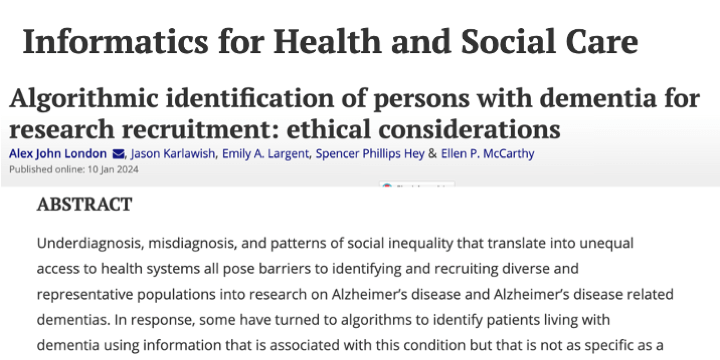
Authors demonstrated the use of Medicare claims to examine healthcare use patterns among older adults with ADRD using datasets provided by the Impact Collaboratory. The brief cites the increase in emergency care, hospitalization, and skilled nursing facility admissions for Medicare recipients and an increased need for planning and care for people with Alzheimer’s Disease and Related Dementias (ADRD) in the U.S.

Read the brief here.