D-CARE: Results of a Pragmatic Intervention Trial and Implications for the GUIDE model

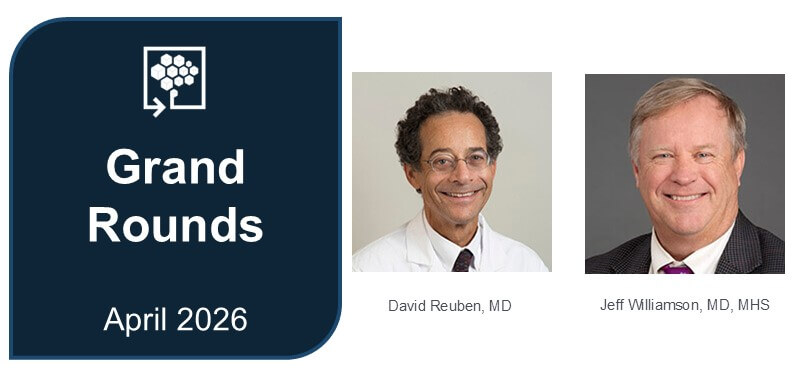
April 16, 2026 – Grand Rounds 65,  David Reuben, MD, and Jeff Williamson, MD, MHS, presented D-CARE: Results of a Pragmatic Intervention Trial and Implications for the GUIDE model.


David Reuben, MD

Professor of Medicine
David Geffen School of Medicine
UCLA

Jeff Williamson, MD, MHS 

Professor, Chief of Geriatric Medicine, and Director for the Center for Healthcare Innovation at Wake Forest School of Medicine

Learning Objectives

  • To understand the differences between health system-based and community-based dementia care.
  • To recognize the differences between structured dementia care programs and usual care.
  • To interpret the implication of D-CARE's findings on dementia care and Medicare's GUIDE program.

Announcing the 2025 IMPACT Real World Data Scholars Program Awardees

The National Institute on Aging (NIA) Imbedded Pragmatic AD/ADRD Clinical Trials (IMPACT) Collaboratory is pleased to announce the recipients of the 2025 Real World Data Scholars Program. Recipients were selected from an impressive group of competitive applications.

About the Real World Data Scholars Program

The Real World Data Scholars Program is a 1-year mentored training experience designed to build practical skills and professional networks for early-career investigators, postdoctoral fellows and graduate students interested in using real-world data to improve care of people living with dementia and care partners.

This funding cycle is a collaborative initiative among the National Institute of Aging (NIA) IMPACT Collaboratory, NEXT STEPs Network and the Long-Term Care (LTC) Data Cooperative. Together, these NIA-funded national efforts aim to build capacity for rigorous, data-driven research to improve care for people living in nursing homes and assisted living communities, including people living with Alzheimer’s disease and Alzheimer’s disease-related dementias.

Each scholar will complete a mentored research project and participate in a broad range of IMPACT Collaboratory activities that support interdisciplinary collaboration, professional growth, and methodological innovation.

Recipients of the 2025 Real World Data Scholar Program Awards are:

Laura Block, PhD, RN, University of Utah
Evaluating Nursing Home EHR Data for Emerging Palliative Care Needs

Taylor Bucy, PhD, MPH, University of Kansas School of Medicine
Validating a Measure of Emergency Department Use Leveraging Long-Term Care EHR Data

Gabrielle Gussin, PhD, MS, University of California Irvine School of Medicine
Impact of Data Source for Benchmarking Antibiotic Usage in U.S. Nursing Homes

Mary Louise Pomeroy, PhD, MPH, Johns Hopkins School of Nursing
Developing a Measure of Unrepresented Status Among Nursing Home Residents with Dementia

Rachel Prusynski, DPT, PhD, University of Washington
Establishing Data Infrastructure for a Home Health and Hospice Data Cooperative

Minzhi Ye, PhD, University of Texas Rio Grande Valley
Measuring Sleep Disturbance in Dementia Using EHR Data in Long-Term Care

Yiyang Yuan, PhD, MPH, MS, UMass Chan Medical School
Advancing Malnutrition Measurement Using Linked EHR and MDS Data




IMPACT Collaboratory Funds Four James L. Rudolph Career Development Awards

The National Institute on Aging (NIA) Imbedded Pragmatic AD/ADRD Clinical Trials (IMPACT) Collaboratory is pleased to announce the recipients of the 2025 James L. Rudolph Career Development Award Program. Recipients were selected from an impressive group of competitive applications.

About the James L. Rudolph Career Development Award Program

The James L. Rudolph Career Development Award recognizes promising investigators in honor of Dr. Rudolph’s distinguished career in gerontology, dementia, and palliative care, his enduring commitment to improving care for older adults, and his unwavering dedication to mentoring and inspiring the next generation of clinicians, researchers, and health professionals.

Dr. Rudolph was a leader in advancing models of care that support people living with dementia and their care partners, particularly within health systems. His work helped translate evidence-based dementia care into system-level solutions and reflected a deep commitment to mentoring and developing the next generation of investigators who carry this work forward.

This award prepares emerging investigators to lead embedded pragmatic clinical trials (ePCTs) that improve care for people living with dementia (PLWD) and their care partners. Through training, mentorship, and collaboration with experts in the field and healthcare systems, the program builds expertise in pragmatic trial methods and equips investigators to address the unique clinical, ethical, and implementation challenges of dementia care while conducting impactful, real-world research.

2025 James L. Rudolph Career Development Award Recipients:

Natalia Festa, MD, MHS, Yale School of Medicine
External Validation of Instruments to Improve Detection of Undiagnosed Dementia

Chan Mi Park, MD, PMH, Hebrew SeniorLife’s Hinda and Arthur Marcus Instute for Aging Research; Harvard Medical School
Developming an AI-based Measure for Behavioral and Psychological Symptoms of Dementia Using Nursing Home Electronc Health Records

Kendra Plourde, PhD, Yale School of Public Health
Designing Cluster ePCTs in Dementia Care Dyads to Assess Treatment Heterogeneity

Lauren Pollack, MD, MS, University of Washington
Improving Communication for People Living with Dementia During Emergency Response


Getting to the Bottom of TMLE: A New Post in Keith Goldfeld’s Blog Series

IMPACT Design and Statistics Core member Keith Goldfeld, DrPH, MS, MPA, continues his four-part blog series exploring Targeted Minimum Loss Estimation (TMLE)—a causal inference approach developed for observational studies that is increasingly relevant for randomized trials as well, including cluster randomized and stepped-wedge designs.

In the latest post, Dr. Goldfeld recaps key ideas from earlier installments, including how TMLE goes beyond simply improving “nuisance” models by making a targeted update so the empirical mean of the estimated efficient influence function is brought back to zero.

He then turns to simulation to examine what the targeting step changes in practice. By comparing two estimators of the average treatment effect (ATE) with TMLE, the post aims to clarify what the targeted step is doing mechanically and how it shapes the final estimate.

Getting to the bottom of TMLE: targeting in action | March 18, 2026

Identifying and Engaging Care Partners through Electronic Health Records for Pragmatic Research

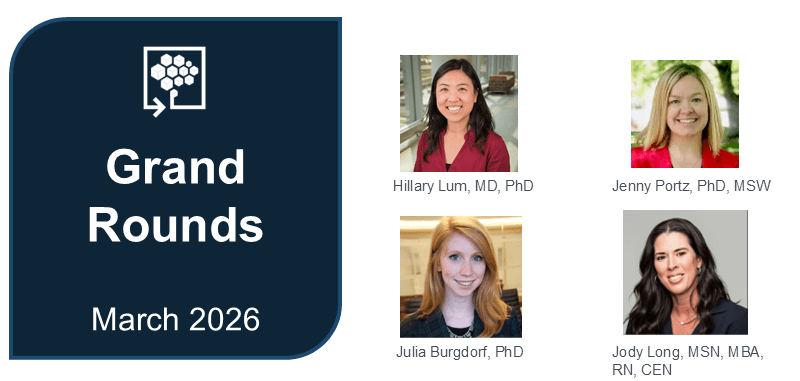
March 2026 – Grand Rounds 64, IMPACT PCRO Core member Dr. Hillary Lum and guest speakers Drs. Julia Burgdorf and Jenny Portz, and Jody Long present on “Identifying and Engaging Care Partners through Electronic Health Records for Pragmatic Research.”

Hillary Lum, MD, PhD

IMPACT Patient/Caregiver Relevant Outcomes Core

Professor of Medicine, Division
of Geriatric Medicine,
Department of Medicine,
University of Colorado Anschutz

Jenny Portz, PhD, MSW

Associate Professor, General Internal Medicine, University of Colorado Anschutz

Julia Burgdorf, PhD

Research Scientist, Center for Home Care Policy & Research at VNS Health

Jody Long, MSN, MBA, RN, CEN

Director of Clinical Affairs, PointClickCare

Learning Objectives

  • Communicate the need and promise for improvement of dementia care with embedded pragmatic trials within dynamic health care settings.
  • Review what we have found to be key components of ePCT trial design and conduct for ensuring that study results are implementable.
  • Provide learnings of two ePCT trialists from The Dementia Care Study: A Pragmatic Clinical Trial of Health System-Based Versus Community-Based Dementia Care (D-CARE)


Getting to the Bottom of TMLE: A New Blog Series from Keith Goldfeld

IMPACT Design and Statistics Core member Keith Goldfeld, DrPH, MS, MPA, has created a blog series exploring an analytic method called Targeted Minimum Loss Estimation (TMLE). TMLE is among causal inference approaches—methods first developed for observational data, but increasingly relevant for randomized trials as well. In particular, Dr. Goldfeld is digging into what TMLE can (and can’t) offer for cluster randomized trials, including stepped-wedge designs.

In this series, Dr. Goldfeld explores TMLE’s use in the context of cluster randomized trials generally and stepped-wedge trials more specifically. One of the challenges of this method for regular users is the underlying theory of the method and the math that goes along with it. In this blog series Dr. Goldfeld works through the theory to get a better understanding of it.

Getting to the bottom of TMLE: influence functions and perturbations | Posted on February 5, 2026

Getting to the bottom of TMLE: the (almost) vanishing nuisance interaction | Posted on March 2, 2026

Getting to the bottom of TMLE: forcing the target to behave | Posted on March 9, 2026

Read the ongoing series here.


IMPACT Collaboratory Announces the 2026 Faculty Scholars

March 5, 2026 – The National Institute on Aging (NIA) Imbedded Pragmatic Alzheimer’s Disease (AD) and AD-Related Dementias (AD/ADRD) Clinical Trials (IMPACT) Collaboratory is pleased to announce the 2026 IMPACT Faculty Scholars.

The IMPACT Collaboratory’s Faculty Scholars Program is a one-year enrichment opportunity for investigators to develop expertise in designing and conducting embedded pragmatic clinical trials (ePCTs) for people living with AD/ADRD and their care partners through integration into IMPACT Collaboratory activities.

Faculty Scholars are mentored by IMPACT executive committee members, engage in scholarly projects to enrich career development, and attend Collaboratory-wide events including Training Workshops and the Annual Business Meeting and Scientific Conference. Throughout the year, attend monthly Core meetings and participate in Grand Rounds and quarterly Research-in-Progress seminars and have other opportunities for career development, training and networking.

The 2026 IMPACT Faculty Scholars:

  • Catherine Auriemma, MD, MSHP, University of Pennsylvania
  • Glenna Brewster, PhD, MA, FNP-BC, Emory University
  • Cecelia Canales, MD, MPH, MS, David Geffen School of Medicine, University of California, Los Angeles
  • Maya Elias, PhD, MA, RN, University of Washington
  • Elizabeth Fauth, PhD, Utah State University
  • Erica Frechman, PhD, AGPCNP-BC, ACHPN, NEA-BC, Wake Forest University School of Medicine
  • Joo, MD, MA, Massachusetts General Hospital, Harvard Medical School
  • Yu Jin Kang, PhD, MPH, RN, Georgia State University
  • Rebecca Lassell, PhD, OTR/L, Indiana University School of Public Health – Bloomington
  • Jiaming Liang, PhD, MA, University of Texas Health Science Center at Houston
  • David Lynch, BMBS, University of North Carolina at Chapel Hill
  • Ryan Mace, PhD, Massachusetts General Hospital, Harvard Medical School
  • Stephanie Nothelle, MD, Johns Hopkins University School of Medicine
  • Elizabeth Rhodus, PhD, MS, OTR/L, University of Kentucky College of Medicine
  • Abigail Rolbiecki, PhD, MSW, MPH, Colorado State University
  • Judith Vick, MD, MPH, Yale School of Medicine


The IMPACT Collaboratory is happy to announce a Request for Applications for the 2026 Health Care Systems Scholars Program.

The National Institute on Aging (NIA) Imbedded Pragmatic Alzheimer’s Disease (AD) and AD-Related Dementias (AD/ADRD) Clinical Trials (IMPACT) Collaboratory is pleased to announce a Request for Applications  for the 2026 Health Care Systems Scholars Program.

The IMPACT Collaboratory will fund up to two Health Care Systems Scholar Awards. Each award will provide $120,000 in total direct costs for a one-year mentored experience designed to support immersion of investigators (MD, PhD, or equivalent) within a health care system to foster durable partnerships, advance system-informed research priorities, and lay the groundwork for future embedded pragmatic clinical trials in dementia care.

Through funded, protected time embedded within a health care system, scholars build collaborative partnerships, gain a strong understanding of system priorities, clinical workflows and data infrastructures, and co-design interventions and implementation strategies that align with real-world needs, enhancing readiness for future pilot or full-scale ePCTs.

Each scholar will complete a mentored project in collaboration with the HCS that focuses on identifying system priorities in dementia care and co-designing an intervention and implementation strategy to address those needs, preparing the partnership for an ePCT. Scholars will also participate in monthly meetings of the Health Care Systems Core, peer-learning sessions, and research-in-progress seminars. In addition, they will have opportunities to engage in the activities of the IMPACT Collaboratory, including Grand Rounds, training opportunities, and annual meetings that foster interdisciplinary exchange, professional development, and methodological advancement.

The Health Care Systems (HCS) Scholars Program supports researchers in partnering with a health care system or organization that provides care for people living with dementia or their care partners to:

  1. Build meaningful relationships with HCS staff at all levels, from frontline clinicians and direct care providers to system leaders.
  2. Develop a comprehensive understanding of the health care system, including staff-identified needs of people living with dementia and care partners, organizational priorities, clinical workflows, data infrastructure, and processes for implementing new programs.
  3. Engage HCS staff in identifying opportunities to improve and/or evaluate dementia care and enhance understanding of what it means to conduct embedded pragmatic clinical trials (ePCTs) within their setting(s).
  4. Co-develop a research proposal for an ePCT aimed at improving care for people living with dementia and care partners.

Eligible individuals include MD, PhD, or equivalent investigators – typically mid-career or approaching mid-career – with an established or developing focus on conducting ePCTs for PLWD and their care partners.  Candidates are required to apply with an identified health care system and be affiliated with an organization based in the United States (US) and be US citizens, non-citizen nationals, or permanent residents at the time of application. No research may be conducted outside of the US.

Informational Webinar

An optional informational webinar will be hosted to provide investigators with an overview of application details and an opportunity to ask questions. Pre-registration is required.

Thursday, February 26, 2026 @ 12:00 PM ET

Letters of Intent (LOI) – Required

Interested applicants are required to submit an LOI on or before April 2, 2026 @ 8:00 PM ET.

Full Proposals (By invitation only)

Applications selected for further consideration will be invited to submit a full proposal due May 21, 2026 @ 8:00 PM ET.

Read the full RFA here.

Learn more about our previous Health Care Systems Scholar Awardees here.

If you have any questions about this funding opportunity, please email IMPACTcollaboratory@hsl.harvard.edu.