The Ethical Value of Notification Without Consent

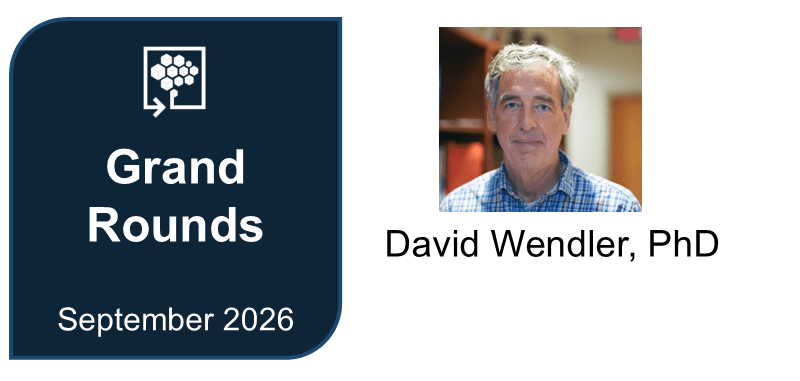
September 2026 - Grand Rounds 68

Pragmatic clinical trials frequently satisfy the regulatory criteria for a waiver of informed consent for research. Investigators and Institutional Review Boards might thus assume that there is no reason to disclose information about these studies to participants. To assess this approach, this Grand Rounds presentation will discuss reasons to provide information to participants, even when the study does not pose significant risks to them, and their consent for research is not being solicited.

Speaker
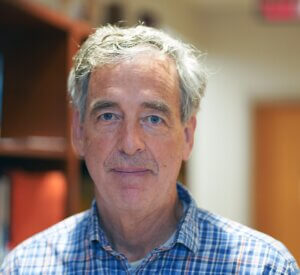
David Wendler, PhD
Acting Chief
Department of Bioethics
NIH Clinical Center

Learning Objectives

  • Identify reasons to disclose information to research participants
  • Consider which reasons apply to research without informed consent
  • Evaluate potential concerns with disclosure
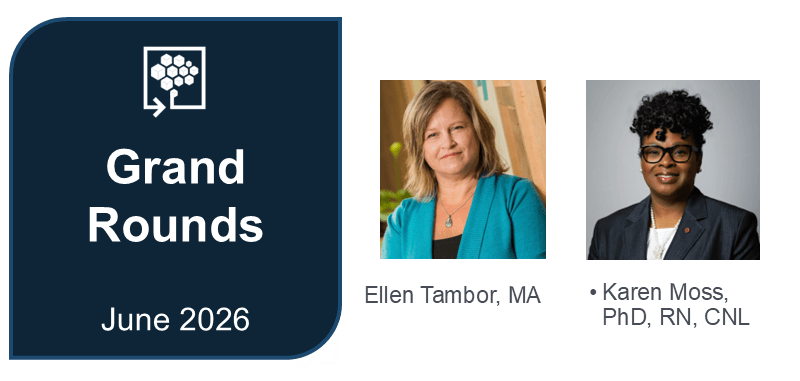
Shaping Dementia Research Together: Engaging People Living With Dementia and Care Partners

June 2026 - Grand Rounds 67

Pragmatic trials have been defined as an essential approach in the national strategy to rapidly and dramatically improve dementia care. It is therefore essential that trials are aligned with what matters most to people living with dementia, their care partners and families, and the health care systems that care for them. Interventions to improve dementia care often originate from researchers rather than emerging as a direct result of asking people living with dementia and care partners to define and prioritize the problems they need addressed. This disconnect between the interventions selected by researchers for testing and people’s everyday experiences of living with dementia is one reason why some interventions do not get adopted into care delivery, despite their apparent success during trials. In this grand rounds, we present the science of engaging community partners in research on dementia care and hear directly from members of IMPACT's community review panel.

Speakers

Ellen Tambor, MA
Lead
IMPACT Engaging Partners Team


Karen Moss, PhD, RN, CNL
Associate Professor
College of Nursing
Ohio State University

IMPACT Community Review Panel

Katie Brandt
Katie Brandt
Freddye James
Freddye James
Lupita Gutierrez-Parker
Dale Rivard
Dale Rivard

Learning Objectives

  • Explain the importance of engaging people living with dementia and care partners in developing and evaluating ePCTs.
  • Describe strategies for engaging people living with dementia and care partners in evaluating research proposals.
  • Understand the needs, priorities, and perspectives of people living with dementia and care partners engaged as research partners.


ePCTs and Health System Ethical Obligations

May 2026 - Grand Rounds 66

Pragmatic clinical trials (PCTs) embed research into clinical care. This deliberate research-care integration means that health care institutions are key partners for PCTs. Prior literature has identified several ethical challenges in PCTs for which institutional involvement is a necessary condition for their resolution. However, no comprehensive account exists to describe the moral obligations of health care institutions for PCTs. In this talk, I will introduce a framework of ten obligations for institutions when leading or participating in PCTs, and the corresponding practical implications for the ethical conduct of embedded PCTs.

Speakers

Stephanie Morain, PhD, MPH 
Associate Professor of Health Policy & Management
Johns Hopkins Bloomberg School of Public Health, Dracopoulos Rising Professor of Bioethics, Berman Institute of Bioethics

Learning Objectives

  • Identify ethical challenges arising in embedded pragmatic clinical trials that require institutional involvement for appropriate ethical management.
  • Identify ethical obligations for health care institutions when participating in or leading embedded pragmatic clinical trials.
  • Describe practical strategies for supporting the ethical conduct of embedded pragmatic clinical trials.

D-CARE: Results of a Pragmatic Intervention Trial and Implications for the GUIDE model

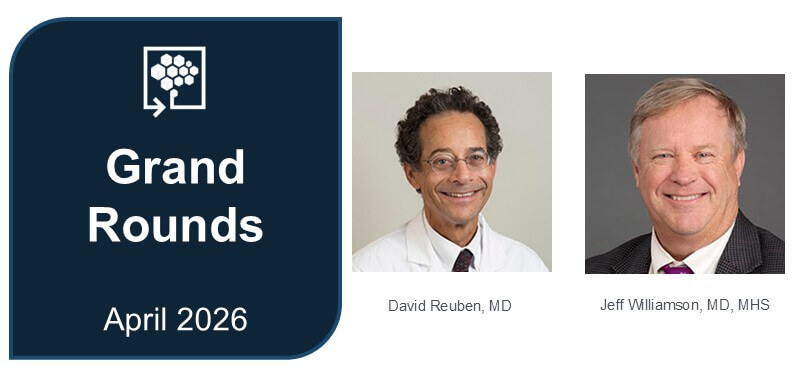
April 16, 2026 – Grand Rounds 65

D-CARE, the Dementia Care Study funded by PCORI and NIA is the largest pragmatic, randomized clinical trial of dementia care, to date. Although the primary outcomes of person living with dementia behavioral symptoms and caregiver stress did not differ between health system-based, community-based, and usual dementia care, caregiver self-efficacy, satisfaction, and perceived quality of dementia care were higher in both treatment groups compared to usual care. These findings and their implications for dementia care and Medicare's GUIDE program will be discussed.

David Reuben, MD

Professor of Medicine
David Geffen School of Medicine
UCLA

Jeff Williamson, MD, MHS 

Professor, Chief of Geriatric Medicine, and Director for the Center for Healthcare Innovation at Wake Forest School of Medicine

Learning Objectives

  • To understand the differences between health system-based and community-based dementia care.
  • To recognize the differences between structured dementia care programs and usual care.
  • To interpret the implication of D-CARE's findings on dementia care and Medicare's GUIDE program.

Identifying and Engaging Care Partners through Electronic Health Records for Pragmatic Research

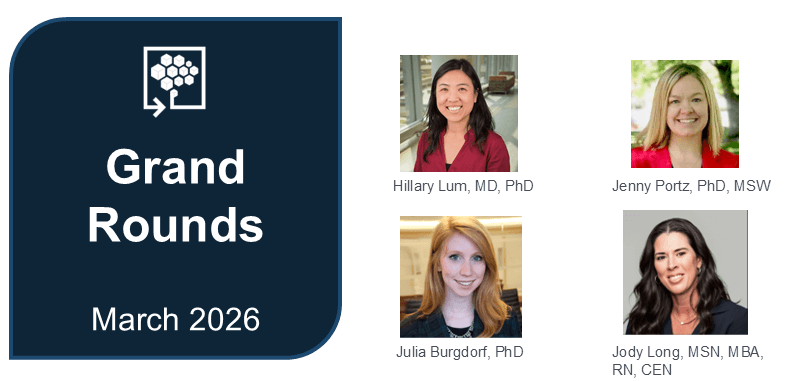
March 2026 – Grand Rounds 64, IMPACT PCRO Core member Dr. Hillary Lum and guest speakers Drs. Julia Burgdorf and Jenny Portz, and Jody Long present on “Identifying and Engaging Care Partners through Electronic Health Records for Pragmatic Research.”

Hillary Lum, MD, PhD

IMPACT Patient/Caregiver Relevant Outcomes Core

Professor of Medicine, Division
of Geriatric Medicine,
Department of Medicine,
University of Colorado Anschutz

Jenny Portz, PhD, MSW

Associate Professor, General Internal Medicine, University of Colorado Anschutz

Julia Burgdorf, PhD

Research Scientist, Center for Home Care Policy & Research at VNS Health

Jody Long, MSN, MBA, RN, CEN

Director of Clinical Affairs, PointClickCare

Learning Objectives

  • Communicate the need and promise for improvement of dementia care with embedded pragmatic trials within dynamic health care settings.
  • Review what we have found to be key components of ePCT trial design and conduct for ensuring that study results are implementable.
  • Provide learnings of two ePCT trialists from The Dementia Care Study: A Pragmatic Clinical Trial of Health System-Based Versus Community-Based Dementia Care (D-CARE)


Home Time as a Patient-Centered Outcome in Pragmatic Trials: Promise, Pitfalls, and the Path Forward

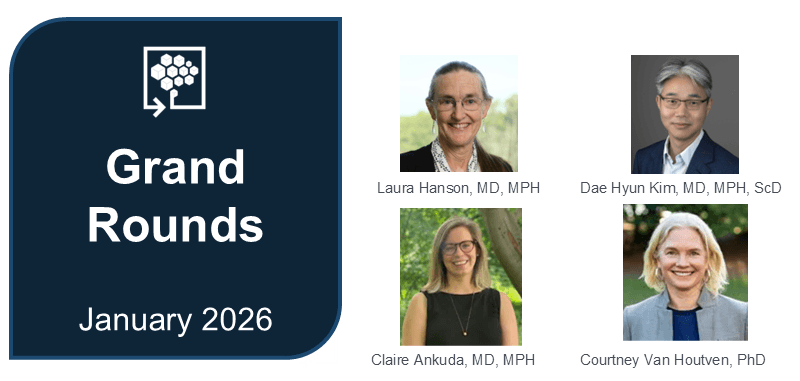
January 2026 – Grand Rounds 62, Drs. Hanson, Kim, Ankuda, and Van Houtven discuss home time as a patient-centered outcome in pragmatic trials.

Webinar Slides

Laura Hanson, MD, MPH

Professor, Division of Geriatric Medicine and Director, UNC Palliative Care Program, University of North Carolina School of Medicine


Claire Ankuda, MD, MPH

Associate Professor, Icahn School of Medicine at Mount Sinai

Dae Hyun Kim, MD, MPH, ScD

Associate Director of Marcus Institute for Aging Research, Associate Professor of Medicine, Harvard Medical School

Courtney Van Houtven, PhD

Professor, Population Health Sciences, Duke University School of Medicine and Duke-Margolis Institute for Health Policy

Learning Objectives

  • Understand the concept of home time as a patient‑centered, system‑relevant outcome measure and how it is operationalized across different clinical contexts.
  • Recognize the limitations, measurement challenges, and equity concerns associated with using home time as an outcome or performance metric in pragmatic clinical trials.
  • Reflect on emerging evidence and future directions for developing more person‑centered home time measures that better capture quality of life for older adults and caregivers.
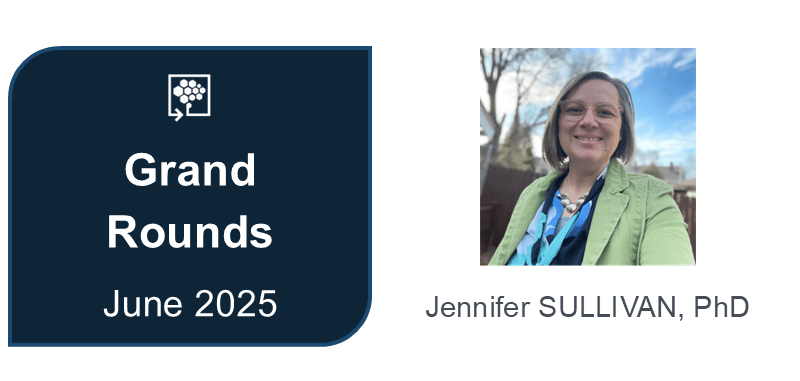
Sullivan_June 2025 Grand Rounds card

Meta Lessons Learned from Pilot and Demonstration Projects Implementation 

June 2025 –  In Grand Rounds 57, Jennifer Sullivan, PhD, describes lessons learned from IMPACT Pilot and Demonstration Projects implementation data.

Speakers

Jennifer Sullivan, PhDJennifer Sullivan, PhD
Associate Professor, Brown University School of Public Health
Department of Health Service, Policy and Practice

Associate Director & Investigator
THRIVE COIN
VA Providence Healthcare System

Learning Objectives

  • Describe factors enabling and/or hindering pilot and demonstration project implementation
  • Understand which implementation strategies were being used by pilot and demonstration grants
  • Gain knowledge about how implementation progress was made by programs over the funding timelines


RWD Scholars headshots

Bridging Research and Practice: An Update from Real World Data Scholars

May 2025 – In Grand Rounds 56, the 2023 Real World Data Scholars presented on their research projects using the Long-Term Care (LTC) Data Cooperative dataset.

Webinar Slides

Headshot of Jinying Chen, PhD from the shoulders upJinying Chen, PhD

Boston University Chobanian & Avedisian School of Medicine

Validating Medication Orders by Leveraging Natural Language Processing

Headshot of Kenneth Lam, MD, MAS from the shoulders up, smiling and wearing a suit.

Kenneth Lam, MD, MAS  

University of Colorado
School of Medicine

Validation of Functional Measures in LTC EHR Data

Headshot of Lindsay White from the shoulders up.Lindsay White, PhD

University of Pennsylvania Perelman School of Medicine

Determination of Cognitive Status in NH Residents: The Utility of EHR Data

Headshot of Yongkang Zhang, Phd, MS from the shoulders up.

Yongkang Zhang, PhD, MS 

Weill Cornell Medical College

Evaluating LTC Data Cooperative EHRs to Study T2D among Nursing Home Residents

Improving Advance Care Planning for Seriously Ill Primary Care Patients: UC Health Care Planning Study

January 2025 - In Grand Rounds 52, Rebecca Sudore, MD, and Anne Walling, MD, PhD, present on "Improving Advance Care Planning (ACP) for Seriously Ill Primary Care Patients: UC Health Care Planning Study". They discuss the evolving ACP definition and research, along with lessons learned from their ACP PCORI pragmatic randomized control trial.

Speakers

Rebecca Sudore, MDRebecca Sudore, MD
Professor of Medicine,
University of California,
San Francisco

Anne Walling, MD, PhDAnne Walling, MD, PhD
Professor-in-Residence,
University of California,
Los Angeles

Learning Objectives

  • The Evolving ACP Definition & Research
  • Lessons for an ACP PCORI Pragmatic RCT
    • Identifying the cohort with validated algorithms
    • Constructing the ACP EMR Intervention Infrastructure
    • Healthcare navigator arm
    • Trial outcomes: NLP
    • Implementation Lessons