
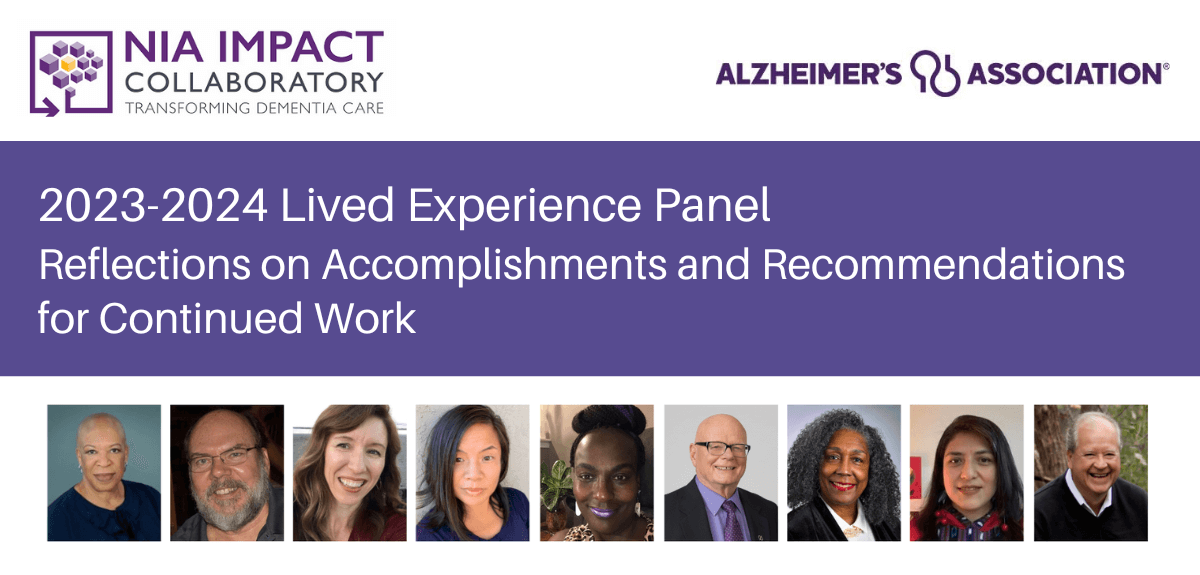
The IMPACT Collaboratory Lived Experience Panel: Reflections on Accomplishments and Recommendations for Continued Work

This extended summary report, authored by Yaideliz M. Romero-Ramos, a Brown University graduate student and Health Equity Scholar, describes feedback from Lived Experience Panel members about their involvement with the panel to date and recommendations for future work. The report details discussions from a series of meetings where members revisited and shared perspectives on previously discussed topics. Additionally, the report highlights members' reflections on their experience with the panel and their suggestions for future initiatives.
Read the full report here.

2023-2024 LEP Report Reflections (1)

Citation: Yaideliz M. Romero-Ramos, Carolyn A. Malone, Kerry Finegan, Willetha Barnette, Bart Brammer, Katie Brandt, Roberta Cruz, Monica Downer, Darrell Foss, Ying-Ling Jao, LuPita Gutierrez-Parker, Freddye G. James, Joan Monin, Emily Mroz, Maria Mora Pinzon, Judith S. Rocha, Lauren Stratton, Mark Toles, Anthony Wagner, Monica Moreno, Gary Epstein-Lubow. The IMPACT Collaboratory Lived Experience Panel: Reflections on Accomplishments and Recommendations for Continued Work. NIA IMPACT Collaboratory; 2024.
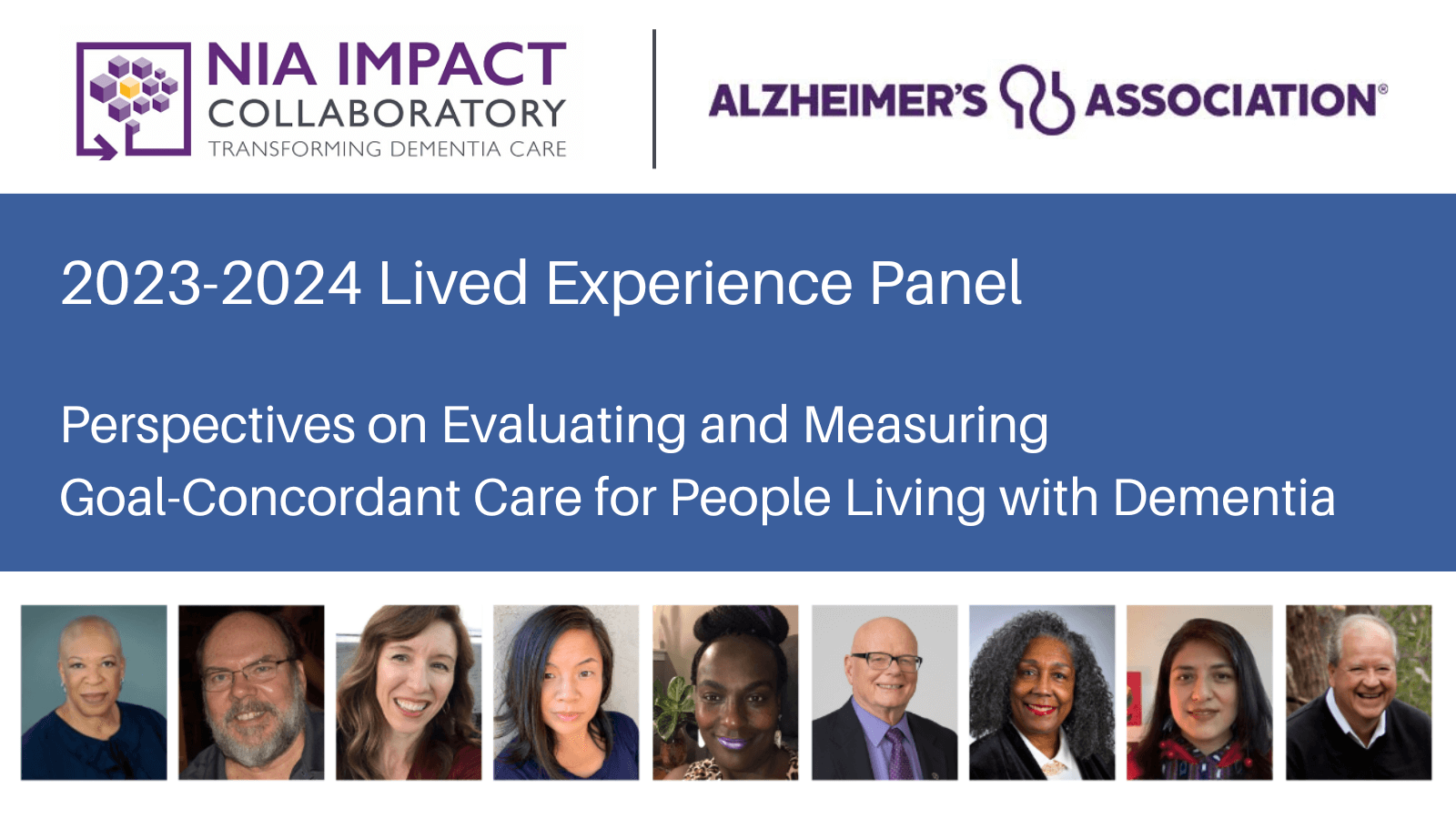
The 2023-2024 Lived Experience Panel Report: Perspectives on Evaluating and Measuring Goal-Concordant Care for People Living with Dementia

July 10, 2024

Authors: Joshua Niznik, PharmD, PhD, Antonia Bennett, PhD, Natalie C. Ernecoff, PhD, MPH, Sheryl Zimmerman, PhD, Kathryn Wessell, MPH, Laura Hanson, MD, Gary Epstein-Lubow, MD, MPH, Carolyn Malone, MPH, Willetha Barnette, Bart Brammer, Katie Brandt, Roberta Cruz, Monica Downer, Darrell Foss, LuPita Gutierrez-Parker, Freddye G. James, Judith S. Rocha, Anthony Wagner

Description: This report describes the major lessons learned from a series of discussions between people living with dementia, care partners, researchers, healthcare providers, and other community members about ways to improve the quality of healthcare for people living with dementia. The main topic of these discussions was ‘goal-concordant care’ which means ensuring that healthcare treatments and decisions are in line with what matters most to patients and families. Panel members were asked to discuss their experiences talking about goals with their healthcare providers and how thinking about their goals could help with making healthcare decisions. Some key takeaway points are:

  1. Decision-making for people living with dementia is more often driven by needs and priorities, than by healthcare “goals.”
  2. Decision-making for people living with dementia involves many people, which is not often reflected in research.
  3. It can be difficult for people living with dementia and care partners to feel actively involved in healthcare decision-making.

Further study is needed to identify strategies to ensure that people living with dementia and care partners are actively involved in decision-making and in identifying the best ways to measure whether the needs and priorities of people living with dementia and care partners are being met.

Read the full report here.

Citation: Niznik J, Bennett A, Ernecoff NC, Zimmerman S, Wessell K, Hanson L, Epstein-Lubow G, Malone C, Barnette W, Brammer B, Brandt K, Cruz R, Downer M, Foss D, Gutierrez-Parker L, James FG, Rocha JS, Wagner A. 2023-2024 Lived Experience Panel Report: Perspectives on Evaluating and Measuring Goal-Concordant Care for People Living with Dementia. NIA IMPACT Collaboratory; 2024. doi: 10.58234/35429703
Click to view LEP Report | PCRO Goal-Concordant Care

CAPRA Data Brief | health care use patterns among older adults with dementia

IMPACT’s Cameron Gettel, MD and Julie Bynum, MD, MPH are among the authors of the CAPRA Data Brief on health care use patterns among older adults with dementia. The brief was developed by the Center to Accelerate Population Research on Alzheimer’s (CAPRA) at the University of Michigan.

Authors demonstrated the use of Medicare claims to examine healthcare use patterns among older adults with ADRD using datasets provided by the Impact Collaboratory. The brief cites the increase in emergency care, hospitalization, and skilled nursing facility admissions for Medicare recipients and an increased need for planning and care for people with Alzheimer’s Disease and Related Dementias (ADRD) in the U.S.

Read the brief here.

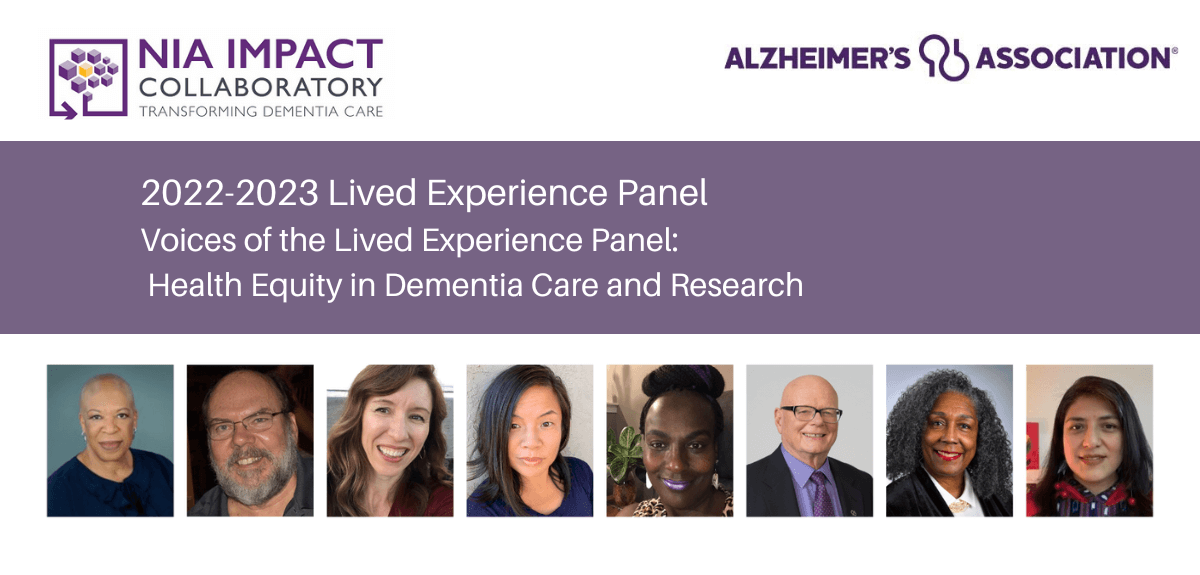
22-23 lived experience panel headshots of 7 people.

The 2022-2023 Lived Experience Panel Report, Voices of the Lived Experience Panel: Health Equity in Dementia Care and Research (English/Spanish)

October 3, 2023

Authors: María P. Aranda, PhD, MSW, MPA, LCSW, Talha Ali, Willetha Barnette, Bart Brammer, Katie Brandt, Roberta Cruz, Monica Downer, Shekinah Fashaw-Walters, Darrell Foss, Lupita Gutierrez-Parker, Ladson Hinton, MD, Freddye G. James, Gary Epstein-Lubow, MD, Carolyn Malone, MPH, Karen O. Moss, Katherine D. Peak, MPH, Judith S. Rocha

Description: This report summarizes the overarching themes that emerged during four meetings of the NIA IMPACT Collaboratory’s Lived Experience Panel, the Health Equity Team, and the Engaging Partners Team. The goal of these discussions was to learn about Panel members’ lived experiences and insights related to health equity in dementia care and research practices.

Read the full report here. Read the Spanish translated version here.

Citation: Aranda MP, Ali T, Barnette W, Brammer B, Brandt K, Cruz R, Downer M, Fashaw-Walters S, Foss D, Gutierrez-Parker L, Hinton L, James FG, Epstein-Lubow G, Malone C, Michael C, Moss K, Peak KD, Rocha JS. 2022-2023 Lived Experience Panel Report: Voices of the Lived Experience Panel: Health Equity in Dementia Care and Research. NIA IMPACT Collaboratory; 2023. doi: 10.58234/23680579
Health Equity LEP Report - English Version
Click to view Spanish LEP Report | Health Equity

Decadal Survey of Behavioral and Social Science Research on Alzheimer’s Disease and Alzheimer’s Disease-Related Dementias

At the request of the National Institute on Aging of the U.S. Department of Health and Human Services, Reducing the Impact of Dementia in America assesses the contributions of research in the social and behavioral sciences and identifies a research agenda for the coming decade. This report offers a blueprint for the next decade of behavioral and social science research to reduce the negative impact of dementia for America’s diverse population. Learn more at this link.

AcademyHealth report identifies health systems’ priority research questions on COVID-19

AcademyHealth has developed a report focused on information needs of the health care and community organizations engaged in the COVID-19 response. The report is intended to inform decision-making of federal and foundation funders of health services research to guide investments in responsive research.

Read the full report and background information on the AcademyHealth website.