
D-CARE: Results of a Pragmatic Intervention Trial and Implications for the GUIDE model

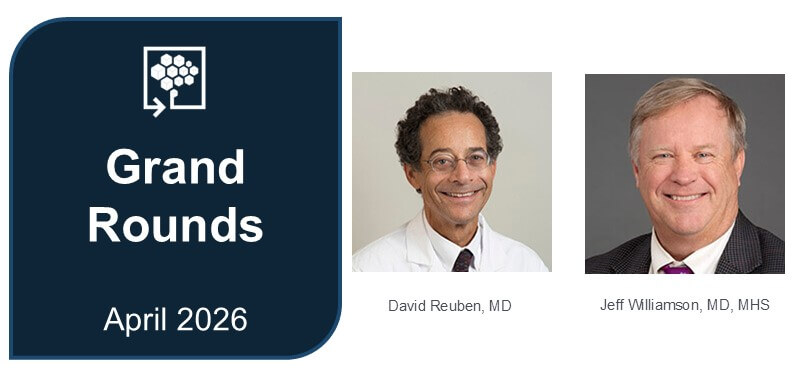
April 16, 2026 – Grand Rounds 65,  David Reuben, MD, and Jeff Williamson, MD, MHS, presented D-CARE: Results of a Pragmatic Intervention Trial and Implications for the GUIDE model.


David Reuben, MD

Professor of Medicine
David Geffen School of Medicine
UCLA

Jeff Williamson, MD, MHS 

Professor, Chief of Geriatric Medicine, and Director for the Center for Healthcare Innovation at Wake Forest School of Medicine

Learning Objectives

  • To understand the differences between health system-based and community-based dementia care.
  • To recognize the differences between structured dementia care programs and usual care.
  • To interpret the implication of D-CARE's findings on dementia care and Medicare's GUIDE program.

Identifying and Engaging Care Partners through Electronic Health Records for Pragmatic Research

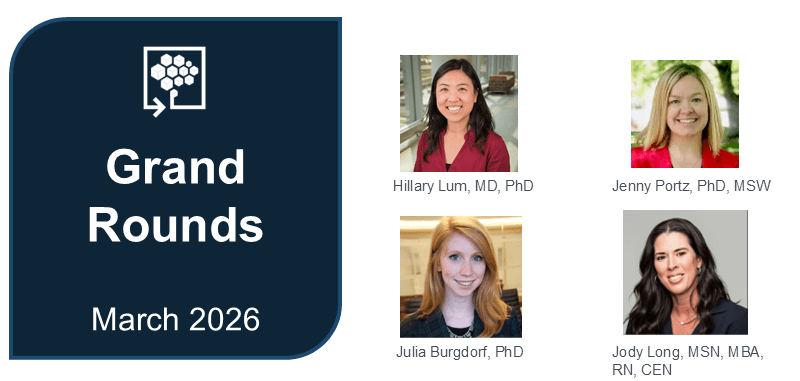
March 2026 – Grand Rounds 64, IMPACT PCRO Core member Dr. Hillary Lum and guest speakers Drs. Julia Burgdorf and Jenny Portz, and Jody Long present on “Identifying and Engaging Care Partners through Electronic Health Records for Pragmatic Research.”

Hillary Lum, MD, PhD

IMPACT Patient/Caregiver Relevant Outcomes Core

Professor of Medicine, Division
of Geriatric Medicine,
Department of Medicine,
University of Colorado Anschutz

Jenny Portz, PhD, MSW

Associate Professor, General Internal Medicine, University of Colorado Anschutz

Julia Burgdorf, PhD

Research Scientist, Center for Home Care Policy & Research at VNS Health

Jody Long, MSN, MBA, RN, CEN

Director of Clinical Affairs, PointClickCare

Learning Objectives

  • Communicate the need and promise for improvement of dementia care with embedded pragmatic trials within dynamic health care settings.
  • Review what we have found to be key components of ePCT trial design and conduct for ensuring that study results are implementable.
  • Provide learnings of two ePCT trialists from The Dementia Care Study: A Pragmatic Clinical Trial of Health System-Based Versus Community-Based Dementia Care (D-CARE)


Home Time as a Patient-Centered Outcome in Pragmatic Trials: Promise, Pitfalls, and the Path Forward

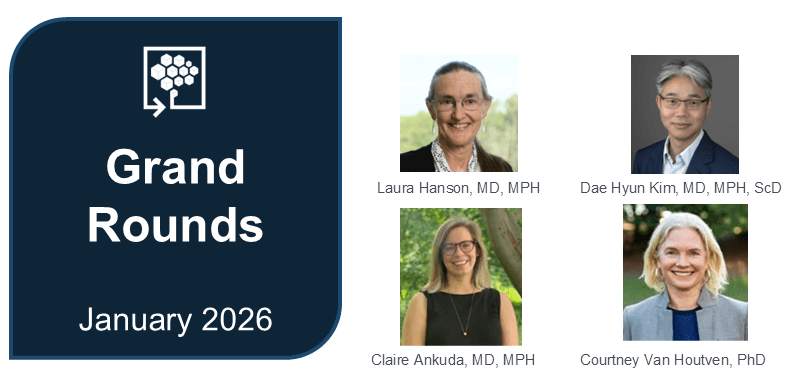
January 2026 – Grand Rounds 62, Drs. Hanson, Kim, Ankuda, and Van Houtven discuss home time as a patient-centered outcome in pragmatic trials.

Webinar Slides

Laura Hanson, MD, MPH

Professor, Division of Geriatric Medicine and Director, UNC Palliative Care Program, University of North Carolina School of Medicine


Claire Ankuda, MD, MPH

Associate Professor, Icahn School of Medicine at Mount Sinai

Dae Hyun Kim, MD, MPH, ScD

Associate Director of Marcus Institute for Aging Research, Associate Professor of Medicine, Harvard Medical School

Courtney Van Houtven, PhD

Professor, Population Health Sciences, Duke University School of Medicine and Duke-Margolis Institute for Health Policy

Learning Objectives

  • Understand the concept of home time as a patient‑centered, system‑relevant outcome measure and how it is operationalized across different clinical contexts.
  • Recognize the limitations, measurement challenges, and equity concerns associated with using home time as an outcome or performance metric in pragmatic clinical trials.
  • Reflect on emerging evidence and future directions for developing more person‑centered home time measures that better capture quality of life for older adults and caregivers.

LEAP! Rx: A randomized trial of a pragmatic approach to lifestyle medicine

December 2025 - In Grand Rounds 61, Amber Watts, PhD and Amanda N. Szabo-Reed, PhD discuss “LEAP! Rx: A randomized trial of a pragmatic approach to lifestyle medicine.”

Speakers

Amber Watts, PhD
Associated Professor
University of Kansas
Director, BRANCH LAb

Amanda N. Szabo-Reed, PhD
Research Associate Professor
University of Kansas Medical Center

Learning Objectives

  • Understand why exercise is important for Alzheimer’s disease prevention.
  • Recognize barriers to translating exercise research into clinical practice.
  • Learn how the LEAP! Rx trial was designed and implemented.
  • Compare outcomes and adherence between physician-referred and self-referred participants.
  • Explore strategies for supporting long-term exercise habits in older adults.