Building the nation’s capacity to conduct pragmatic clinical trials embedded within healthcare systems for people living with dementia and their care partners
Description: This document provides guidance on what dyadic data is, how it is different from proxy data, and what information can be gained by collecting and analyzing dyadic data compared to proxy data when conducting embedded pragmatic clinical trials (ePCTs) that include people living with dementia and care partners. Topic covered:
Dyadic Data
Proxy Data
Constructs Often Measured for Both People Living with Dementia and Care Partners
Analyzing Dyadic Data
When Data Don’t Require Dyadic Analysis
Proxy Data
Do I Have Dyadic Data?
Citation: Newkirk K, Monin J. Guidance for Proxy Data and Dyadic Analysis. NIA IMPACT Collaboratory; 2024. doi: 10.58234/236781742
Click to view PDF of Guidance for Proxy Data and Dyadic Analysis
IMPACT’s Cameron Gettel, MD and Julie Bynum, MD, MPH are among the authors of the CAPRA Data Brief on health care use patterns among older adults with dementia. The brief was developed by the Center to Accelerate Population Research on Alzheimer’s (CAPRA) at the University of Michigan.
Authors demonstrated the use of Medicare claims to examine healthcare use patterns among older adults with ADRD using datasets provided by the Impact Collaboratory. The brief cites the increase in emergency care, hospitalization, and skilled nursing facility admissions for Medicare recipients and an increased need for planning and care for people with Alzheimer’s Disease and Related Dementias (ADRD) in the U.S.
Description: This report documents the insights gained from two meetings between members of IMPACT’s Ethics and Regulation Core and the Lived Experience Panel, featuring conversations regarding the ethical challenges related to conducting embedded pragmatic clinical trials among people living with dementia and their care partners using waivers of informed consent.
Citation: Largent E, Karlawish J, Joffe S, Epstein-Lubow G. The 2021-2022 Lived Experience Panel Report: Ethical Challenges in Conducting Research Using a Waiver of Informed Consent with People Living with Dementia. NIA IMPACT Collaboratory; 2022. doi: doi.org/10.58234/92591162
Description: Summarizes the discussions with the Lived Experience Panel and members from the Patient and Caregiver Relevant Outcomes Core about research study outcomes that are important to people living with dementia and their care partners.
The NIH Pragmatic Trials Collaboratory aims to improve the way clinical trials are conducted by creating a new infrastructure for collaborative research with healthcare systems, ultimately ensuring that healthcare providers and patients can make decisions based on the best available clinical evidence. The Collaboratory supports the design and rapid execution of pragmatic clinical trial Demonstration Projects to address questions of major public health importance and engage healthcare delivery systems in research partnerships. The Collaboratory also provides training resources on how to design, conduct, and disseminate embedded pragmatic clinical trials (ePCTs).
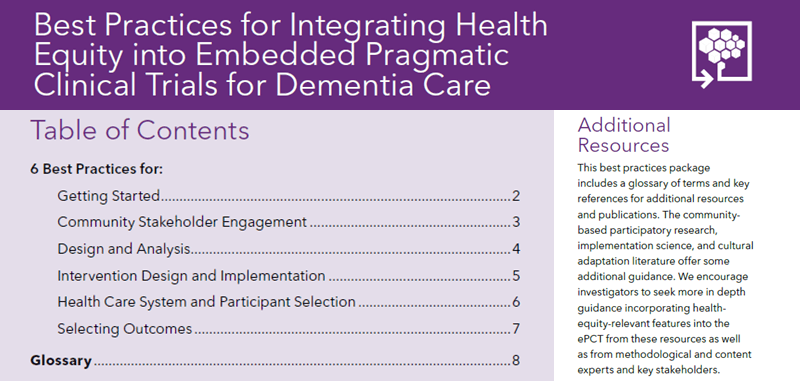
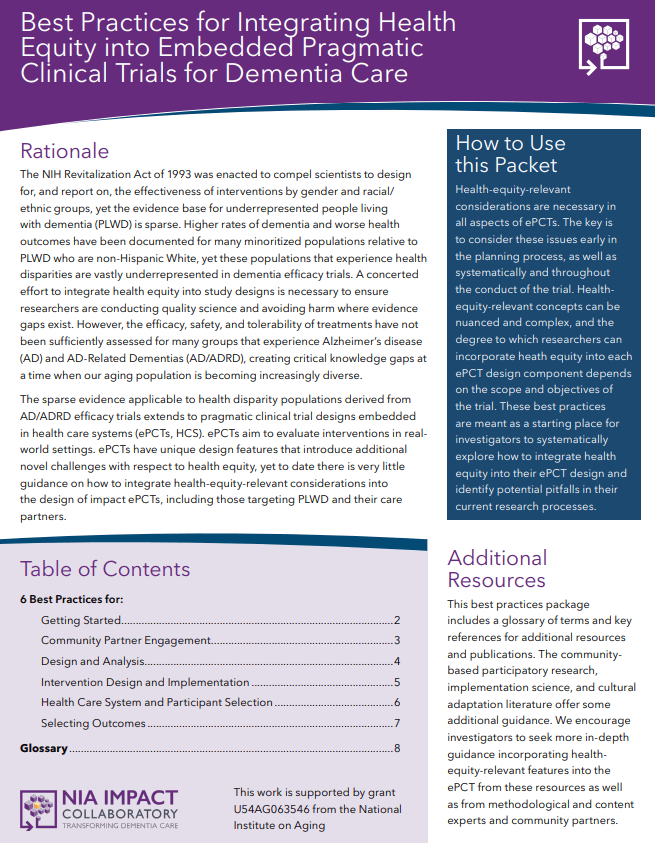
The IMPACT Collaboratory’s leadership and Health Equity Team have worked with experts from across the Collaboratory to create a set of best practices related to integrating health equity into the design and conduct of embedded pragmatic clinical trials for people living with dementia and their care partners.
The guidance document includes a brief introduction, followed by best practices for six specific areas of concern including:
• Getting Started
• Community Partner Engagement
• Design and Analysis
• Intervention Design and Implementation
• Health Care System and Participant Selection
• Selecting Outcomes
Each of the focus areas includes best practices along with brief explanations for why these practices are important, and suggestions for their implementation.
In addition to the six separate focus area sheets, the document includes an extensive glossary of terms and key references for additional resources and key publications.
Citation: Best Practices for Integrating Health Equity into Embedded Pragmatic Clinical Trials for Dementia Care. NIA IMPACT Collaboratory; 2022. doi: doi.org/10.58234/74152992
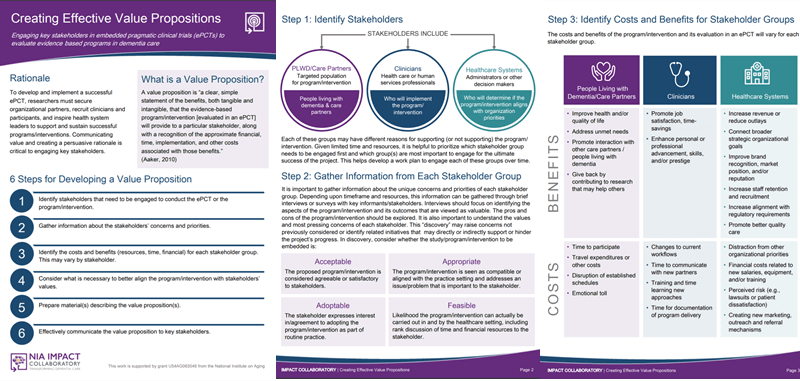
The NIA IMPACT Collaboratory Cores and Teams are creating a series of guidance documents to share important considerations and approaches to planning and conducting embedded pragmatic clinical trials (ePCTs) with people living with dementia (PLWD) and their care partners.
The first of these documents is, “Creating Effective Value Propositions” developed by the Implementation Core. The guide provides a definition and rationale for using value propositions to communicate value and address potential concerns of key stakeholders related to conducting ePCTs of programs/interventions in dementia care. Six steps for developing value propositions are described, and examples are shared.
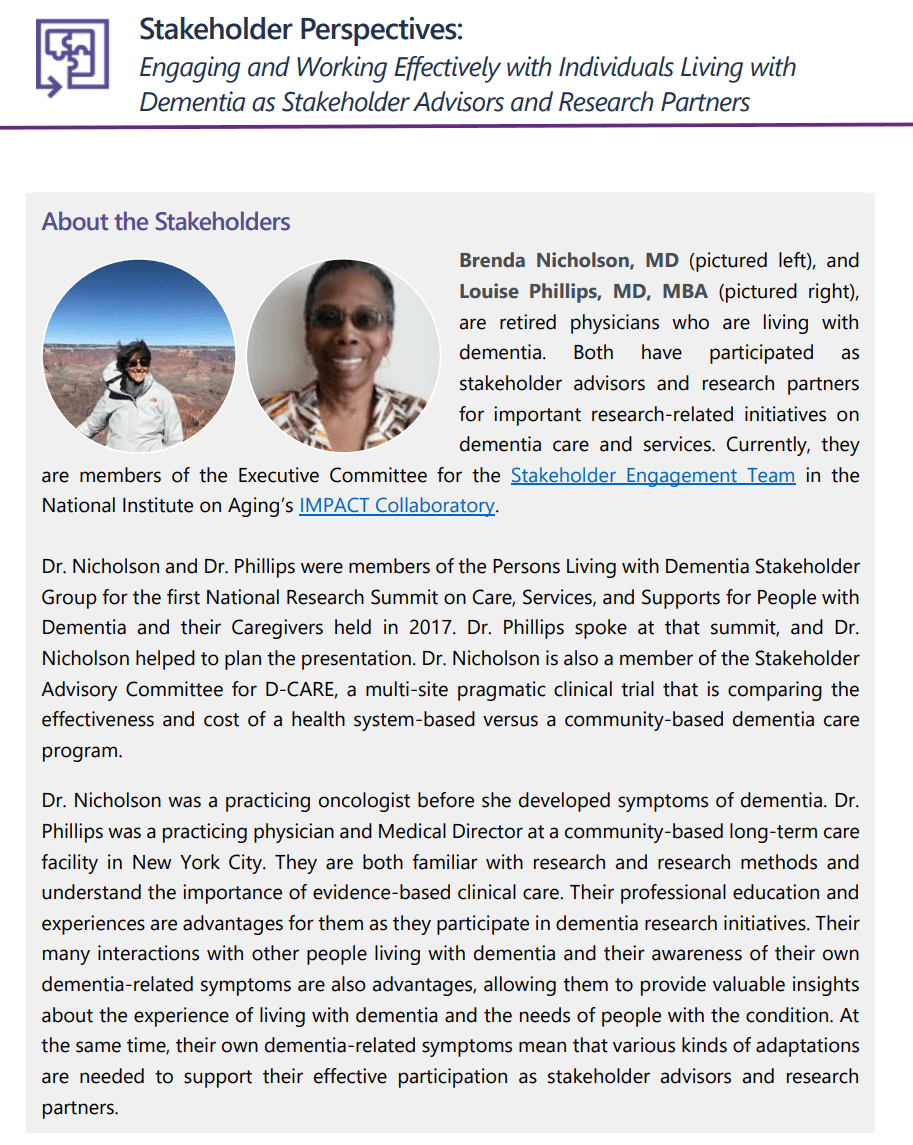
Louise Phillips (Left) and Brenda Nicholson (Right)
Members of the Executive Committee for the IMPACT Engaging Partners Team have collaborated to create a guide for researchers seeking stakeholder advisors living with dementia.
Dr. Nicholson and Dr. Phillips provided three reasons why they participate as stakeholder advisors and research partners in dementia care research:
They hope to encourage more research on topics that are important and relevant for the well-being of people living with dementia and their families
They hope their participation will help convince researchers that it is valuable to include people living with dementia as research partners in their dementia care studies; so, in a sense, to “break through the glass ceiling” in this research area
They hope their involvement as research partners will be a clear and present reminder to research team members of the real human needs of people living with dementia, which are sometimes lost in the strong focus on research procedures and challenges.
Dr. Nicholson and Dr. Phillips drew on their own experiences to offer tips to researchers, but also emphasized that each person living with dementia has their own unique needs and circumstances to consider. Their tips suggest the importance of considering the needs of stakeholder advisors throughout the engagement process; from planning the meeting format and time commitment, through post-meeting follow-up. They stress the importance of providing multiple opportunities for advisors to share their ideas and have their voices heard. The full perspective piece can be found at this link.
Citation: Stakeholder Perspectives: Engaging and Working Effectively with Individuals Living with Dementia as Stakeholder Advisors and Research Partners. NIA IMPACT Collaboratory; 2021. doi: doi.org/10.58234/32478403