

The other dementia breakthrough—Comprehensive dementia care
May 22, 2023
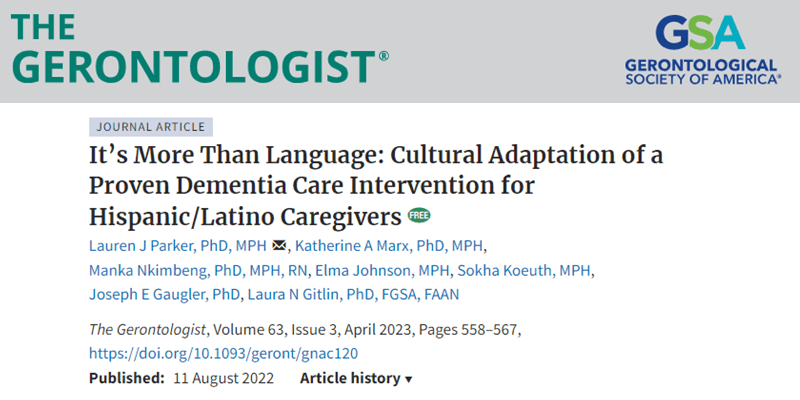
Although nonpharmacological approaches are considered first-line treatments for dementia-related behaviors, it is unclear as to their effectiveness for different racial groups. IMPACT’s Laura Gitlin, PhD, FGSA, FAAN, Nancy Hodgson, PhD, RN, FAAN, Lauren Parker, PhD (2021-2022 IMPACT Faculty Scholar) evaluated the effects of the Tailored Activity Program (TAP) on agitated and aggressive behaviors in Black and White families.
They found that Black families, when compared to White families, derived greater behavioral benefits from TAP for people living with dementia (PLWD) at 3 months despite having less treatment exposure. Additionally, examining differential race effects may enhance precision in using nonpharmacological approaches and promote equity in dementia care for underserved populations.
To read the full article, visit this link.
Advanced Dementia: Research Informing Practice
Slides from Dr. Susan Mitchell’s presentation at the National Academy of Medicine (NAM) Decadal Survey of Behavioral and Social Science Research on Alzheimer’s Disease and Alzheimer’s Disease-Related Dementias Workshop 3 on “Nursing Home, Hospice, and Palliative Care for Individuals with Later-Stage Dementia: Making Health Systems More Responsive to Dementia.” You can view the full slide deck here.
October 26, 2020
A paper presenting results from a study in which an evidence-based, nonpharmacologic intervention for persons living with Alzheimer’s disease and related dementia (ADRD) and their informal caregivers, Care of Persons with Dementia in their Environments (COPE), was tested in a Medicaid and state revenue-funded home and community-based service (HCBS) program. Read the full article here.
March 1, 2021
A paper reviewing a cross-sectional study of 24 ,839 Medicare fee-for-service beneficiaries at two geriatric emergency departments. There was a significant association with reduced total costs of care after being seen by either a transitional care nurse and/or social worker trained to deliver geriatric emergency care. Per beneficiary, these savings were as much as $2905 after 30 days and $3202 after 60 days of the index ED visit. Read the full article here.
Recommendations to Improve Payment Policies for Comprehensive Dementia Care
September 25, 2020
This special article reviews the recommendations for payment policy reform from the Payment Model for Comprehensive Dementia Care Conference in November 2019. More than 50 national experts from diverse perspectives reviewed promising strategies for payment reform including ways to accelerate their adoption. Recommendations for reform included payments for services to family caregivers; new research to determine success metrics; education for consumers, providers, and policymakers; and advancing a population health model approach to tier coverage based on risk and need within a health system. Read the full article at this link.
PCORI is a leader in driving US clinical research to becomes more patient-centered. They are committed to ensuring that patients and other healthcare stakeholders are involved throughout the research process, offering awards to promote engagement in research, dissemination and implementation projects, methodology research, and the development of research infrastructure.
The Clin-STAR (Clinician–Scientists Transdisciplinary Aging Research Coordinating Center) Initiative aims to connect and support the development of clinician-scientists across a variety of disciplines in order to expand aging research that focuses on improving the health, independence, and well-being of older adults. To facilitate these goals, Clin-STAR provides funding, mentorship, and resources for clinician-scientists at all careers levels across a variety of disciplines. They also host the Clin-STAR database, a discovery tool that enables research collaboration and networking among members.