
IMPACT Community Member Awarded ASPPH Early Career Research Excellence Award

Fan Li, PhD, assistant professor of biostatistics at Yale School of Public Health and member of IMPACT’s Design and Statistics Core, has been selected as a recipient of the 2026 Association of Schools & Programs of Public Health Early Career Research Excellence Award in recognition of his outstanding contributions as an early-career investigator.

Dr. Li is the first biostatistician to receive this distinction which acknowledges exceptional impact and leadership in the field of public health.  The award is in appreciation of his leadership and work enhancing the reliability and applicability of evidence used in population health research.

Home Time as a Patient-Centered Outcome in Pragmatic Trials: Promise, Pitfalls, and the Path Forward

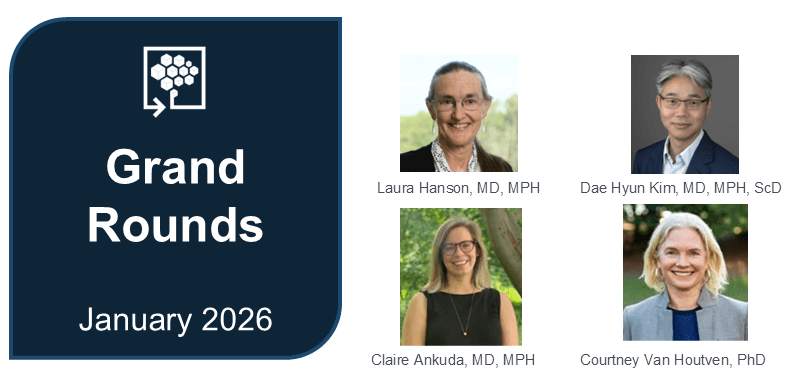
January 2026 – Grand Rounds 62, Drs. Hanson, Kim, Ankuda, and Van Houtven discuss home time as a patient-centered outcome in pragmatic trials.

Webinar Slides

Laura Hanson, MD, MPH

Professor, Division of Geriatric Medicine and Director, UNC Palliative Care Program, University of North Carolina School of Medicine


Claire Ankuda, MD, MPH

Associate Professor, Icahn School of Medicine at Mount Sinai

Dae Hyun Kim, MD, MPH, ScD

Associate Director of Marcus Institute for Aging Research, Associate Professor of Medicine, Harvard Medical School

Courtney Van Houtven, PhD

Professor, Population Health Sciences, Duke University School of Medicine and Duke-Margolis Institute for Health Policy

Learning Objectives

  • Understand the concept of home time as a patient‑centered, system‑relevant outcome measure and how it is operationalized across different clinical contexts.
  • Recognize the limitations, measurement challenges, and equity concerns associated with using home time as an outcome or performance metric in pragmatic clinical trials.
  • Reflect on emerging evidence and future directions for developing more person‑centered home time measures that better capture quality of life for older adults and caregivers.

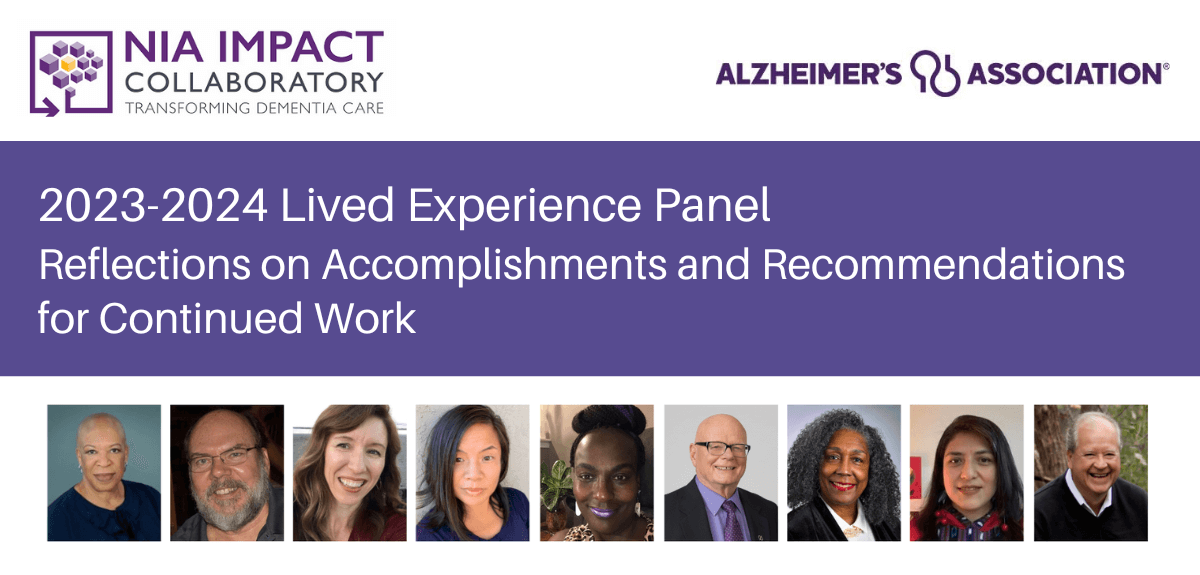
The IMPACT Collaboratory Lived Experience Panel: Reflections on Accomplishments and Recommendations for Continued Work

This extended summary report, authored by Yaideliz M. Romero-Ramos, a Brown University graduate student and Health Equity Scholar, describes feedback from Lived Experience Panel members about their involvement with the panel to date and recommendations for future work. The report details discussions from a series of meetings where members revisited and shared perspectives on previously discussed topics. Additionally, the report highlights members' reflections on their experience with the panel and their suggestions for future initiatives.

Read the full report here.

2023-2024 LEP Report Reflections (1)

Citation: Yaideliz M. Romero-Ramos, Carolyn A. Malone, Kerry Finegan, Willetha Barnette, Bart Brammer, Katie Brandt, Roberta Cruz, Monica Downer, Darrell Foss, Ying-Ling Jao, LuPita Gutierrez-Parker, Freddye G. James, Joan Monin, Emily Mroz, Maria Mora Pinzon, Judith S. Rocha, Lauren Stratton, Mark Toles, Anthony Wagner, Monica Moreno, Gary Epstein-Lubow. The IMPACT Collaboratory Lived Experience Panel: Reflections on Accomplishments and Recommendations for Continued Work. NIA IMPACT Collaboratory; 2024.

Research Grants Core

Research Grants Core

Core Activities

The Research Grants Core administers and manages a portfolio of research grants including the Pilot Projects Program, the Demonstration Projects Program and the Project Planning Grants Program to advance the testing of non-pharmacologic dementia care interventions within health care systems. The Core solicits, funds, and provides methodologic guidance to grant awardees throughout the duration of their projects..

Core members provide mentorship, consultation, and resources to IMPACT-funded investigators to ensure rigorous and timely conduct of funded studies. They also promote investigators’ expertise by integrating them into IMPACT Collaboratory activities and assisting awardees in moving completed project ePCTs to the next scientific stage of the NIH stage model.

Key Resources

    link to the Knowledge Repository
    square link to the Knowledge Repository

    High Risk Populations Core

    High Risk Populations Core

    Team Activities

    The High-Risk Populations Core (HRPC) advises and guides investigators about how considerations related to high-risk, high-need populations are integrated across the IMPACT Collaboratory.  Its goal is to ensure that the design and conduct of embedded pragmatic clinical trials (epCTs) are grounded in best practices and meaningfully address the needs of both settings of care and individuals living with dementia and their care partners who face the greatest barriers to high-quality and accessible care. 

    Working closely with the Research Grants and Training Cores, the HRPC strengthens investigator capacity to design and conduct ePCTs for those at highest risk for adverse outcomes and reduced access to care. The Core also develops and disseminates knowledge to advance best practices and methodologies for addressing the needs of high-risk populations and settings of care in the design and conduct of ePCTs. 

    Members of the Core are integrated throughout the Collaboratory’s scientific cores, launchpads, and Leadership Team, working with Cores and teams across the Collaboratory to ensure strategic, coordinated, and measurable actions that directly support IMPACT’s mission through its four Aims.  

    Key Resources

    link to the Knowledge Repository
    square link to the Knowledge repository

    Publications

    News


    Technical Data Health Care Systems Core

    Technical Data Health Care Systems Core

    Core Activities

    The Technical Data and Health Care Systems Core provides the opportunity, conceptual foundations, technical expertise, and research resources for investigators and health care system to partner to design and conduct rigorous, feasible and highly impactful ePCTs of non-pharmacological interventions to improve dementia care.

    The Core builds relationships with health care systems in variety of settings willing to host these trials and identifies priority areas for dementia care in these settings. Through the Project Planning Grants program, the Core fosters partnerships between investigators and HCS to enable the development of rigorous ePCT protocols to address those priority areas. The Core also enables the application of electronic health records and other real world data structures to conduct ePCTs. The Core helps build investigator capacity through IMPACT’s various training opportunities and develops and disseminates knowledge to advance best practices and methodologies in the design and conduct of ePCTs in dementia specifically related to use of data platforms and health care system organization.

    Key Resources

    horizontal link to the Knowledge Repository
    square link to the Knowledge Repository

    Leadership

    Health Care System Scholars Program

    Overview Page
    Awardees
    FAQ

    One-year support for junior and senior investigators to work directly with health care systems interested in improving care provided to people living with AD/ADRD and their care partners.  RFAs are generally released in January of each year.

    Member Directory | VIEW ALL

    Gitlin and Kales share tips for care partners of people living with dementia in NYT article

    IMPACT Implementation Core Leader, Laura Gitlin, PHD, FGSA, FAAN, and IMPACT Pilot Grant Awardee, Helen Kales, MD are quoted in the recent New York Times article, “How to care for a loved one with dementia: 5 Expert Tips,” by Isabelle Taft.

    The article highlights the challenges to family members providing care for people living with dementia and tips of support. Dr. Gitlin describes the importance of full disclosure about the course of the disease to help individuals and family caregivers prepare and stresses the need to check in on caregivers.  Dr. Kales encourages people living with dementia and their care partners to avoid the temptation for isolation and remain social.  Other recommendations in the article include establishing a caregiving team, seeking help from experts, and considering using technology that can help monitor loved ones.

    Read the full article.