

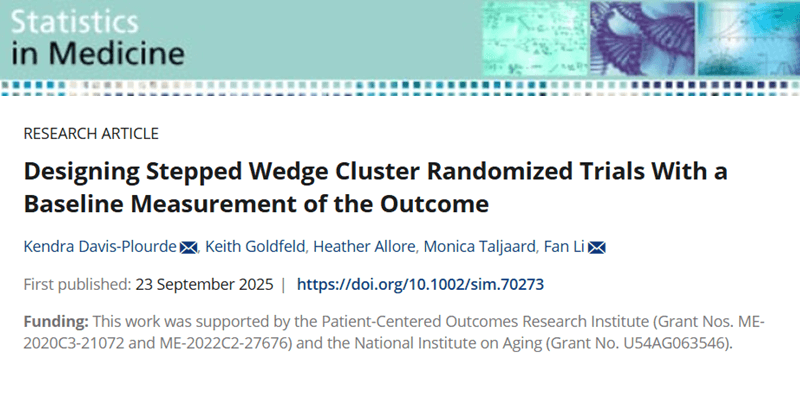
Designing Stepped Wedge Cluster Randomized Trials With a Baseline Measurement of the Outcome
September 23, 2025
Stepped wedge cluster randomized trials (SW-CRTs) are a type of uni-directional crossover design that are increasingly common in prevention and implementation research. Although sample size formulas have been developed to support the planning of SW-CRTs, most methods don’t account for baseline measurements of the outcome – a common feature in many randomized trials and, increasingly, in cross-sectional SW-CRTs. This study explores how including a baseline measurement can make SW-CRTs more efficient.
IMPACT researchers Kendra Plourde, PhD, Fan Li, PhD, Monica Taljaard, PhD, Heather Allore, PhD, and Keith Goldfeld, DrPH, MS, MPA investigated the possibility of addressing a baseline outcome measurement in designing cross-sectional SW-CRTs. The investigators tested three linear mixed modeling approaches to adjust for baseline outcomes and derived the corresponding variance formulas to estimate treatment effects under each. These formulas help clarify how baseline data can improve trial efficiency and offer a way to compare adjustment strategies.
Simulations confirmed the benefits of each approach, and the study includes a real-world example to show how the methods work in practice. The findings offer new guidance for researchers planning SW-CRTs and highlight the value of using baseline data to strengthen trial design.
These findings offer new guidance for researchers planning SW-CRTs and highlight the value of using baseline data to strengthen trial design.
Read the full article here. Explore the GitHub repository here.