

October 2019
Topics
NIH Pragmatic Trials Collaboratory and Living Textbook
The NIH Pragmatic Trials Collaboratory aims to improve the way clinical trials are conducted by creating a new infrastructure for collaborative research with healthcare systems, ultimately ensuring that healthcare providers and patients can make decisions based on the best available clinical evidence. The Collaboratory supports the design and rapid execution of pragmatic clinical trial Demonstration Projects to address questions of major public health importance and engage healthcare delivery systems in research partnerships. The Collaboratory also provides training resources on how to design, conduct, and disseminate embedded pragmatic clinical trials (ePCTs).
Sample size calculation for stepped-wedge cluster-randomized trials with more than two levels of clustering
April 24, 2019
This paper provides power and sample size methods for stepped-wedge trials with more than two levels (subjects within clusters), and illustrates these methods in the settings of the CHANGE trial–which randomizes nursing homes (level 4) consisting of nursing home wards (level 3) in which nurses (level 2) are observed with respect to their hand hygiene compliance during hand hygiene opportunities (level 1) in the care of patients.
Abstract
Background/Aims: Power and sample size calculation formulas for stepped-wedge trials with two levels (subjects within clusters) are available. However, stepped-wedge trials with more than two levels are possible. An example is the CHANGE trial which randomizes nursing homes (level 4) consisting of nursing home wards (level 3) in which nurses (level 2) are observed with respect to their hand hygiene compliance during hand hygiene opportunities (level 1) in the care of patients. We provide power and sample size methods for such trials and illustrate these in the setting of the CHANGE trial.
Methods: We extend the original sample size methodology derived for stepped-wedge trials based on a random intercepts model, to accommodate more than two levels of clustering. We derive expressions that can be used to determine power and sample size for p levels of clustering in terms of the variances at each level or, alternatively, in terms of intracluster correlation coefficients. We consider different scenarios, depending on whether the same units in a particular level are repeatedly measured as a cohort sample or whether different units are measured cross-sectionally.
Results: A simple variance inflation factor is obtained that can be used to calculate power and sample size for continuous and by approximation for binary and rate outcomes. It is the product of (1) variance inflation due to the multilevel structure and (2) variance inflation due to the stepped-wedge manner of assigning interventions over time. Standard and non-standard designs (i.e. so-called “hybrid designs” and designs with more, less, or no data collection when the clusters are all in the control or are all in the intervention condition) are covered.
Conclusions: The formulas derived enable power and sample size calculations for multilevel stepped-wedge trials. For the two-, three-, and four-level case of the standard stepped wedge, we provide programs to facilitate these calculations.

LTC Focus
LTCFocus.org provides data on nursing home care in the US. Their goal is to allow researchers to trace relationships between state policies, local market forces, and the quality of long-term care, enabling policymakers to craft state and local guidelines that promote high-quality, cost-effective, equitable care for older Americans.
Public Attitudes toward Consent When Research Is Integrated into Care—Any “Ought” from All the “Is”?

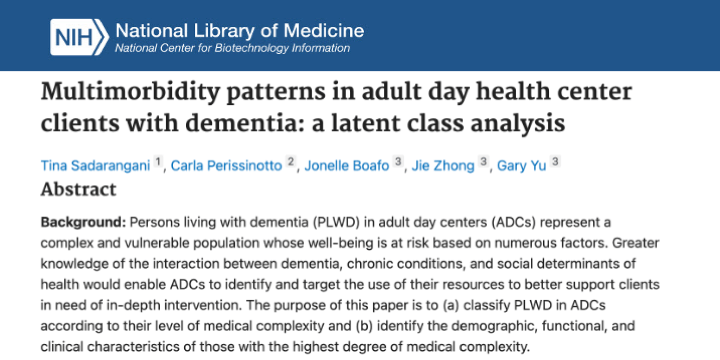
IMPACT to hold pre-conference workshop on embedded pragmatic clinical trials for people living with dementia and their caregivers at AAIC 2022
The IMPACT Collaboratory will hold a pre-conference workshop at the 2022 Alzheimer’s Association International Conference (AAIC) in San Diego, CA on July 29, 2022 to share key considerations in the design and conduct of ePCTs for PLWD. The goals of the workshop are to:
- Train investigators in the design and conduct of ePCTs for people living with dementia and their care partners
- Identify priorities for improving care for people living with dementia
- Highlight the importance of engaging stakeholders
- Provide guidance for investigators on the design and conduct of ePCTs for people living with dementia and their care partners in health care settings
The workshop, organized by IMPACT’s Administration Core Executive Director Jill Harrison, PhD, will be lead entirely by IMPACT members, including Vincent Mor, PhD, Partha Bhattacharyya, PhD, Marcel Salive, MD, MPH, Kenneth Hepburn, PhD, María Aranda, PhD, MSW, MPA, LCSW, Ellen McCreedy, PhD, MPH, David Reuben, MD, Deborah Barnes, PhD, MPH, and Joseph Gaugler, PhD.
Visit the AAIC website for additional information here and view the IMPACT pre-conference workshop agenda here.
Registration is required and separate from the AAIC registration.