
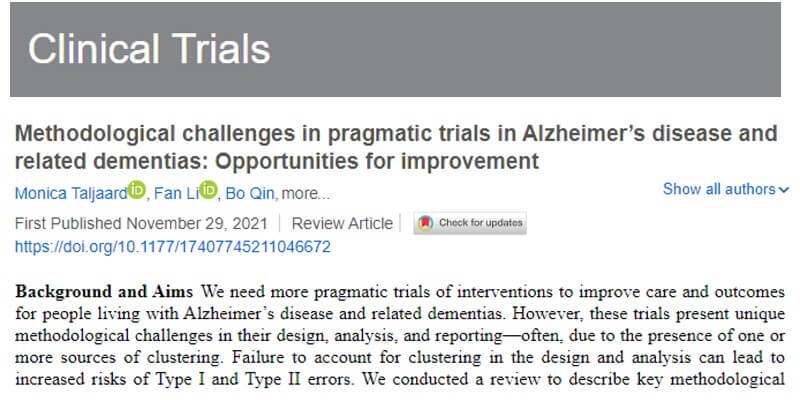
Goldfeld examines the design effects of cluster randomized trial and stepped wedge designs with baseline measurements in two recent blog posts

Keith Goldfeld, DrPH, MS, MPA of the IMPACT Design and Statistics Core, recently published two blog posts examining whether it is possible to reduce the sample size requirements of a stepped wedge cluster randomized trial by collecting baseline information.

Goldfeld explains that reducing sample size requirements is possible for randomization at the individual level and in cluster randomized trails, but he and colleagues Monica Taljaard and Fan Li, also members of the IMPACT Design and Statics Core, are exploring the question for stepped wedge designs.

The first blog post focuses on work already done to derive design effects for parallel cluster randomized trials (CRTs) that collect baseline measurements, and the second addresses the questions for stepped wedge designs.

Blog post 1 of the series:  The design effect of a cluster randomized trial with baseline measurements

Posted on November 23, 2021

In the first blog Goldfeld lays the groundwork for future posts by focusing on work already done to derive “design effects” for parallel cluster randomized trials (CRTs) that collect baseline measurements.  He shares a discussion about why baseline measurements may have impact and how they can be used to reduce required sample size in cluster randomized trials.  Goldfeld cites a paper published in 2012 by Teerenstra et al, “A simple sample size formula for analysis of covariance in cluster randomized trials” as a great foundation to understand how baseline measurements can impact sample sizes in clustered designs. He provides examples and simulations, and describes the work being done by himself fellow researchers to expand this to stepped wedge cluster randomized trials in particular.

Blog post 2 of the series: Exploring design effects of stepped wedge designs with baseline measurements

Posted on December 7, 2021

In this post, Goldfeld extends the simulations provided in the previous post to stepped wedge trials in an effort to identify and define design effects on stepped wedge designs in particular.  He concludes by sharing the code to estimate statistical power of each model reviewed under a range of sample size assumptions.
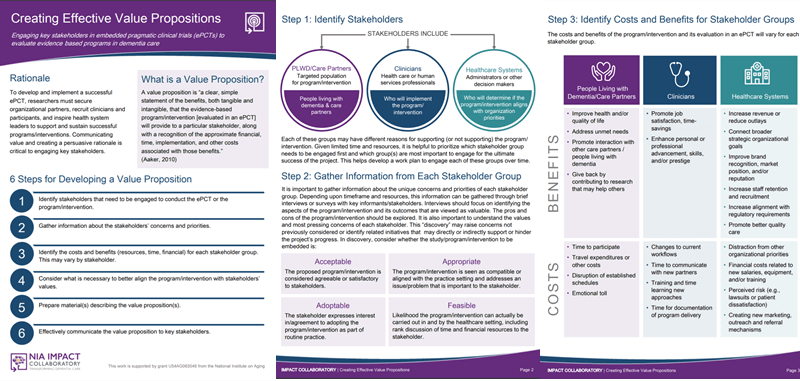
Creating Effective Value Propositions: Engaging key stakeholders in embedded pragmatic clinical trials (ePCTs) to evaluate evidence based programs in dementia care

The NIA IMPACT Collaboratory Cores and Teams are creating a series of guidance documents to share important considerations and approaches to planning and conducting embedded pragmatic clinical trials (ePCTs) with people living with dementia (PLWD) and their care partners.

The first of these documents is, “Creating Effective Value Propositions” developed by the Implementation Core.  The guide provides a definition and rationale for using value propositions to communicate value and address potential concerns of key stakeholders related to conducting ePCTs of programs/interventions in dementia care. Six steps for developing value propositions are described, and examples are shared.

The full guidance document can be found here.

Citation: Creating Effective Value Propositions: Engaging key stakeholders in embedded pragmatic clinical trials (ePCTs) to evaluate evidence based programs in dementia care. NIA IMPACT Collaboratory; 2021. doi: doi.org/10.58234/80661959
Click to view Value Proposition

AHCA Partners With Exponent, MatrixCare on New Effort to Track COVID-19 and Future Threats to Nursing Homes

IMPACT Collaboratory multiple principal investigator Vince Mor, PhD, and Brown University’s Center for Long-Term Care Quality & Innovation are partnering with the American Health Care Association/National Center for Assisted Living, Exponent, and other research partners in a powerful new initiative, funded by the National Institute on Aging, which enables public health surveillance of COVID-19 and other potential public health threats facing nursing homes.

The research partners are leveraging their capabilities to establish the Long Term Care Data Cooperative, which uses nursing home residents’ electronic medical records and associated data to create comprehensive resident electronic health records to help providers monitor their residents’ needs and outcomes. Additionally, the health records system will support public health reporting as well as allow researchers to generate real-world evidence on different treatments and care practices for the elderly and individuals with disabilities in nursing homes.

Mor and his colleagues at Brown University are working with, Exponent, an interdisciplinary and scientific consulting company, electronic health records (EHR) software firm MatrixCare, the AHCA to assemble the largest and most comprehensive health records database from geographically and structurally diverse nursing homes and residents.

This multi-year initiative will continue to characterize and monitor the immediate and long-term effects of COVID-19 and its vaccines among residents and contribute to better preparedness for future public health threats.

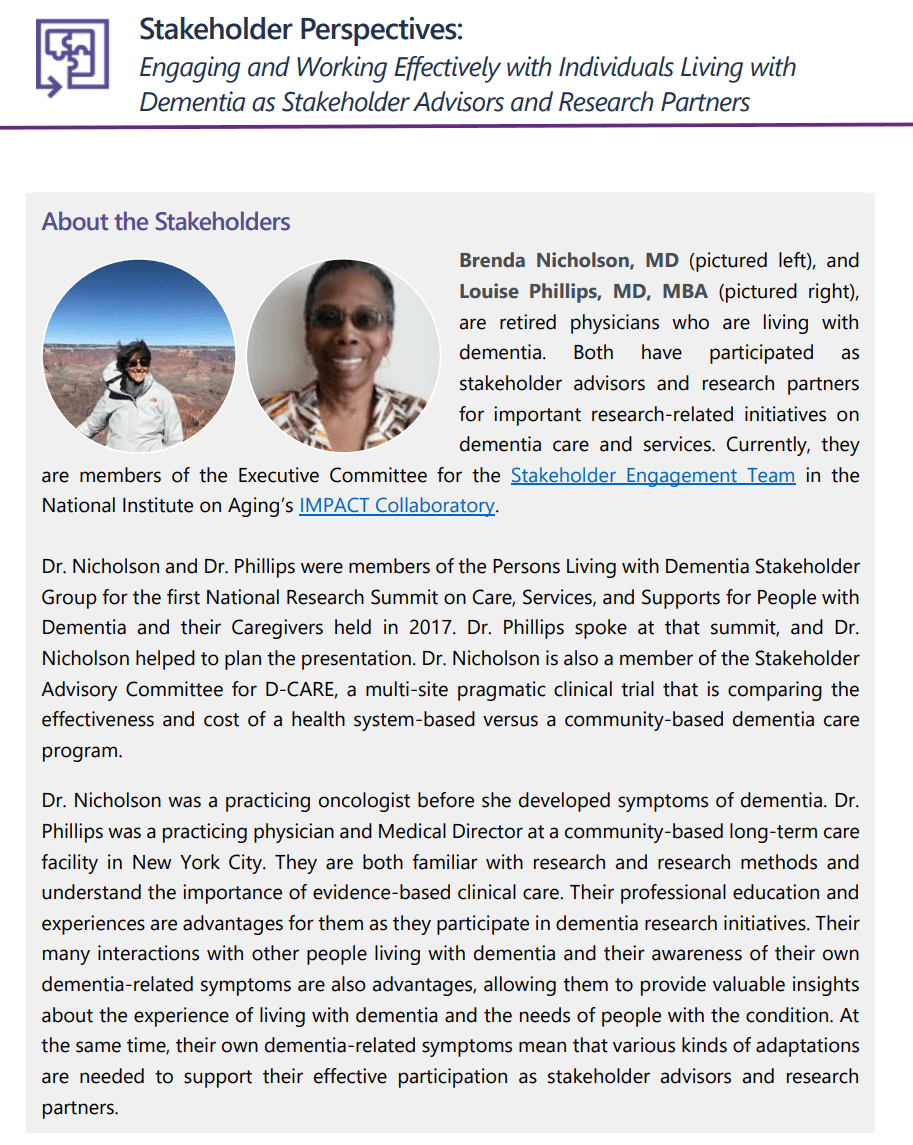
Stakeholder Perspectives: Engaging and Working Effectively with Individuals Living with Dementia as Stakeholder Advisors and Research Partners

September 28, 2021

Louise Phillips (Left) and Brenda Nicholson (Right)

Members of the Executive Committee for the IMPACT Engaging Partners Team have collaborated to create a guide for researchers seeking stakeholder advisors living with dementia.

Brenda Nicholson, MD , and Louise Phillips, MD, MBA, are retired physicians who are living with dementia. Both have participated as stakeholder advisors and research partners for important research-related initiatives on dementia care and services. They collaborated with Katie Maslow, MSW, to create the perspective piece entitled, Engaging and Working Effectively with Individuals Living with Dementia as Stakeholder Advisors and Research Partners.

Dr. Nicholson and Dr. Phillips provided three reasons why they participate as stakeholder advisors and research partners in dementia care research:

  • They hope to encourage more research on topics that are important and relevant for the well-being of people living with dementia and their families
  • They hope their participation will help convince researchers that it is valuable to include people living with dementia as research partners in their dementia care studies; so, in a sense, to “break through the glass ceiling” in this research area
  • They hope their involvement as research partners will be a clear and present reminder to research team members of the real human needs of people living with dementia, which are sometimes lost in the strong focus on research procedures and challenges.

Dr. Nicholson and Dr. Phillips drew on their own experiences to offer tips to researchers, but also emphasized that each person living with dementia has their own unique needs and circumstances to consider. Their tips suggest the importance of considering the needs of stakeholder advisors throughout the engagement process; from planning the meeting format and time commitment, through post-meeting follow-up.  They stress the importance of providing multiple opportunities for advisors to share their ideas and have their voices heard. The full perspective piece can be found at this link.

Citation: Stakeholder Perspectives: Engaging and Working Effectively with Individuals Living with Dementia as Stakeholder Advisors and Research Partners. NIA IMPACT Collaboratory; 2021. doi: doi.org/10.58234/32478403
Click to view Stakeholder Perspectives

New Funding Opportunity: Request for Applications for IMPACT Demonstration Project Program

The IMPACT Collaboratory is pleased to announce a Request for Applications (RFA) for the second cycle of the Demonstration Project Program.

IMPACT will fund up to two Demonstration Projects (maximum duration 24 months) designed as full-scale, Stage IV effectiveness embedded pragmatic clinical trials (ePCT) (based on the NIH Stage Model) that test, measure and evaluate the effect of a non-pharmacological care delivery intervention program in a health care system for people living with Alzheimer’s Disease (AD) and AD-related dementias (ADRD) and their care partners.  The goal of the Demonstration Project is to generate evidence on effective care delivery practices that can be expanded and/or implemented in other systems.

Under this mechanism, interventions must be linked to the needs of the health care system.  Suitable interventions typically encompass relatively simple system changes or direct patient outreach, or successfully piloted programs ready for testing at scale. Demonstration Projects will allow health care systems and investigators to gain real-world experience integrating pragmatic non-pharmacological interventions into usual clinical workflow and health care delivery practices in a controlled manner that provides clear information on the impact of the intervention program.

The IMPACT Collaboratory will only fund Demonstration Project applications that include a clinical trial as defined by the National Institutes of Health.  Preference will be given to applications that address dementia care for populations historically marginalized or underrepresented in clinical trials and those that promote health equity.

It is anticipated that Demonstration Project awards will be for up to $500,000 in direct costs for a maximum of 24-months and will be non-renewable.

Learn more about the Demonstration Projects Program here.

Informational Webinar

An optional informational webinar will be hosted to provide investigators with an overview of application details and an opportunity to ask questions. Pre-registration is required using the link below.

Tuesday, October 19, 2021 at 1:00 pm ET: Registration closed.

Letters of Intent (LOI) by Email – Required
Interested applicants are required to submit an LOI. LOIs are accepted on a rolling basis through:

October 29, 2021 @ 5pm ET

Full Applications Due – By invitation only

Applicants selected for further consideration will be invited to submit a full application due:

January 14, 2022 @ 5pm ET

Read the full RFA here. Learn more about our previous Demonstration Project Awardees here.

If you have any questions regarding this funding opportunity, please refer to our Frequently Asked Questions or email IMPACTcollaboratory@hsl.harvard.edu.

Please help to publicize this IMPACT funding opportunity and encourage investigators and colleagues to apply.

IMPACT members suggest an adaptive approach to dissemination and implementation of interventions to improve care for people living with dementia in editorial

Members of the IMPACT Collaboratory co-authored an editorial in the October edition of the Journal of the American Medical Directors Association (JAMDA) addressing the limitations of the linear model for development and testing on new interventions and the need for support for dissemination and implementation of dementia care interventions.

Joseph Gaugler, PhD, and Laura Gitlin, PhD from IMPACT’s Implementation Core, and Sheryl Zimmerman, PhD from the Patient Caregiver Relevant Outcomes Core collaborated in writing this commentary. They acknowledge the value of conducting early stage research of interventions within the linear NIH Stage Model, but argue that a more dynamic circular model of intervention development is important when developing an intervention for dementia care. The authors offer 3 guiding principles for considering readiness of dementia care interventions for dissemination and implementation: 1) The evidence base of dementia care interventions requires ongoing development; 2) The importance of incorporating implementation science principles throughout the life cycle of intervention development; and 3) The heterogeneous nature of intervention evidence is to be embraced, not shunned.  Read more here.

IMPACT members share research and insights at NASEM meeting addressing Alzheimer’s Disease and AD-Related Dementias

Multiple NIA IMPACT members participated in the National Academies of Sciences, Engineering, and Medicine (NASEM) virtual workshop entitled, “Behavioral and Social Research and Clinical Practice Implications of Biomarkers and Other Preclinical Diagnostics of Alzheimer’s Disease (AD) and AD-Related Dementias” (AD/ADRD) on June 28 and 29, 2021.

The meeting addressed behavioral and social science research questions raised by the use of biomarkers and other measures (e.g., digital/sensor data) for pre-clinical AD/ADRD diagnosis, including the personal, social, ethical, legal, economic, health equity, and healthcare implications for patients and families, the impact of disclosure of preclinical diagnosis on identity and self-concept, study partners and interpersonal relationships, interactions with the healthcare system, participation in the workforce, and other outcomes. It also addressed the implications of preclinical diagnosis of AD/ADRD for the design and conduct of AD/ADRD prevention research.

IMPACT Collaboratory members who participated in the meeting include:

The format of the meeting was a series of panel presentations followed by reflections/discussions by other participants.  Mor and Largent presented summaries of their research, and Jackson, Karlawish and Parker were respondents to panel discussions.   The meeting summary report was recently released and includes descriptions of the studies presented by Mor and Largent, as well as responses from Jackson and Parker.

Mor discussed screening and disclosure of dementia diagnoses to give patients and families more information to make decisions and prepare for the future. He shared the results of the CARE (Caregivers’ Reactions and Experience) study, which is a supplemental study to the IDEAS (Imaging Dementia—Evidence for Amyloid Scanning) study. IDEAS uses amyloid PET scans to gather more informa­tion on patients with an unclear diagnosis, and CARE uses surveys and interviews to examine why these patients and their care partners sought a definitive diagnosis of cognitive defects, how they reacted to the results, and what impact the results had on their future plans.

Emily Largent, presented findings from her research, which used qualitative methods to look at the disclosure of AD biomarker results.  Largent asserted that a diagnosis of Alzheimer’s disease before the onset of cognitive impairment will change the lived experience of Alzheimer’s disease for millions of adults.  While not all of these people will progress to experiencing cognitive impairment, the diagnosis itself is a “clinical experience” and can change people’s perceptions of themselves as patients. Families are also af­fected, both because of what it may mean for their own risk, in addition to the risk of becoming a caregiver to their loved one.

Parker, was among the respondents to a panel presentation about issues related to health equity in studies of presymptomatic people.  Jason Karlawish responded to the presentations related to implications of diagnosis disclosure.

The full meeting summary report can be found at this link.