
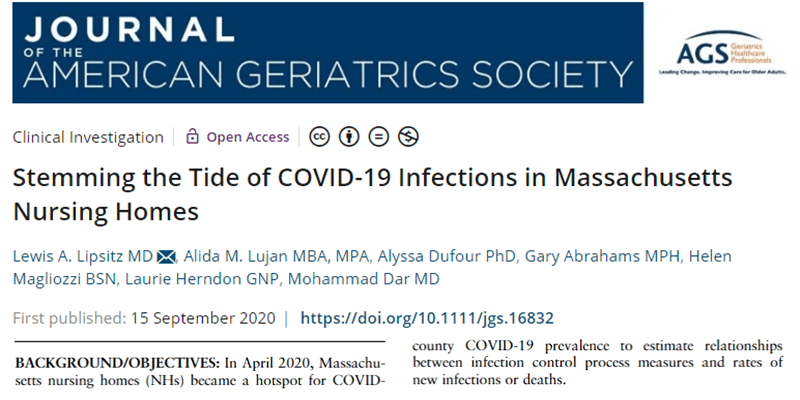
Stemming the Tide of COVID-19 Infections in Massachusetts Nursing Homes
September 15, 2020
The National Institute on Aging (NIA) IMbedded Pragmatic Alzheimer’s disease (AD) and AD-Related Dementias (AD/ADRD) Clinical Trials (IMPACT) Collaboratory has released a new funding opportunity available for investigators interested in developing embedded pragmatic clinical trials (ePCTs) in dementia research.
Detailed information about the program as well as timelines, eligibility, and other requirements are provided below and in the request for applications (RFAs). Updates will be posted to IMPACT Pilot Grant Program webpage.
Pilot Grant Program RFA Cycle 2B
The IMPACT Collaboratory is soliciting letters of intent for several 1-year pilot awards for up to $175,000 in direct costs. The goal of these awards is to support pilot studies to generate the preliminary data necessary to design and conduct future full-scale ePCTs of non-pharmacologic interventions in health care systems for people living with AD/ADRD and/or their care partners. The mandatory letter of intent is due September 18, 2020.
The IMPACT Collaboratory will consider applications for pilot ePCTs testing non-pharmacological interventions in people living with AD/ADRD and their care partners. In this grant cycle, the IMPACT Collaboratory will consider all applications that propose pilot ePCTs for people living with AD/ADRD and their care partners but will prioritize those in the following areas:
The IMPACT Collaboratory will fund up to five 1-year, non-renewable pilot grant awards for up to $175,000 in direct costs. Letters of intent are required and due September 18, 2020. Full proposal applications are by invitation only and will be due January 8, 2021. For further details, please see the on the IMPACT Pilot Grant Program webpage.
Two optional informational webinars will provide investigators with an overview of application details and support that the IMPACT Collaboratory can provide to assist with proposal development (e.g., trial design, measurement, data extraction, etc.). Investigators will have the opportunity to ask questions. Pre-registration is required using the links below.
Registrants will receive a confirmation email containing information to join the webinar.
The IMPACT Collaboratory encourages all eligible researchers to take advantage of this important funding opportunity, which has the potential to advance care for people living with dementia and/or their care partners in real-world settings. For more information about the IMPACT Collaboratory, please visit impactcollaboratory.org.
The NIA IMPACT Collaboratory is supported through funding from the National Institute on Aging (U54AG063546).
A hurdle model is a modified count model that also assumes a relatively high frequency of zeros, but is set up as a two-stage data generation process rather than as a mixture distribution. In his most recent blog post, Keith Goldfeld, DrPH, MS, MPA of the IMPACT Design and Statistics Core discusses using a hurdle model in the context of planning a new study to address COVID-19 infection rates in nursing homes using much more aggressive testing strategies. Read the full blog post here.
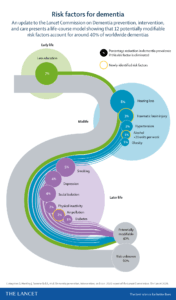 The Lancet Commission on dementia prevention, intervention, and care published a report July 30, 2020 that highlights recommendations for policy makers and individuals to help reduce dementia risk worldwide.
Eric B. Larson, MD, MPH, core leader of the IMPACT Health Care Systems Core and Laura Gitlin, PhD, FGSA, FAAN, core leader of the Implementation Core are among 28 internationally recognized dementia experts who contributed to the comprehensive report.
The report expands the number of modifiable risk factors from nine to 12, to now include head injuries in mid-life, excessive alcohol consumption in mid-life, and exposure to air pollution in later life. The Commission estimates that 40% of dementia cases could be prevented or delayed by targeting these 12 modifiable risk factors. The 2020 Lancet Commission update calls for nations and individuals to be ambitious about preventing dementia, and lays out a set of policies and lifestyle changes to help. Read https://hubs.ly/H0s-vHK0
Larson also answered questions from Kaiser Permanente Washington about the report. You can read the Q&A at this link.
The IMPACT Collaboratory will have a strong presence at the upcoming Alzheimer’s Association International Conference (AAIC). The presentation, “NIA IMPACT Embedded Pragmatic Clinical Trials for the Improvement of Care for People Living with Dementia and their Care Partners” includes modules by IMPACT members: Vince Mor, Laura Hanson, Jason Karlawish, and Fan Li and will be available from July 27th –July 31st.
IMPACT presenters will discuss key considerations in the design and conduct of embedded pragmatic clinical trials for persons living with dementia in a live panel discussion on July 31st at 2PM EST. Registration is free at alz.org/aaic. AAIC will provide instructions on how to join the live panel through their platform closer to the date of the event.
The National Institute on Aging (NIA) is holding a virtual summit series, “2020 National Research Summit on Care, Services, and Supports for Persons with Dementia and Their Caregivers.” Held over 3 days, the summit series provides an opportunity for researchers and stakeholders to discuss the current research environment, gaps, opportunities and priorities for future dementia care research. Each session includes research presentations, panel discussions and moderated Q&As. IMPACT members participated in the first of the three sessions on July 10th and will be participating in both remaining sessions. Learn more about the virtual summit series. Registration is open to the public for individual sessions.
Friday, July 10, 2020, 1:30-4:30 pm EDT
The first virtual meeting will cover the welcome, setting the stage, Impact of Dementia (Theme 1), and Participation of Persons with Dementia and their Caregivers in Research (Theme 4). The meeting materials and recording can be found here.
IMPACT members included: David Reuben,MD, University of California, Los Angeles (Summit Steering Committee Member), Maria Aranda, PhD, Chris Callahan, MD, MACP, Jason Karlawish, MD, Katie Maslow, MSW, and Vince Mor, PhD (Committee members).
Tuesday, July 21, 2020, 1:00-4:30 pm EDT
The second meeting will cover Long-Term Services and Supports in Home, Community, and Residential Care Settings for Persons with Dementia and their Caregivers (Theme 2), Services and Supports in Medical Care Settings for Persons with Dementia (Theme 3), and Integration: The Present and Future of Integrated Long-Term and Medical Care.
IMPACT members included: David Reuben, MD, Chris Callahan, MD, MACP, Josh Chodosh, MD, MSHS, Sheryl Zimmerman, PhD, and Kimberly Van Haitsma, PhD.
Thursday, August 13, 2020, 1:30-5:00 pm EDT
The third meeting will cover Intervention Research, Implementation, and Dissemination (Theme 5), Research Resources, Methods, and Data Infrastructure (Theme 6), and Emerging Topics.
IMPACT members included: David Reuben, MD, Vincent Mor, PhD, Joan Monin, PhD, MS, Julie Bynum, MD, MPH, Lisa Onken, PhD, and Thomas Travison, PhD.
May 11, 2020
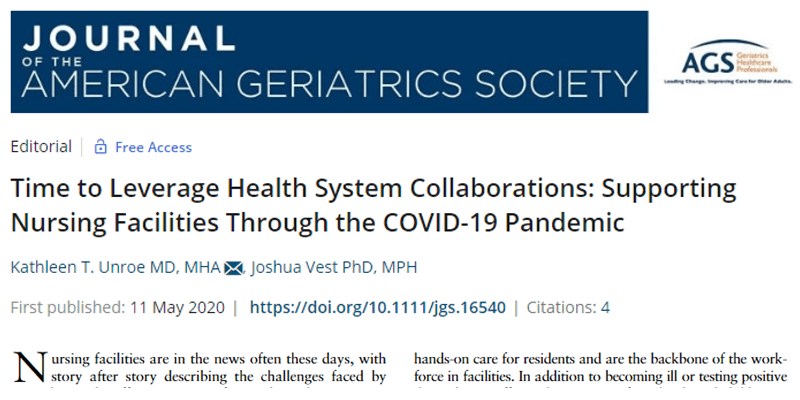
 Kathleen Unroe, MD, MHA from the IMPACT Pilot Studies Core recently co-authored an editorial published in the Journal of the American Geriatrics Society. In it, they stated the benefits of collaboration between health systems and nursing facilities.
The editorial, "Time to Leverage Health System Collaborations: Supporting Nursing Facilities Through the COVID-19 Pandemic," was written in response to a paper published by a research team from the University of Washington. Dr. Unroe and her colleague Joshua Vest, PhD, MPH praise the work, which leveraged an existing university health system infrastructure to provide solutions and support to nursing homes during the outbreak. They believe the University of Washington's model demonstrates what is possible when investments are made in partnerships.
Read more about Dr. Unroe's editorial here.