CMO Panel: How to Achieve Health Systems Change

March 2022 – In Grand Rounds 25, Vince Mor, PhD, IMPACT multiple principal investigator, moderates a panel of three Chief Medical Officers as they share their experiences in how to implement organizational change within healthcare systems.


Troyen Brennan, MD

Troyen Brennan, MD
Executive Vice President and Chief Medical Officer, CVS Health

Saul N. Weingart, MD

Saul N. Weingart, MD
President
Rhode Island Hospital
Hasbro Children's Hospital


Richard Feifer, MD, MPH

Richard Feifer, MD, MPH
President of Genesis Physician Services, Executive Vice President and Chief Medical Officer at Genesis HealthCare

Notice of Intent: IMPACT Collaboratory plans to publish 2 new Requests for Applications on January 10, 2022.

We are pleased to announce that the IMPACT Collaboratory plans to publish two Requests for Applications (RFA) on January 10, 2022. Stay tuned for more details.

Career Development Award (CDA) Program

  • CDA RFA Cycle 3
  • $100k per year in direct costs for 2 years
  • Goal: Mentored training grant for early-stage investigators to gain skills needed to conduct ePCTs for dementia care
  • Informational Webinar: Tuesday, February 1, 2022 at 2pm ET. Registration closed.
  • Learn more about CDA awardees

Health Care Systems (HCS) Scholars Program

  • HCS Scholars RFA Cycle 2
  • $120k in direct costs for 1 year
  • Goal: Embed scholars in health care systems to strengthen research partnerships to conduct ePCTs to improve dementia care
  • Informational Webinar: Thursday, January 20, 2022 at 1:15pm ET. Registration closed.
  • Learn more about HCS Scholar awardees

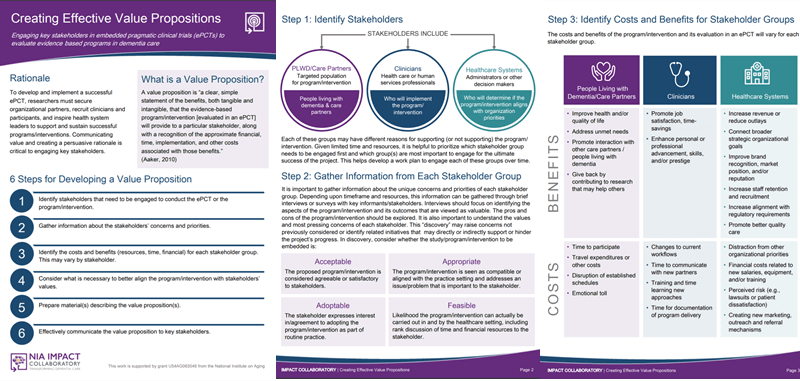
Creating Effective Value Propositions: Engaging key stakeholders in embedded pragmatic clinical trials (ePCTs) to evaluate evidence based programs in dementia care

The NIA IMPACT Collaboratory Cores and Teams are creating a series of guidance documents to share important considerations and approaches to planning and conducting embedded pragmatic clinical trials (ePCTs) with people living with dementia (PLWD) and their care partners.

The first of these documents is, “Creating Effective Value Propositions” developed by the Implementation Core.  The guide provides a definition and rationale for using value propositions to communicate value and address potential concerns of key stakeholders related to conducting ePCTs of programs/interventions in dementia care. Six steps for developing value propositions are described, and examples are shared.

The full guidance document can be found here.

Citation: Creating Effective Value Propositions: Engaging key stakeholders in embedded pragmatic clinical trials (ePCTs) to evaluate evidence based programs in dementia care. NIA IMPACT Collaboratory; 2021. doi: doi.org/10.58234/80661959
Click to view Value Proposition

Results from TRAIN-AD study published in JAMA Internal Medicine

A study team led by IMPACT’s Multiple Principal Investigator Susan Mitchell, PhD, MPH recently published results of a Trial to Reduce Antimicrobial Use in Nursing Home Residents with Alzheimer’s Disease and Other Dementias (TRAIN-AD).   The journal article and an accompanying editorial were published in JAMA Internal Medicine on July 12th.

Mitchell and colleagues conducted a cluster randomized clinical trial of a multicomponent intervention designed to improve management of suspected urinary tract infections (UTIs) and lower respiratory infections (LRIs) for nursing home residents with advanced dementia.  The trial was conducted at 28 Boston-area nursing homes (14 per arm).  The intervention, which targeted nursing home care providers, integrated best practices from infection diseases and palliative care for management of suspected UTIs and LRIs in residents with advanced dementia. Researchers observed a clinically significant 33% reduction in antimicrobial courses for suspected lower respiratory infections (LRIs) and urinary tract infections (UTIs) among participants living in facilities assigned to the intervention. Although this result was underpowered to show a statistically significant reduction, the TRAIN-AD study was unique in that it completed a rigorous evaluation of an intervention to reduce antibiotics in people with advanced dementia.

The study team found that despite a comprehensive training approach that included an in-person seminar, online course, management algorithms, communication tips, and feedback reports and a high adherence to the training, the intervention did not significantly reduce antimicrobial use among nursing home residents with advanced dementia. However, both Mitchell’s team and the commentary authors noted the potential of the intervention to yield more significant results when scaled up and applied to a broader range of nursing home settings.

The study results were accompanied by an invited commentary from Shiwei Zhou, MD and Pretti N. Malani, MD, noting these strengths and describing the study as a “a low-cost, low risk, scalable intervention that is associated with a reduction in inappropriate antibiotic prescriptions is worthy of replication” from a stewardship perspective.

Read the full article here and commentary here.

Citation: Mitchell SL, D’Agata EMC, Hanson LC, et al. The trial to reduce antimicrobial use in nursing home residents with Alzheimer disease and other dementias (TRAIN-AD): a cluster randomized clinical trial. JAMA Intern Med. Published online July 12, 2021. doi:10.1001/jamainternmed.2021.3098

IMPACT Collaboratory announces three new funding opportunities

The NIA IMPACT Collaboratory is pleased to announce three new funding opportunities; Pilot Grants Cycle 3A, and funding opportunities for two new programs, Demonstration Projects and Health Care Systems (HCS) Scholars . These three funding opportunities will support research and training aimed at increasing the nation’s capacity to conduct pragmatic clinical trials (ePCTs) of non-pharmacological interventions within health care systems to improve the care of people living with Alzheimer's disease and related dementias (AD/ADRD) and their care partners.

Demonstration Projects Program

The IMPACT Collaboratory will fund up to two Demonstration Projects (maximum duration 24 months) designed as full-scale, Stage IV effectiveness ePCT (based on the NIH Stage Model) that test non-pharmacological interventions for people living with AD/ADRD and their care partners embedded within and linked to the needs of a health care system. The goal of the Demonstration Projects is to generate evidence on effective care delivery practices that can be expanded and/or implemented in other systems. Interventions must be linked to the needs of a health care system. The intervention will typically encompass relatively simple system changes or direct patient outreach, or successfully piloted programs ready for testing at scale. Preference will be given to applications for Demonstration Projects that address dementia care for populations traditionally marginalized or underrepresented in clinical trials and those that promote health equity.

HCS Scholars Program

The new Health Care Systems (HCS) Embedded Research Scholars Program offers junior and senior investigators an opportunity to work directly with health care systems interested in improving the care provided to people living with dementia (PLWD) and their care partners. The goals of the HCS Scholars Program are to embed investigators in health care systems to:

  • Establish mutually beneficial partnerships to improve the care of PLWD and care partners
  • Train investigators about health care settings needs and how new programs are successfully introduced at all levels of the organization
  • Engage HCS in learning more about what it means to conduct ePCTs and provide resources for understanding opportunities for improvement in dementia care or evaluation of related quality improvement projects
  • Strengthen collaborations between investigators and HCS that may lead to pilot studies or demonstration projects.

Pilot Grant Program –Cycle 3A

The IMPACT Collaboratory funds several one-year pilot studies annually; these are meant to generate the preliminary data necessary to design and conduct a future full-scale Stage IV effectiveness ePCT (based on the NIH Stage Model) funded through other grant mechanisms (National Institutes of Health or other sources). The IMPACT Collaboratory will consider applications for pilot ePCTs that test non-pharmacological interventions embedded in health care system(s) for people living with AD/ADRD and their care partners. All applications should make a convincing case that the pilot ePCT proposed can be scaled up to a full-scale, Stage IV effectiveness ePCT as the next step.

Please check upcoming events for webinars for each opportunity, as well as the IMPACT Twitter feed and mailing list for additional updates.

Health Care Systems Core leaders discuss vision for the IMPACT Learning Health Network

The NIA IMPACT Health Care Systems Core recently launched its Learning Health Network, to connect health care practice and research for people living with dementia and their care partners. The Learning Health Network is a consortium of individuals, organized into 4 unique communities representing unique settings of care for people living with Alzheimer’s disease and related dementias and their care partners.  The goal is to bridge the gap between research and practice by facilitating relationship-building and information sharing between researchers and members of the various care settings.  The Learning Health Network is in its beginning phase, with current efforts aimed at building the 4 unique communities:

  • Long-term Care (nursing homes, assisted living, and other settings that provide around-the-clock care for persons living with dementia)
  • Healthcare Settings (Clinics, ACOs, MA Plans, Integrated Delivery Systems)
  • Hospitals/Emergency Departments
  • Community-based Organizations (Meals on Wheels, Hospice, Senior Centers, Adult Day Centers)

Health Care Systems Core Leaders Eric B. Larson, MD, MPH and  Leah Hanson, PhD are leading the efforts for the Learning Health Network, and recently shared their goals and vision for the network, describing the Learning Health Network as an opportunity to create a transformative and bi-directional relationship between stakeholders working to improve dementia care.

“The idea of a learning health network is foundational to health care systems,” said Larson. We need bi-directional communication, so that research informs practice, and practice informs research. It’s not just “we” educating “them”. We will educate each other about the settings and how we can work with them.”

Hanson recognized the importance of listening to each other as well. “If researchers are operating in a silo and conduct an amazing intervention and we roll out in real world, but it doesn’t work, then it doesn’t help,” she said. “We have to consider those factors in design of research studies. We believe this network is the way to bring people together.”

Larson and Hanson said they believe that groups like the Learning Health Network will prove to be especially helpful when dealing with crises like the COVID-19 pandemic.

“In our system, people are sharing and engaging with each other in ways they never have before,” said Hanson.  “We did a weekly call at our health care system when COVID first started, with large clinician engagement. People want to learn what is happening, and being set up to easily share information will help that process.”

Larson and Hanson said that their hope is that for a small investment of time, members of the Learning Health Network can gain access to thought leaders and experts while also educating researchers about how to improve care in real-world settings. Both core leaders recently presented with two other members of the Core for a Grand Rounds webinar and follow-up podcast about the Core and the Learning Health Network.


Grand Rounds 10 - October 2020

The AHRQ and Lancet Reports on Dementia Interventions: Interpretation and Implications for Embedded Pragmatic Trials

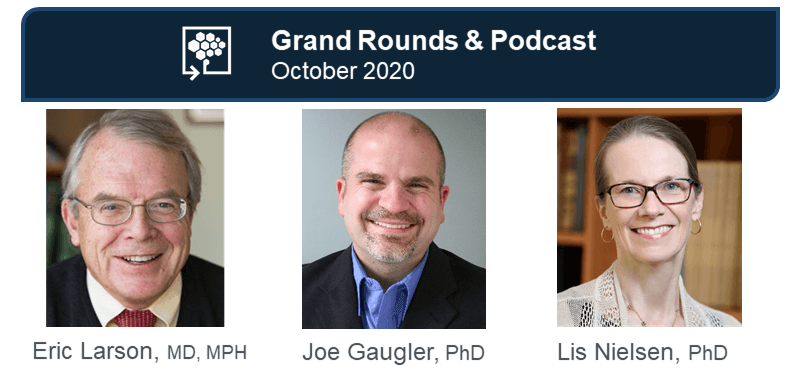
October 2020 – In Grand Rounds 10, Members of the IMPACT Health Care Systems Core and Implementation Core summarize the AHRQ and Lancet Reports on Dementia Interventions and their implications for pragmatic trials, with commentary from NIA representative Lis Nielsen, PhD, Director of the Division of Behavioral and Social Research (DBSR).

Download webinar slides.

Joe Gaugler, PhD

Joe Gaugler, PhD

Associate Core Leader, Implementation Core

Robert L. Kane Endowed Chair in Long-Term Care and Aging, Professor, University of Minnesota

Eric Larson, MD, MPH

Eric Larson, MD, MPH

Core Leader, Health Care Systems (HCS) Core
Member, Steering Committee

Vice President, Research and Health Care Innovation, Kaiser Foundation Health Plan of Washington
Executive Director and Senior Investigator, Kaiser Washington Health Research Institute

Lis Nielsen, PhD 

Lis Nielsen, PhD 

Director, Division of Behavioral and Social Research, National Institute on Aging

Larson and Gitlin contribute to Lancet Commission report with recommendations to help reduce dementia risk

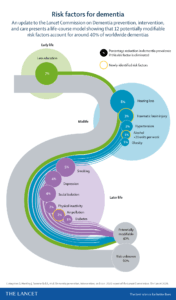
The Lancet Commission on dementia prevention, intervention, and care published a report July 30, 2020 that highlights recommendations for policy makers and individuals to help reduce dementia risk worldwide.

Eric B. Larson, MD, MPH, core leader of the IMPACT Health Care Systems Core and Laura Gitlin, PhD, FGSA, FAAN, core leader of the Implementation Core are among 28 internationally recognized dementia experts who contributed to the comprehensive report.

The report expands the number of modifiable risk factors from nine to 12, to now include head injuries in mid-life, excessive alcohol consumption in mid-life, and exposure to air pollution in later life. The Commission estimates that 40% of dementia cases could be prevented or delayed by targeting these 12 modifiable risk factors. The 2020 Lancet Commission update calls for nations and individuals to be ambitious about preventing dementia, and lays out a set of policies and lifestyle changes to help. Read https://hubs.ly/H0s-vHK0  

Larson also answered questions from Kaiser Permanente Washington about the report. You can read the Q&A at this link.