
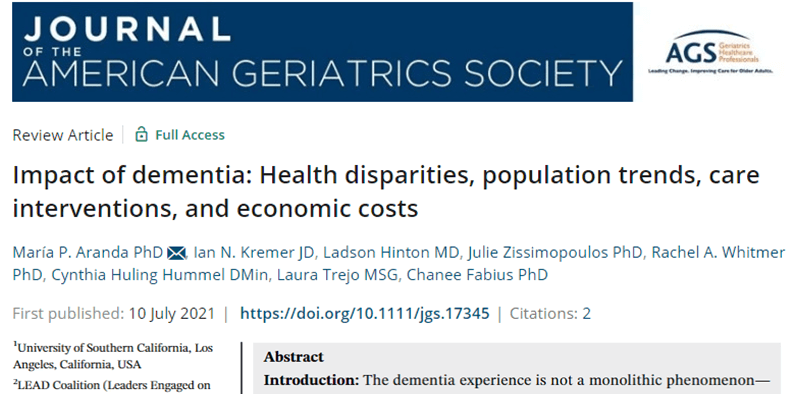
Impact of dementia: Health disparities, population trends, care interventions, and economic costs
July 10, 2021

June 2021 – In Grand Rounds 18, Drs. Teno and Saliba discuss the use of administrative data, including the Minimum Data Set (MDS) in pragmatic clinical trials and share examples of how they have used this data in their own pragmatic clinical trials.

Joan M. Teno, MD, MS
Professor of Medicine, Oregon Health & Science University
Adjunct Professor of Health Services, Policy, & Research, Brown University School of Public Health Physician Scientist, VA Los Angeles, GRECC and HSR&D COIN
Debra Saliba, MD, MPH
Anna & Harry Borun Endowed Chair, Geriatrics and Gerontology, UCLA
Director, UCLA/JH Borun Center for Gerontological Research
Physician Scientist, VA Los Angeles, GRECC and HSR&D COIN
The NIA IMPACT Collaboratory plans to publish a Request for Applications (RFA) for Pilot Grants on August 16, 2021 with Letters of Intent due September 17, 2021.
IMPACT funds several one-year awards of pilot pragmatic clinical trials (ePCTs) that test non-pharmacological interventions embedded in health care system(s) for people living with Alzheimer’s Disease (AD) and AD-related dementias (ADRD) and their care partners. Under this mechanism, interventions must be linked to the needs of a health care system. For more information, please see our Pilot Grants page.
All applications will be considered with priority given to applications for interventions in this population that aim to:
The goal of the pilot projects is to generate the preliminary data necessary to design and conduct a future full-scale Stage IV effectiveness ePCT (based on the NIH Stage Model). The IMPACT Collaboratory will give preference to applications that address dementia care for populations traditionally marginalized or underrepresented in clinical trials and those that promote health equity. It is anticipated that Pilot Projects will be funded for up to $175,000 in direct costs for a maximum of 12-months.
Stay tuned for updates regarding the release of the RFA, an informational webinar and application deadline. If you have questions related to this funding opportunity, please contact IMPACTcollaboratory@hsl.harvard.edu.

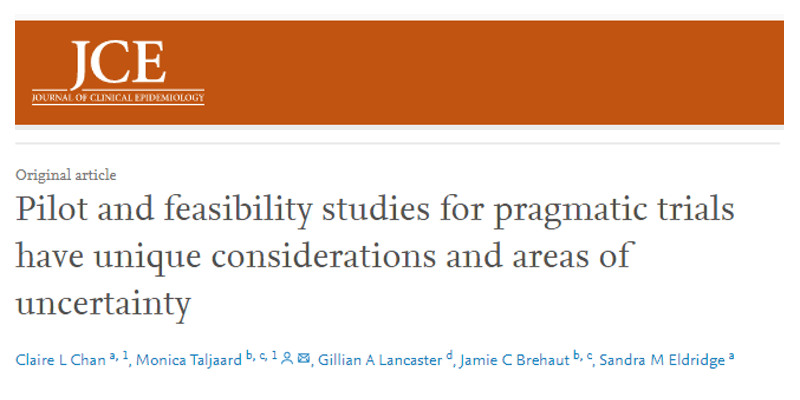
May 2021 – In Grand Rounds 17, Claire Chan presents on the growing number of studies described as pilot or feasibility studies, and describes the challenges in defining and designing these studies.

Claire Chan, MSc
Statistician
Institute of Population Health Sciences (IPHS)
Queen Mary University of London
s
Podcast Transcript: Download the transcript here.
Asymptomatic and symptomatic infection rates fell dramatically after vaccinations in a large multi-state sample of nursing home residents, reported Wednesday in the New England Journal of Medicine
A study of more than 22,000 nursing home residents shows that the COVID-19 mRNA vaccines are highly effective under real-world conditions in reducing infection in this vulnerable population. The study, based at Brown University through a supplement award to the National Institute on Aging (NIA) IMbedded Pragmatic Alzheimer’s disease (AD) and AD-Related Dementias (AD/ADRD) Clinical Trials (IMPACT) Collaboratory, uses electronic health record data from Genesis HealthCare, one of the largest long-term care providers in the US. This is one of the first studies to report individual-level vaccine effectiveness data on nursing home residents, who were excluded from the vaccine clinical trials and often have reduced immune responses to vaccines.
The findings were shared as a research letter in the New England Journal of Medicine on May 19, and are attributed to a year-long collaboration between Brown University and Genesis HealthCare that has leveraged real-time clinical data to investigate COVID-19 outcomes in nursing homes. Led by Elizabeth White, PhD, APRN of the Center for Gerontology and Healthcare Research at the Brown University School of Public Health, the study team included Xiaofei Yang, ScM, Vincent Mor, PhD, and Stefan Gravenstein, MD, MPH from Brown University; and Carolyn Blackman, MD, and Richard Feifer, MD, MPH of Genesis HealthCare. Dr. Mor is one of two principal investigators of the IMPACT Collaboratory.
The study team examined clinical data from 280 nursing homes in 21 states. A total of 18,242 nursing home residents received at least one vaccine dose, and 13,048 of those received both doses as of February 15, 2021. An additional 3,990 residents were unvaccinated. Residents were observed for new infections through March 31, 2021. Residents underwent regular testing, and were assessed daily by nurses for new symptoms.
The incidence of asymptomatic and symptomatic infection fell for both vaccinated and unvaccinated residents over time. Of the 13,048 fully vaccinated residents, 38 (0.3%) developed incident infection more than 14 days after the second dose, but only 9 (0.1%) were symptomatic. Most infections were asymptomatic. The study results are in line with a recent CDC study of Chicago-area nursing homes, but expand upon those findings with a larger and more geographically diverse sample.
The reduced infections in unvaccinated residents suggest that robust resident and staff vaccine coverage, together with continued use of facemasks and other infection control measures, likely affords protection for small numbers of unvaccinated residents in congregate settings. Still, the continued observation of post-vaccine incident cases highlight the critical need to make vaccines and surveillance testing continuously available to nursing homes to mitigate future outbreaks.
“These findings clearly demonstrate the effectiveness and importance of vaccination among nursing home residents, particularly considering their frailty and weakened immune systems. Moreover, the data reinforce the need to maximize vaccine acceptance within this most vulnerable population” says Dr. Feifer, Chief Medical Officer for Genesis HealthCare.
test1
est2
Phasellus vehicula magna sit amet dui pulvinar vulputate. Cras viverra faucibus metus, sit amet eleifend neque sodales aliquet. Pellentesque tempus lectus urna, nec rutrum nunc euismod quis. Quisque pretium id est nec imperdiet. Duis vel malesuada risus, at rutrum diam. Nullam nec massa a orci blandit ultricies non id eros. Aenean rhoncus elit ut mi accumsan tincidunt. Pellentesque in eros fermentum, efficitur neque non, ullamcorper quam. Donec maximus enim eget arcu pulvinar elementum. Aliquam et auctor massa. Aenean et turpis dictum, varius tortor in, fringilla risus. Nulla non ligula dapibus, placerat nulla vel, hendrerit risus. Donec vel tortor turpis. In felis magna, pretium id varius non, euismod sit amet felis.
Phasellus vehicula magna sit amet dui pulvinar vulputate. Cras viverra faucibus metus, sit amet eleifend neque sodales aliquet. Pellentesque tempus lectus urna, nec rutrum nunc euismod quis. Quisque pretium id est nec imperdiet. Duis vel malesuada risus, at rutrum diam. Nullam nec massa a orci blandit ultricies non id eros. Aenean rhoncus elit ut mi accumsan tincidunt. Pellentesque in eros fermentum, efficitur neque non, ullamcorper quam. Donec maximus enim eget arcu pulvinar elementum. Aliquam et auctor massa. Aenean et turpis dictum, varius tortor in, fringilla risus. Nulla non ligula dapibus, placerat nulla vel, hendrerit risus. Donec vel tortor turpis. In felis magna, pretium id varius non, euismod sit amet felis.
Phasellus vehicula magna sit amet dui pulvinar vulputate. Cras viverra faucibus metus, sit amet eleifend neque sodales aliquet. Pellentesque tempus lectus urna, nec rutrum nunc euismod quis. Quisque pretium id est nec imperdiet. Duis vel malesuada risus, at rutrum diam. Nullam nec massa a orci blandit ultricies non id eros. Aenean rhoncus elit ut mi accumsan tincidunt. Pellentesque in eros fermentum, efficitur neque non, ullamcorper quam. Donec maximus enim eget arcu pulvinar elementum. Aliquam et auctor massa. Aenean et turpis dictum, varius tortor in, fringilla risus. Nulla non ligula dapibus, placerat nulla vel, hendrerit risus. Donec vel tortor turpis. In felis magna, pretium id varius non, euismod sit amet felis.