
Two supplement awards to IMPACT Collaboratory will link big data and the impact of COVID-19 on people living with dementia

The National Institute on Aging (NIA) Imbedded Pragmatic Alzheimer’s Disease (AD) and AD-Related Dementias (AD/ADRD) Clinical Trials (IMPACT) Collaboratory has been awarded two COVID-19 Supplements partnering with major retail pharmacies to create a massive monitoring system of the long-term safety and efficacy of COVID-19 vaccination on people with AD/ADRD.

The monitoring system was first established in February and is led by IMPACT Multiple Principal Investigator Vincent Mor, PhD.  Mor and his team initially created the monitoring system through a partnership with  Acumen, LLC and CVS, with data from more than 13 million CVS customers. The newest supplement, announced May 10 2021, adds data from 13.2 million Walgreens customers, effectively doubling the size of the securely monitored data pool. The combined system matches pharmacy customer records from CVS and Walgreens with Medicare claims to create a data infrastructure that is updated weekly, which will provide near real-time insight into the use, effects and outcomes related to use of COVID vaccines among this frail population and introduce the potential of using big data to improve our national response to the pandemic and public health outcomes for older adults.

“Since society cannot wait to vaccinate this population with an effective vaccine, we must establish an active post-vaccination surveillance system of a large population to report vaccine safety,” Mor said. “Monitoring rare adverse events requires very large populations. This project is allowing us to determine the immediate and long-term effects of vaccination on tens of millions of elderly people — nearly half the population of Medicare beneficiaries.”

These two studies are:

Monitoring Medicare Beneficiaries’ Response to COVID vaccines (CVS Project)

This project established an active post-vaccination surveillance system of a large population to track and report safety and outcomes related to SARS-CoV-2 vaccine(s).  Working jointly with CVSHealth and the Medicare & Medicaid Resource Information Center (MedRIC) at Acumen, LLC, the project established a data infrastructure to monitor the effects of COVID-19 vaccines administered to Medicare beneficiaries by CVS across the country.  Data transfers from the national retail pharmacy chain are merged with Medicare data. The resulting data base is analyzed to identify demographic, race/ethnicity, clinical (e.g., ADRD), and health care system factors associated with being vaccinated, estimate the rate of adverse events attributable to the vaccine and estimate breakthrough COVID illness among vaccinated Medicare beneficiaries.  This program provides the basis for assessing mid- to long-term safety and efficacy of the different vaccines being distributed for use in the elderly population in the country.

Medicare Match for post-vaccination monitoring (Walgreens)

This project builds on the researchers’ partnership with CVS to establish a data infrastructure to monitor the effects of COVID-19 vaccines administered to Medicare beneficiaries by CVS across the country.  The goal of this project is to add data from Walgreen’s 13,231,175 million Medicare beneficiary pharmacy customers to the existing infrastructure which will increase the research team’s capacity to track immediate and long term effects of vaccination on nearly half the population of Medicare beneficiaries.

The need for a larger study population is particularly important because those with ADRD already suffering from neurodegenerative diseases may be at greater risk of serious neurological adverse events of vaccines. In addition, the unknown potential for adverse events may result in high rates of incomplete vaccination (both shots) among older adults. Such uncertainty contributes to vaccine hesitancy and may result in large disparities in SARS-CoV-2 vaccination among racial/ethnic groups, for which disparities in seasonal influenza vaccination already exist.

To learn more about these studies, visit this page on Building Infrastructure Supplement Awards, and the press release from Brown University at this link.

Second Annual IMPACT Steering Committee and Business Planning Meeting highlights

The NIA IMPACT Collaboratory hosted the second annual Steering Committee & Business Planning Meeting on April 6-7, 2021.  The meeting was virtual this year due to the pandemic, and included more than 130 participants.

Highlights from the event include remarks from Richard Hodes, MD, the director of National Institutes on Aging, a Mission Moment presented by Brenda Nicholson, MD, retired physician and person living with dementia, and updates from IMPACT leadership.  Presentations highlighted IMPACT activities, funded investigators, and research efforts related to COVID-19.

The meeting began with a welcome from the IMPACT Collaboratory Principal Investigators Susan Mitchell, MD, MPH and Vince Mor, PhD. The director of the National Institute on Aging, Richard Hodes, MD, added remarks about how IMPACT has worked toward its goals in the past two years.

Brenda Nicholson, MD, a retired physician, member of the Stakeholder Engagement Team Executive Committee, and person living with dementia, provided the meeting Mission Moment. Mission Moments are designed to provide real-word insight into the IMPACT Collaboratory mission of building the nation’s capacity to conduct pragmatic clinical trials embedded within healthcare systems for people living with dementia and their care partners. Dr. Nicholson’s Mission Moment reflected on her experience of living with dementia during COVID-19.

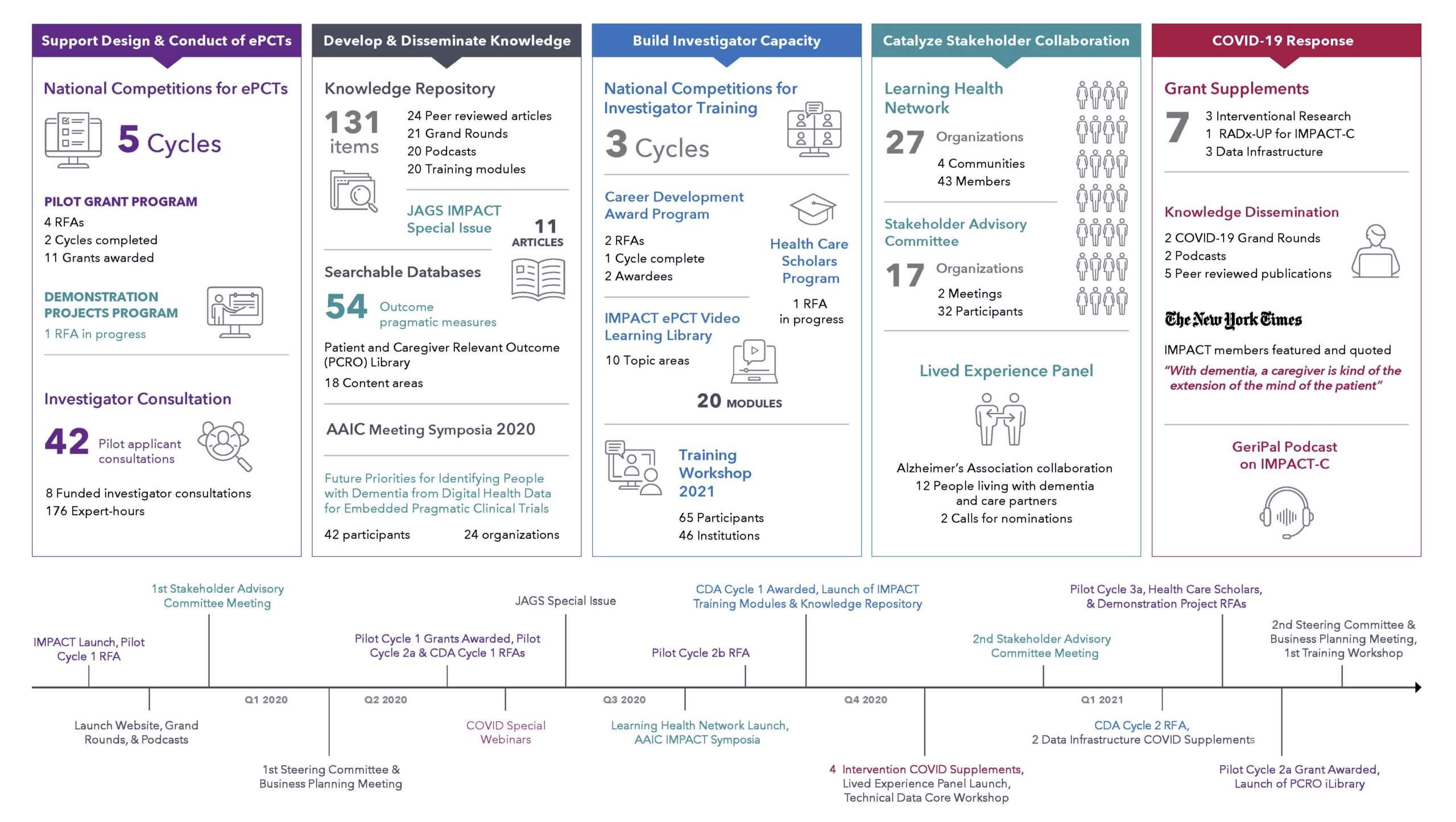
Dr. Mitchell shared the IMPACT Collaboratory’s accomplishments since the beginning of the project in September 2019. Click here to see a larger image of the accomplishments to date.

Accomplishments of the NIA IMPACT Collaboratory since November 2019

Other meeting highlights included updates from the IMPACT Pilot Grant Awardees on the progress of their projects, and achievements of the Health Equity Team, Pilot Studies Core, data sharing, and Ethics and Regulation Core. Investigators also provided updates on three Intervention Supplements, which connect projects and data sources to the broader IMPACT mission.

Day 1 ended with updates from the Training Core and introductions to the first group of Career Development Awardees.

Day 2 featured the convening of the IMPACT External Advisory Panel and Steering Committee, and four Special Sessions led by the Health Equity Team, Design and Statistics Core, and the Ethics and Regulatory Core.

Mor and team share results of IMPACT supplement award study evaluating impact of SARS-CoV-2 vaccine among nursing home residents

Vince Mor, PhD, one of IMPACT Collaboratory’s two Principal Investigators, and team recently shared results from their investigation into the impact of SARS-CoV-2 vaccine among nursing home residents from 280 nursing homes in 21 states.  Results were published in the Journal of the American Geriatrics Society on April 16th.

Researchers partnered with Genesis Healthcare, the largest long-term care provider in the country, for the study, which was a supplement award through the IMPACT Collaboratory.  They monitored the impact of the SARS-CoV-2 vaccine rollout among nursing home residents in 280 nursing homes within 21 states.  Both the Moderna and Pfizer-BioNTech vaccines were included in the study. Researchers created two groups of participating facilities based on the date of their initial vaccine clinic and conducted a matched pair analysis of outcomes.

One week after their initial vaccine clinics, nursing homes with earlier clinics had 2.5 fewer new SARS‐CoV‐2 infections per 100 at‐risk residents than expected based on the experiences of matched facilities with later clinics. Cumulatively over 7 weeks, earlier vaccinated facilities had 5.2 fewer infections per 100 at‐risk residents and 5 fewer hospitalizations and/or deaths per 100 infected residents than expected without vaccinations. These results indicate that the vaccine led to a reduction in incident infections, morbidity, and mortality in this large multi-state nursing home population.

The researchers also suggested the findings support efforts to begin resuming family visitation and lessen other restrictions in nursing homes.

Read the full article at this link.

Mor receives highest faculty honor from Brown University

Vincent Mor, PhD,  IMPACT Multiple  Principal Investigator and longtime professor of health services, policy and practice at Brown University, was one of two recipients of the Susan Colver Rosenberger Medal of Honor during Brown’s graduation service on May 2nd.

Mor was recognized for the “stunning impact” of his service, leadership and research over four decades at Brown, as well as for his devotion to the health and well-being of individuals and to the public good.   Mor was just the 33rd person to receive this honor since its establishment in 1919.

A longtime advocate for vulnerable elders, Mor directed the Center for Gerontology and Health Care Research at Brown for 10 years, and he has been principal investigator of more than 40 National Institutes of Health-funded grants focused on the uses and outcomes of health services by frail and chronically ill people. During the COVID-19 pandemic, in recognition of the urgency of his research, Mor and his team have been awarded multiple supplemental grants related to COVID-19 testing and the adverse health impacts of COVID-19 vaccination in elderly nursing home residents.

Mor said before Sunday’s ceremony that he is deeply honored to receive the award with Julie Strandberg and hopes that their separate efforts at building significant programs at Brown will have lasting value: “What we’ve built, in our respective fields, lays the groundwork for future scholarship and societal improvement,” he said.

Read the full announcement from Brown University at this link.

woman standing at Grand Canyon

Mission Moment: Dr. Brenda Nicholson on Living with Dementia During COVID-19

woman standing at Grand CanyonBrenda Nicholson, MD, a member of the IMPACT Collaboratory Stakeholder Engagement Team Executive Committee and person living with dementia, shares her reflections on living with dementia in the context of COVID-19. Dr. Nicholson’s talk was the mission moment for the IMPACT Collaboratory Steering Committee & Business Planning Meeting on April 6, 2021.  Dr. Nicholson shares her unique experience living with dementia and provides a valuable perspective into the feelings of both people living with dementia and their care partners.


Watch the Video

Inclusion, diversity, and equity in pragmatic clinical trials

April 2020 – In Grand Rounds 16, Dr. Wilkins discusses the definitions of inclusion, diversity and equity in pragmatic clinical trials, and offers insight into how research can be more inclusive and diverse.

Webinar Slides

Speaker

Consuelo H. Wilkins, MD, MSCI

Consuelo H. Wilkins, MD, MSCI
Vice President for Health Equity, VUMC
Associate Dean for Health Equity, Vanderbilt SOM
Associate Director, Vanderbilt Institute for Clinical and Translational Science
Professor of Medicine, Division of Geriatric Medicine

Webinar Recording

Short-term impact of nursing home SARS-CoV-2 vaccinations on new infections, hospitalizations, and deaths

Mor contributes to publication providing evidence of COVID-19 vaccine effectiveness in a real-world nursing home setting

Short-term impact of nursing home SARS-CoV-2 vaccinations on new infections, hospitalizations, and deaths

April 16, 2021

Vince Mor, PhD, IMPACT multiple principal investigator, contributes to publication providing evidence of COVID-19 vaccine effectiveness in a real-world setting of vulnerable nursing homes.

Abstract

Objective

To compare rates of incident SARS-CoV-2 infection and 30-day hospitalization or death among residents with confirmed infection in nursing homes with earlier versus later SARS-CoV-2 vaccine clinics.

Design

Matched pairs analysis of nursing homes that had their initial vaccine clinics between December 18, 2020, and January 2, 2021, versus between January 3, 2021, and January 18, 2021. Matched facilities had their initial vaccine clinics between 12 and 16 days apart.

Setting and Participants

Two hundred and eighty nursing homes in 21 states owned and operated by the largest long-term care provider in the United States.

Measurements

Incident SARS-CoV-2 infections per 100 at-risk residents per week; hospital transfers and/or deaths per 100 residents with confirmed SARS-CoV-2 infection per day, averaged over a week.

Results

The early vaccinated group included 136 facilities with 12,157 residents; the late vaccinated group included 144 facilities with 13,221 residents. After 1 week, early vaccinated facilities had a predicted 2.5 fewer incident SARS-CoV-2 infections per 100 at-risk residents per week (95% CI: 1.2–4.0) compared with what would have been expected based on the experience of the late vaccinated facilities. The rates remained significantly lower for several weeks. Cumulatively over 5 weeks, the predicted reduction in new infections was 5.2 cases per 100 at-risk residents (95% CI: 3.2–7.3). By 5 to 8 weeks post-vaccine clinic, early vaccinated facilities had a predicted 1.1 to 3.8 fewer hospitalizations and/or deaths per 100 infected residents per day, averaged by week than expected based on late vaccinated facilities' experience for a cumulative on average difference of 5 events per 100 infected residents per day.

Conclusions

The SARS-CoV-2 vaccines seem to have accelerated the rate of decline of incident infections, morbidity, and mortality in this large multi-state nursing home population.

Hey and Taljaard co-authors on review of pragmatic clinical trials

A review of pragmatic trials found a high degree of diversity in design and scope, deficiencies in reporting and trial registry data, and poor indexing

March 28, 2021

IMPACT Collaboratory members Spencer Hey, PhD and Monica Taljaard, PhD are among the authors of a review of pragmatic clinical trials recently published online in the Journal of Clinical Epidemiology and covered in a blog post from the US GRADE network. The first author of the study is Stuart G. Nicholls, PhD, of the Ottawa Hospital Research Institute.

The researchers identified 4,337 eligible trials in their review of data collected from MEDLINE, Web of Science, ClinicalTrials.gov and full text between January 2014 and April 2019. They found diversity in research areas, but only 22% of the trials identified were labeled as pragmatic in the title, abstract or full text of the document. In addition, the authors estimated one-fifth of trials under-accrued by at least 15%. They concluded that there is a need to improve reporting of pragmatic trials and quality of trial registry data. Under accrual remains a challenge in pragmatic RCTs despite calls for more streamlined recruitment approaches.

The US GRADE Network blog developed an infographic to share the findings of the review.

view image larger
Source: US GRADE Network Blog