

The IMPACT Collaboratory held its fourth annual Training Workshop on January 24-25, 2024. The 1.5-day virtual workshop included 87 participants from 54 institutions and featured all new material to build a foundation in practical aspects of designing and conducting ePCTs in Alzheimer’s disease (AD) and AD-related dementias (ADRD). Modules focused on: sample size estimation for cluster randomized trials, participant and community engagement, and partnering with healthcare systems for ePCTs.
Topics
Aranda inducted as fellow at American Academy of Social Work and Social Welfare
IMPACT’s Health Equity Team co-leader Maria Aranda, PhD, MSW, MMPA, LCSW was inducted as a 2024 fellow of the American Academy of Social Work and Social Welfare (AASWSW). Aranda is one of two distinguished faculty members inducted from the University of Southern California (USC) Suzanne Dworak-Peck School of Social Work. The AASWSW recognizes the accomplishments of scholars, practitioners and policy leaders dedicated to achieving excellence in high-impact work to advance social good. Aranda received the honor at a ceremony in Washington, D.C. on January 13.

IMPACT Certificate Program – Best Practices for Integrating Health Equity into ePCTs for Dementia Care
IMPACT Collaboratory introduced its latest online training program designed to empower researchers at all levels in integrating health equity considerations into embedded Pragmatic Clinical Trials (ePCTs) for people living with dementia (PLWD) and their care partners.
Program Overview:
This comprehensive training program, aligned with the “Best Practices for Integrating Health Equity into ePCTs for Dementia Care” document, equips researchers with the knowledge and skills to incorporate health equity considerations into design and research activities at every level of ePCTs for people living with dementia. The program covers six essential topic areas:
· Getting Started
· Community Partner Engagement
· Design and Analysis
· Intervention Design and Implementation
· Healthcare System and Participant Selection
· Selecting Outcomes
Key Features:
· Free, accessible online training
· Six courses, each including 2-5 brief and engaging videos
· Self-paced learning, typically completed in 3 hours or less
· Certificate upon successful completion of the program
Access the Training:
Visit the IMPACT Collaboratory HE certificate web page for details and links to set up your free learning account. This account not only provides access to the health equity training program but also to other certificate programs and training materials.
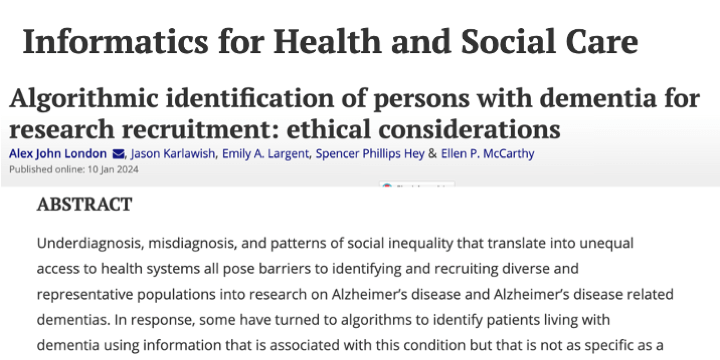



Prevalence estimates are created using the Bynum 1-Year Standard Algorithm for identifying Alzheimer’s Disease and Related Dementias in Medicare Claims
Prevalence estimates are created using the Bynum 1-Year Standard Algorithm for identifying Alzheimer’s Disease and Related Dementias in Medicare Claims
IMPACT member Gary Epstein-Lubow awarded grant to support providers within CMS’s new evidence-based dementia care model
IMPACT’s Engaging Partners Team leader Gary Epstein-Lubow, MD from the global health nonprofit, Education Development Center, received a grant from The John A. Hartford Foundation to coordinate with the developers of six evidence-based comprehensive dementia care programs to help define dissemination strategies, establish standards and tools, and conduct training to accelerate the adoption of evidence-based programs under the new Guiding an Improved Dementia Experience (GUIDE) Model. The collaborating programs include:
- The Benjamin Rose Institute Care Consultation (BRI-CC)TM
- Care Ecosystem
- Eskenazi Healthy Aging Brain Center (HABC 3.0)
- Integrated Memory Care (IMC)
- Maximizing Independence (MIND) at Home
- UCLA Alzheimer’s and Dementia Care (ADC) Program
Dr. Epstein-Lubow and team, including IMPACT’s Engaging Partners Team Co-leader Ellen Tambor, MA will lead the National Dementia Care Collaborative (NDCC) which will provide a common platform for health systems and other provider organizations that have already implemented a proven model of comprehensive dementia care or are seeking to establish a new program in response to the call from CMS for applications for the Guiding an Improved Dementia Experience (GUIDE) Model.
The Guide Model was announced by the Centers for Medicare and Medicaid Services (CMS) in July 2023 to test an alternative payment model for Medicare to pay for comprehensive dementia care that includes support for family caregivers. On November 15, 2023, CMS released a Request for Applications (RFA) (PDF) for health systems and provider organizations interested in participating in the program. Applications will be accepted through Tuesday, January 30, 2024.
Health systems and organizations selected to participate in the GUIDE Model will establish dementia care programs (DCPs) that provide ongoing, longitudinal care and support to people living with dementia through an interdisciplinary team. GUIDE participants will be Medicare Part B enrolled providers/suppliers, excluding durable medical equipment (DME) and laboratory suppliers, who are eligible to bill for Medicare Physician Fee Schedule services and agree to meet the care delivery requirements of the model. (CMS.gov)