

Creating the Truth with Persons Living with Advanced Dementia
June 29, 2021

June 2021 – In Grand Rounds 18, Drs. Teno and Saliba discuss the use of administrative data, including the Minimum Data Set (MDS) in pragmatic clinical trials and share examples of how they have used this data in their own pragmatic clinical trials.

Joan M. Teno, MD, MS
Professor of Medicine, Oregon Health & Science University
Adjunct Professor of Health Services, Policy, & Research, Brown University School of Public Health Physician Scientist, VA Los Angeles, GRECC and HSR&D COIN

Debra Saliba, MD, MPH
Anna & Harry Borun Endowed Chair, Geriatrics and Gerontology, UCLA
Director, UCLA/JH Borun Center for Gerontological Research
Physician Scientist, VA Los Angeles, GRECC and HSR&D COIN

May 2021 – In Grand Rounds 17, Claire Chan presents on the growing number of studies described as pilot or feasibility studies, and describes the challenges in defining and designing these studies.

Claire Chan, MSc
Statistician
Institute of Population Health Sciences (IPHS)
Queen Mary University of London
s
Podcast Transcript: Download the transcript here.

April 2020 – In Grand Rounds 16, Dr. Wilkins discusses the definitions of inclusion, diversity and equity in pragmatic clinical trials, and offers insight into how research can be more inclusive and diverse.

Consuelo H. Wilkins, MD, MSCI
Vice President for Health Equity, VUMC
Associate Dean for Health Equity, Vanderbilt SOM
Associate Director, Vanderbilt Institute for Clinical and Translational Science
Professor of Medicine, Division of Geriatric Medicine
Podcast Transcript: Download the transcript here
April 16, 2021
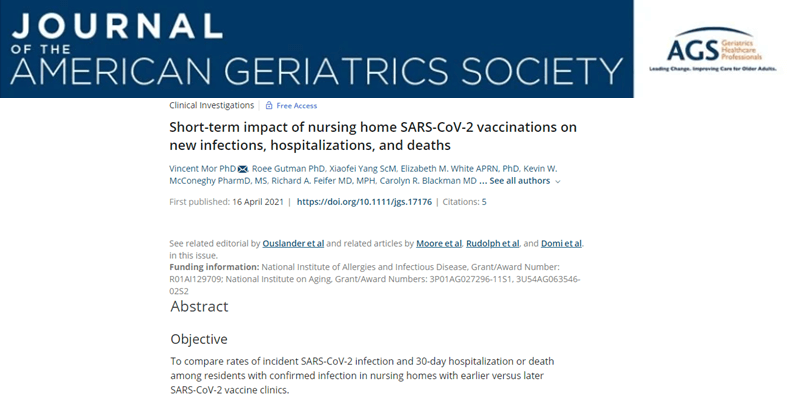
Vince Mor, PhD, IMPACT multiple principal investigator, contributes to publication providing evidence of COVID-19 vaccine effectiveness in a real-world setting of vulnerable nursing homes.
To compare rates of incident SARS-CoV-2 infection and 30-day hospitalization or death among residents with confirmed infection in nursing homes with earlier versus later SARS-CoV-2 vaccine clinics.
Matched pairs analysis of nursing homes that had their initial vaccine clinics between December 18, 2020, and January 2, 2021, versus between January 3, 2021, and January 18, 2021. Matched facilities had their initial vaccine clinics between 12 and 16 days apart.
Two hundred and eighty nursing homes in 21 states owned and operated by the largest long-term care provider in the United States.
Incident SARS-CoV-2 infections per 100 at-risk residents per week; hospital transfers and/or deaths per 100 residents with confirmed SARS-CoV-2 infection per day, averaged over a week.
The early vaccinated group included 136 facilities with 12,157 residents; the late vaccinated group included 144 facilities with 13,221 residents. After 1 week, early vaccinated facilities had a predicted 2.5 fewer incident SARS-CoV-2 infections per 100 at-risk residents per week (95% CI: 1.2–4.0) compared with what would have been expected based on the experience of the late vaccinated facilities. The rates remained significantly lower for several weeks. Cumulatively over 5 weeks, the predicted reduction in new infections was 5.2 cases per 100 at-risk residents (95% CI: 3.2–7.3). By 5 to 8 weeks post-vaccine clinic, early vaccinated facilities had a predicted 1.1 to 3.8 fewer hospitalizations and/or deaths per 100 infected residents per day, averaged by week than expected based on late vaccinated facilities' experience for a cumulative on average difference of 5 events per 100 infected residents per day.
The SARS-CoV-2 vaccines seem to have accelerated the rate of decline of incident infections, morbidity, and mortality in this large multi-state nursing home population.
March 28, 2021
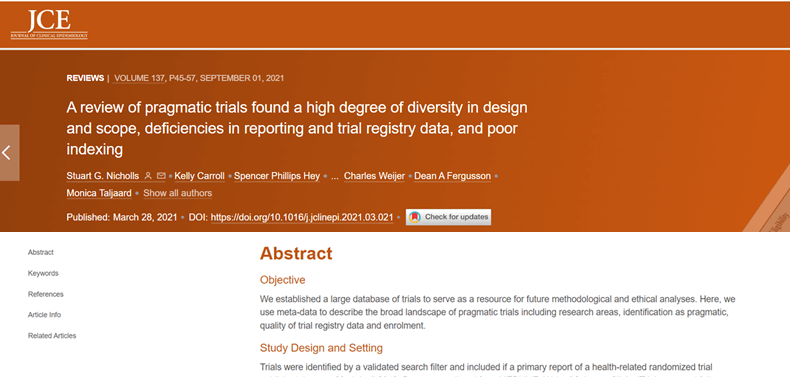
IMPACT Collaboratory members Spencer Hey, PhD and Monica Taljaard, PhD are among the authors of a review of pragmatic clinical trials recently published online in the Journal of Clinical Epidemiology and covered in a blog post from the US GRADE network. The first author of the study is Stuart G. Nicholls, PhD, of the Ottawa Hospital Research Institute.
The researchers identified 4,337 eligible trials in their review of data collected from MEDLINE, Web of Science, ClinicalTrials.gov and full text between January 2014 and April 2019. They found diversity in research areas, but only 22% of the trials identified were labeled as pragmatic in the title, abstract or full text of the document. In addition, the authors estimated one-fifth of trials under-accrued by at least 15%. They concluded that there is a need to improve reporting of pragmatic trials and quality of trial registry data. Under accrual remains a challenge in pragmatic RCTs despite calls for more streamlined recruitment approaches.
The US GRADE Network blog developed an infographic to share the findings of the review.