Zimmerman comments on impact of isolation on nursing home residents during COVID-19 pandemic

Sheryl Zimmerman, PhD, a member of the executive committee for the IMPACT Patient and Caregiver Relevant Outcomes Core, was recently quoted in a New York Times opinion piece about the impact of isolation on nursing home residents during the COVID-19 pandemic.

“We’ve lost part of the long-term care work force by restricting families,” said Zimmerman,  who is also co-director of the Program on Aging, Disability and Long-Term Care at the University of North Carolina at Chapel Hill and the School of Social Work. “Sure, the risk of spreading COVID-19 (or any other infectious disease) is less when visitors are restricted, but the consequence of social detachment may be greater, and this is a serious risk: we’ve known for more than 40 years that isolation increases death.”

Read the full piece at this link.

Grand Rounds 12- December 2020

Improving Serious Illness Care Through Large Pragmatic Trials

December 2020 – In Grand Rounds 12, Dr. Halpern discusses improving care through large pragmatic trials. Dr. Halpern reviews explanatory trials in serious illness care, informed consent, and many other approaches of pragmatic clinical trials to improve the palliative care for seriously ill, hospitalized patients.

Webinar Slides

Speaker

Scott Halpern, MD, PhD

Scott Halpern, MD, PhD

Member, Steering Committee

Professor of Medicine, Epidemiology, and Medical Ethics and Health Policy,
University of Pennsylvania

Webinar Recording

Learning Objectives

  • Participants will understand the importance of improving serious illness care and how it can be done through large pragmatic trials
  • Participants will understand the use of explanatory trials in serious illness care
  • Participants will understand how pragmatic trials can improve palliative care for hospitalized patients

Congress approves $300 million increase for Alzheimer’s and dementia research funding at the NIH for FY 2021

The  fiscal year 2021 omnibus spending bill includes a $300 million increase for Alzheimer’s and dementia research funding at the National Institutes of Health (NIH), including $15 million to fund and implement the BOLD Infrastructure for Alzheimer’s Act (P.L. 115-406), and advances the Improving HOPE for Alzheimer’s Act (S. 880/H.R. 1873).

This research funding increase was advocated for by the Alzheimer’s Association, the Alzheimer’s Impact Movement (AIM) and its nationwide network of dedicated advocates. Spearheaded by Sen. Roy Blunt (R-Mo.), Sen. Patty Murray (D-Wash.), Rep. Tom Cole (R-Okla.) and Rep. Rosa DeLauro (D-Conn.), the action demonstrates policymakers’ renewed commitment to advance Alzheimer’s and dementia research.

In addition to enabling new research into Alzheimer’s and all other dementia, the omnibus spending package includes $15 million to fund the BOLD Infrastructure for Alzheimer’s Act. Passed overwhelmingly in December 2018, the law directs the Centers for Disease Control and Prevention (CDC) to strengthen the public health infrastructure across the country by implementing effective Alzheimer’s interventions focused on public health issues such as increasing early detection and diagnosis, reducing risk, and preventing avoidable hospitalizations.

Medicare has covered care planning for individuals with cognitive impairment, including dementia, since January 2017. However, in the first year, fewer than 1% of seniors living with Alzheimer’s received the care planning benefit. The Improving HOPE for Alzheimer’s Act will give clinicians the knowledge and tools to better help people living with dementia and their families.

In addition to educating clinicians on care planning services available under Medicare, this act requires the Department of Health and Human Services (HHS) to report on the barriers to individuals receiving care planning services and how the rate of usage can be increased.

The bipartisan Improving HOPE for Alzheimer’s Act was introduced by Sens. Debbie Stabenow (D-Mich.), Susan Collins (R-Maine), Ed Markey (D-Mass.), Shelley Moore Capito (R-W. Va.) and Bob Menendez (D-N.J.), and Reps. Paul Tonko (D-N.Y.), Jackie Walorski (R-Ind.), Earl Blumenauer (D-Ore.), Brett Guthrie (R-Ky.), Maxine Waters (D-Calif.) and Chris Smith (R-N.J.). Since its introduction, AIM advocates grew support for the bill resulting in nearly half of the Senate and over 200 members in the House having cosponsored the legislation.

This announcement is modified from the Alzheimer’s Association press release on December 21, 2020. Read their full release at this link.


Penn Roybal Center announces new funding opportunity with special option for IMPACT co-funding

The Penn Roybal Center on Palliative Care in Dementia is pleased to announce a new funding opportunity. Their pilot program seeks to revolutionize the development and testing of behavioral interventions that leverage behavioral economic insights and data science methods to improve palliative care delivery for persons with dementia (PWD) in long-term services and support (LTSS) facilities. Through an innovative partnership with Genesis HealthCare, one of the nation’s largest LTSS companies, successfully funded pilots will be implemented in Genesis HealthCare facilities.

Proposals for Stage IV larger-scale trials may be eligible for co-funding from the NIA IMPACT Collaboratory. Investigators interested in pursuing this option should send a 2-paragraph outline of the proposal and approximate trial duration and budget to Scott Halpern, MD, PhD (shalpern@upenn.edu) no later than January 15, 2021.

Please note the following about the Penn Roybal Center pilot program priorities:

  1. They welcome applications related to the broad themes of palliative care delivery and advance care planning for persons with dementia in LTSS facilities and their family caregivers.
  2. They specifically encourage applications that use methods from the fields of behavioral economics, data science, or both, but the most meritorious applications regardless of methodologic discipline(s) will be funded.
  3. They will only fund applications that include a clinical trial as defined by the NIH (which may be a pilot trial designed to test intervention acceptability, preliminary efficacy, or other early-phase outcomes). Proposals for multi-year awards may include research in the first year using other methods that will provide essential data in direct support of a clinical trial (e.g., testing of feasibility, acceptability, methods of identifying patients, etc), if the proposal includes a clinical trial in later years.

The Penn Roybal Center will distribute up to $200,000 in direct costs for pilot funding this year. Individual applicants may request budgets from $25,000 to $150,000 in direct costs per year, and may propose projects lasting 1 to 3 years (though 3 years will only be considered for large-scale and highly impactful studies). Additionally, proposals for Stage IV larger-scale trials may be eligible for co-funding from the NIA IMPACT Collaboratory, in which case larger budgets may be requested.  Applications are due February 1, 2021 at 5 PM EST.

More information about the Penn Roybal Center on Palliative Care in Dementia pilot program can be found here
More information about the pilot program and application process can be found here: PennRoybal-Center-Pilot-Announcement_Year-3-RFA-002.pdf.

Vince Mor Featured in New JHF Documentary on ‘What COVID-19 Exposed in Long-Term Care’

IMPACT Principal Investigator Vince Mor, PhD is among the experts interviewed for a new documentary from the Jewish Healthcare Foundation (JHF) which explores the reasons theCOVID-19 pandemic has so severely impacted long-term care (LTC) and nursing facilities across the United States. What COVID-19 Exposed in Long-Term Care analyzes the challenges LTC facilities have faced since the pandemic swept the world early this year, including the blame placed on individual long term care facilities and front-line healthcare workers amidst so many systemic shortcomings.

The 20-minute documentary features commentary from public health professionals from across the United States, including Mor. Public health officials interviewed in the documentary attribute the virus’s severe impact on LTC facilities to the vulnerable health of the residents coupled with years of inadequate funding, lack of infection management resources, and the limited response from health systems and public health authorities.

Increased understanding about how this virus and pandemic impacts LTC facilities, underscore the importance for researchers and healthcare workers to find long-term solutions to the disparities that impact this population. Watch the documentary here to learn more about how this public health crisis is affecting older populations and LTC facilities, and how to help find solutions for the inequities within these populations.

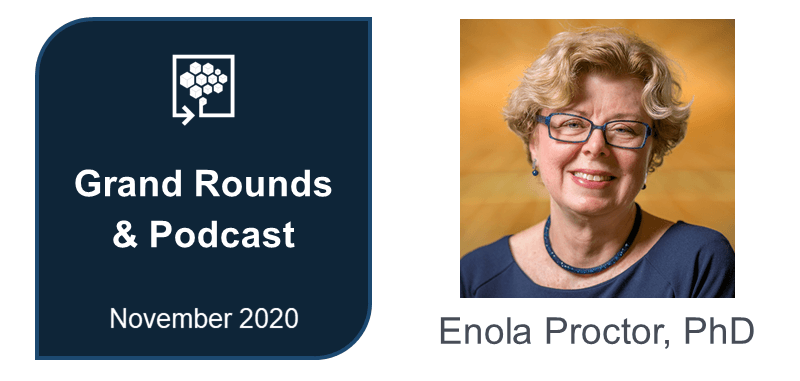
Grand Rounds 11 November 2020

Implementation Outcomes: Their Role in Treatment Success

November 2020 – In Grand Rounds 11, Dr. Proctor presents on the role of implementation outcomes in implementation science, the current state of knowledge, conceptual and methodological challenges they pose, and directions for research to clarify how to effectively achieve implementation outcomes, understand their dynamic relationships to one another, and capture their effects in treatment effectiveness and public health impact.

Speaker

Enola Proctor, PhD

Enola Proctor, PhD

Professor
Brown School, Washington University in St. Louis

Learning Objectives

  • Participants will understand the importance of implementation outcomes
  • Participants will understand the conceptual and methodological challenge for studying implementation outcomes
  • Participants will know priorities for future research on implementation outcomes

IMPACT Collaboratory receives supplement grant to develop adverse events monitoring system for nursing home populations following COVID-19 vaccination

IMPACT Collaboratory Principal Investigator Vincent Mor, PhD will lead a new supplement to the IMPACT funding to study adverse events in nursing home residents who receive the COVID-19 vaccination in real time.
The award to Brown University will be used to design an adverse event monitoring system to identify adverse health impacts after receipt of COVID-19 vaccination by elderly nursing home residents. While there are currently four vaccines in Phase 3 trials in the US, the vaccine trials have rarely included frail, aged subjects with multiple morbidities. For these reasons, and because there is considerable evidence that the immune systems of frail older people are not as responsive as those of the younger people on which vaccines are being tested, careful monitoring of their response to the vaccine will be required. Once a vaccine is approved, it is expected that frail older persons living in congregate settings are in the top priority group for distribution.

This new effort, provides funding for the School to work with Genesis HealthCare (Genesis), one of the nation’s largest post-acute care providers with more than 350 facilities across 25 states. Brown will monitor the occurrence of adverse events following nursing home residents’ receipt of a COVID-19 vaccine in facilities affiliated with Genesis. Since the beginning of the pandemic, Brown and Genesis have been working together to study data and uncover patterns that can be used to develop informed strategies to mitigate the impact of the pandemic in nursing homes.

Mor, lead investigator and professor of health service, policy and practice in the School of Public Health, said “Nursing home residents constitute about 40% of all deaths due to COVID in the nation, but make up less than one half of one percent of the US population. Residents are in desperate need of protection from the virus but no one as sick as a nursing home resident was enrolled in any of the vaccine trials.”

This work is part of the Centers for Disease Control’s effort to establish Vaccine Adverse Event Monitoring Systems, particularly focused on the frail elderly who were not included in the vaccine trials.

Mor added that “We don’t know how frail seniors will react to the vaccine and it will roll out quickly once distribution begins. Under normal circumstances, we would not know until most residents have been vaccinated if the rate of adverse events is higher than expected. Therefore, the ‘real time’ adverse event monitoring system we are establishing cooperatively with the CDC and Genesis is unique and critically important to understand how frail seniors will respond to the vaccines.”

Additional local collaborations in this work include the Rhode Island Quality Institute led by Dr. Neil Sarkar, Ph.D., president and chief executive officer, and associate professor of medical science at the Warren Alpert Medical School of Brown University.

The work is supported by the National Institute on Aging of the National Institutes of Health under Award No. U54AG063546. The content is solely the responsibility of the authors and does not necessarily represent the official views of the National Institutes of Health.

Modified from the Brown University School of Public Health announcement. Read the full text here.

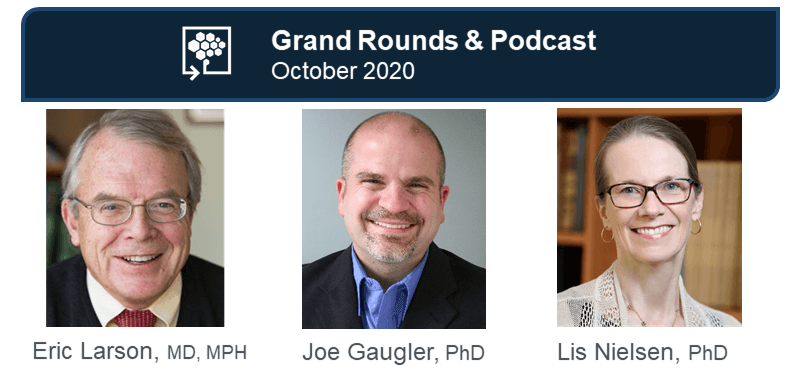
Grand Rounds 10 - October 2020

The AHRQ and Lancet Reports on Dementia Interventions: Interpretation and Implications for Embedded Pragmatic Trials

October 2020 – In Grand Rounds 10, Members of the IMPACT Health Care Systems Core and Implementation Core summarize the AHRQ and Lancet Reports on Dementia Interventions and their implications for pragmatic trials, with commentary from NIA representative Lis Nielsen, PhD, Director of the Division of Behavioral and Social Research (DBSR).

Download webinar slides.

Joe Gaugler, PhD

Joe Gaugler, PhD

Associate Core Leader, Implementation Core

Robert L. Kane Endowed Chair in Long-Term Care and Aging, Professor, University of Minnesota

Eric Larson, MD, MPH

Eric Larson, MD, MPH

Core Leader, Health Care Systems (HCS) Core
Member, Steering Committee

Vice President, Research and Health Care Innovation, Kaiser Foundation Health Plan of Washington
Executive Director and Senior Investigator, Kaiser Washington Health Research Institute

Lis Nielsen, PhD 

Lis Nielsen, PhD 

Director, Division of Behavioral and Social Research, National Institute on Aging

Call for Nominations to Serve on the Lived Experience Panel for People Living with Dementia and Their Family Members and Care Partners

The NIA IMPACT Collaboratory, in collaboration with the Alzheimer’s Association, is seeking nominations to establish a Lived Experience Panel. We are looking for people living with dementia  and those caring for people with dementia to share experiences to help inform the development and testing of interventions to improve dementia care. It is critical to include personal experiences of those living with dementia and care partners to help researchers, professionals, and other stakeholders better understand and prioritize the most urgent needs. Lived Experience Panel will meet quarterly to engage in discussions about methods and strategies for studying non-medication interventions and provide feedback to researchers to improve the quality of life of people living with dementia, their family members, and care partners.

A one-year commitment is requested. Participation will include:

1) training regarding the goals of the Lived Experience Panel

2) four 90-minute meetings (one every 3 months)

3) review of pre-meeting materials

4) evaluation of each meeting soon after it has completed. Meetings will take place over video and/or conference calls

Please share this opportunity with individuals you believe might be good candidates for this panel. To learn more, please visit the Lived Experience Panel page, the Frequently-Asked-Questions and complete the Nomination Form (self-nominations welcome).

Nominations are due by November 17, 2020.