
IMPACT-C team shares findings on study of vaccine hesitancy in frontline nursing home staff

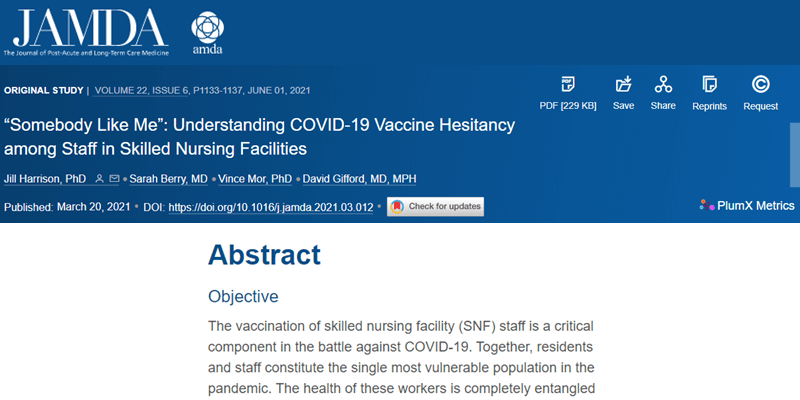
The IMPACT-C supplement award recently shared the results of their “town hall” style discussions with frontline nursing home staff in a journal article and podcast.

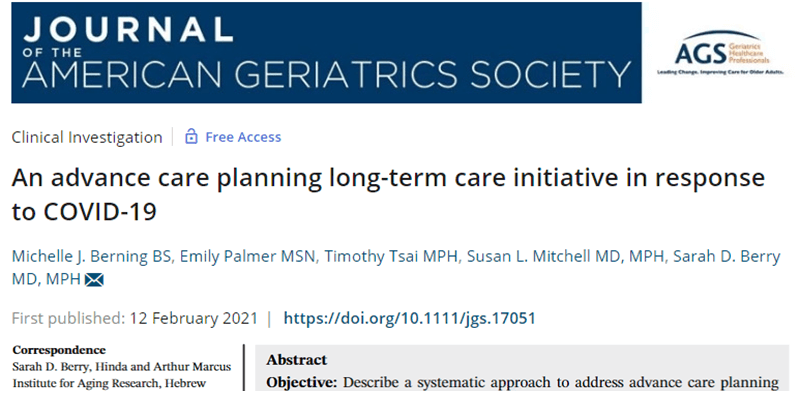
The findings were shared in the Journal of the American Geriatrics Society on March 25th. The study included one hundred and ninety three staff from 50 facilities who participated in 26 meetings between December 30, 2020 and January 15, 2021. Most staff reported getting information about the vaccine from friends or social media. Concerns about how rapidly the vaccines were developed and side effects, including infertility or pregnancy related concerns, were frequently raised. There were no differences in concerns raised by discipline. Questions about returning to prior activities after being vaccinated were common and offered the opportunity to build on positive emotions to reduce vaccine hesitancy.

IMPACT-C study team members Sarah Berry, Kimberly Johnson, and David Gifford also discussed the research on the March 25th GeriPal Podcast.  The podcast discussion was around the devastating impact of COVID on nursing homes and the effects and update rates of vaccine among patients and staff in nursing home.

Click here to read the full journal article.

Click here to listen to the podcast.
Podcast 14: Ethical challenges with pragmatic RCTs: General issues and special considerations in dementia

link to brody profileStuart Nicholls, PhD, from the Clinical Epidemiology Program at the Ottawa Hospital Research Institute, continues the discussion from his February 18 Grand Rounds presentation. This discussion with IMPACT Principal Investigator Susan Mitchell, MD, MPH answers questions from Dr. Nicholls's presentation on giving an overview of ethical issues raised by pragmatic randomized controlled trials (RCTs) and which derive from ongoing work to develop guidance for those designing and conducting pragmatic RCTs.


Want to hear more? View the full Grand Rounds presentation.

For alerts about new episodes, subscribe free on iTunes or SoundCloud.

IMPACT Collaboratory Funds Four Pilot Study Awards

The NIA IMPACT Collaboratory is happy to announce the recipients of its second cycle (2A) of the IMPACT Pilot Grant award program. Recipients were selected from an impressive group of competitive applications.

IMPACT Collaboratory Pilot Grant Award Recipients (RFA 2020)

Joan Carpenter, PhD, CRNP, University of Maryland School of Nursing

Implementation of a Telehealth Palliative Care Model for Persons with Dementia

Richard Fortinsky, PhD, University of Connecticut Health Center

Pilot Pragmatic Clinical Trial to Embed Tele-Savvy into Health Care Systems

Jennifer Gabbard, MD, Wake Forest School of Medicine

Using Telemedicine to Improve Engagement in Advance Care Planning in Patients with Cognitive Impairment or Unrecognized Dementia

Ariel Green, MD, MPH, PhD, Johns Hopkins University School of Medicine

ALIGN: Aligning Medications with What Matters Most

Additional details on these recipients and their pilot studies can be found on Pilot Grants Awardees Page at this link.

About the IMPACT Pilot Grant Program

The IMPACT Collaboratory funds several one-year pilot studies annually, which are meant to generate the preliminary data necessary to design and conduct future full-scale, stage 4 effectiveness ePCTs funded through other grant mechanisms. Awards are for single Principal Investigator applications for one year and are non-renewable. In response to the coronavirus disease (COVID-2019) outbreak, in this award cycle, the IMPACT Collaboratory prioritized applications proposing pilot ePCTs of telemedicine, telehealth, and remote technologies interventions aimed at improving the health care, unmet needs, quality of life, and/or health outcomes for people living with AD/ADRD and their care partners. The IMPACT Collaboratory encourages applications that address dementia care for people of all backgrounds and promote health equity.

Currently Accepting Applications for 2021 IMPACT Pilot Grant Program

Award applications for the current awards cycle opened February 1, 2021. The application process is a 2-step competitive process. The first step, a mandatory LOI, is due no later than Friday, March 5, 2021.  Selected investigators will be invited to submit a full application.

Ethical challenges with pragmatic RCTs: General issues and special considerations in dementia

February 2021 – In Grand Rounds 14, Dr. Nicholls provides an overview of ethical issues raised by pragmatic randomized controlled trials (RCTs), outlines challenges in conducting empirical studies of the published literature, and provides preliminary data on the reporting of key ethical issues in published pragmatic RCTs in AD/ADRD.

Speaker

Stuart G. Nicholls, PhD

Stuart G. Nicholls, PhD
Ottawa Health Research Institute

Watch the Webinar

Webinar Slides

Learning Objectives

  • Describe key ethical issues raised by pragmatic RCTs and which may be particularly salient to the ADRD context
  • Describe the challenges of identifying a sample of pragmatic RCTs from the literature
  • Describe the landscape of key ethical issues in published pragmatic RCTs in ADRD

IMPACT Collaboratory announces three new funding opportunities

The NIA IMPACT Collaboratory is pleased to announce three new funding opportunities; Pilot Grants Cycle 3A, and funding opportunities for two new programs, Demonstration Projects and Health Care Systems (HCS) Scholars . These three funding opportunities will support research and training aimed at increasing the nation’s capacity to conduct pragmatic clinical trials (ePCTs) of non-pharmacological interventions within health care systems to improve the care of people living with Alzheimer's disease and related dementias (AD/ADRD) and their care partners.

Demonstration Projects Program

The IMPACT Collaboratory will fund up to two Demonstration Projects (maximum duration 24 months) designed as full-scale, Stage IV effectiveness ePCT (based on the NIH Stage Model) that test non-pharmacological interventions for people living with AD/ADRD and their care partners embedded within and linked to the needs of a health care system. The goal of the Demonstration Projects is to generate evidence on effective care delivery practices that can be expanded and/or implemented in other systems. Interventions must be linked to the needs of a health care system. The intervention will typically encompass relatively simple system changes or direct patient outreach, or successfully piloted programs ready for testing at scale. Preference will be given to applications for Demonstration Projects that address dementia care for populations traditionally marginalized or underrepresented in clinical trials and those that promote health equity.

HCS Scholars Program

The new Health Care Systems (HCS) Embedded Research Scholars Program offers junior and senior investigators an opportunity to work directly with health care systems interested in improving the care provided to people living with dementia (PLWD) and their care partners. The goals of the HCS Scholars Program are to embed investigators in health care systems to:

  • Establish mutually beneficial partnerships to improve the care of PLWD and care partners
  • Train investigators about health care settings needs and how new programs are successfully introduced at all levels of the organization
  • Engage HCS in learning more about what it means to conduct ePCTs and provide resources for understanding opportunities for improvement in dementia care or evaluation of related quality improvement projects
  • Strengthen collaborations between investigators and HCS that may lead to pilot studies or demonstration projects.

Pilot Grant Program –Cycle 3A

The IMPACT Collaboratory funds several one-year pilot studies annually; these are meant to generate the preliminary data necessary to design and conduct a future full-scale Stage IV effectiveness ePCT (based on the NIH Stage Model) funded through other grant mechanisms (National Institutes of Health or other sources). The IMPACT Collaboratory will consider applications for pilot ePCTs that test non-pharmacological interventions embedded in health care system(s) for people living with AD/ADRD and their care partners. All applications should make a convincing case that the pilot ePCT proposed can be scaled up to a full-scale, Stage IV effectiveness ePCT as the next step.

Please check upcoming events for webinars for each opportunity, as well as the IMPACT Twitter feed and mailing list for additional updates.

Implementation in ongoing ADRD ePCTS in different health care settings using real examples

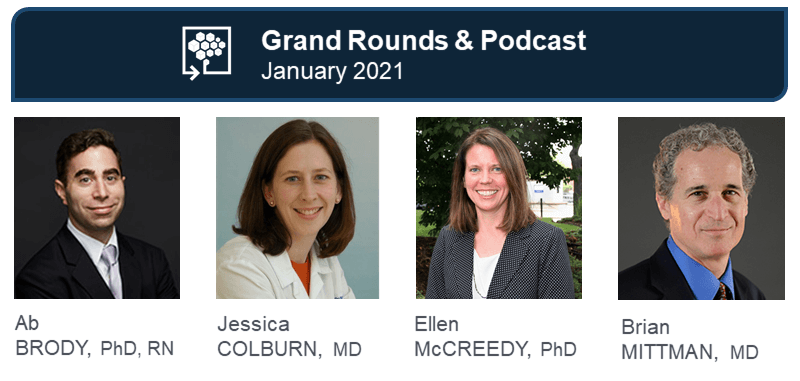
January 2021 – Ground Rounds 13, features Drs. Brody, McCreedy, and Colburn providing examples of ongoing implementation of ePCTs within health care systems for people with AD/ADRD followed by a response from Dr. Mittman, a prominent scientist with expertise in implementation of complex interventions in health care systems.

Webinar Slides

Webinar Recording

Ab Brody, PhD, RN, FAAN

Ab Brody, PhD, RN, FAAN

Core Leader, Pilot Studies Core
Member, Steering Committee

Associate Professor of Nursing and Medicine, New York University Rory Meyers College of Nursing
Associate Director, Hartford Institute for Geriatric Nursing
Founder, Aliviado Health

Ellen McCreedy, PhD, MPH

Ellen McCreedy, PhD, MPH

Executive Committee, Technical Data Core

Assistant Professor, Brown University School of Public Health

Jessica Colburn, MD

Jessica Colburn, MD

Johns Hopkins University School of Medicine

Implementation Workgroup Lead


Learning Objectives

  • Understand the implementation strategies used in 3 pragmatic clinical trials among persons living with dementia
  • Gain knowledge about implementation barriers and facilitators of complex interventions in pragmatic trials
  • Apply a novel framework to promote complex health intervention implementation in health care systems


Health Care Systems Core leaders discuss vision for the IMPACT Learning Health Network

The NIA IMPACT Health Care Systems Core recently launched its Learning Health Network, to connect health care practice and research for people living with dementia and their care partners. The Learning Health Network is a consortium of individuals, organized into 4 unique communities representing unique settings of care for people living with Alzheimer’s disease and related dementias and their care partners.  The goal is to bridge the gap between research and practice by facilitating relationship-building and information sharing between researchers and members of the various care settings.  The Learning Health Network is in its beginning phase, with current efforts aimed at building the 4 unique communities:

  • Long-term Care (nursing homes, assisted living, and other settings that provide around-the-clock care for persons living with dementia)
  • Healthcare Settings (Clinics, ACOs, MA Plans, Integrated Delivery Systems)
  • Hospitals/Emergency Departments
  • Community-based Organizations (Meals on Wheels, Hospice, Senior Centers, Adult Day Centers)

Health Care Systems Core Leaders Eric B. Larson, MD, MPH and  Leah Hanson, PhD are leading the efforts for the Learning Health Network, and recently shared their goals and vision for the network, describing the Learning Health Network as an opportunity to create a transformative and bi-directional relationship between stakeholders working to improve dementia care.

“The idea of a learning health network is foundational to health care systems,” said Larson. We need bi-directional communication, so that research informs practice, and practice informs research. It’s not just “we” educating “them”. We will educate each other about the settings and how we can work with them.”

Hanson recognized the importance of listening to each other as well. “If researchers are operating in a silo and conduct an amazing intervention and we roll out in real world, but it doesn’t work, then it doesn’t help,” she said. “We have to consider those factors in design of research studies. We believe this network is the way to bring people together.”

Larson and Hanson said they believe that groups like the Learning Health Network will prove to be especially helpful when dealing with crises like the COVID-19 pandemic.

“In our system, people are sharing and engaging with each other in ways they never have before,” said Hanson.  “We did a weekly call at our health care system when COVID first started, with large clinician engagement. People want to learn what is happening, and being set up to easily share information will help that process.”

Larson and Hanson said that their hope is that for a small investment of time, members of the Learning Health Network can gain access to thought leaders and experts while also educating researchers about how to improve care in real-world settings. Both core leaders recently presented with two other members of the Core for a Grand Rounds webinar and follow-up podcast about the Core and the Learning Health Network.

Goldfeld examines constrained randomization to evaulate the vaccine rollout in nursing homes

Keith Goldfeld, member of the Executive Committee of the IMPACT Design & Statistics Core (DSC), is part of the IMPACT Collaboratory study examining the rollout of COVID-19 vaccine in nursing homes. He recently authored a blog post describing the statistical approach to the study.

The effort involves a cluster randomized trial (CRT) to evaluate the effectiveness of a wide-ranging outreach program designed to encourage nursing home residents to get their shots. The focus is on facilities that have relatively high proportions of African-American and Latinx residents, because these facilities have been among the least successful in the past in convincing residents to get vaccinated. The outcome measure of the trial, which will be measured at the individual level, will be the probability of vaccination within 5 weeks of being available at the nursing home.

Read the full blog post at: https://www.rdatagen.net/post/2020-12-22-constrained-randomization-to-evaulate-the-vaccine-rollout-in-nursing-homes/