Ethical challenges with pragmatic RCTs: General issues and special considerations in dementia

February 2021 – In Grand Rounds 14, Dr. Nicholls provides an overview of ethical issues raised by pragmatic randomized controlled trials (RCTs), outlines challenges in conducting empirical studies of the published literature, and provides preliminary data on the reporting of key ethical issues in published pragmatic RCTs in AD/ADRD.

Speaker

Stuart G. Nicholls, PhD

Stuart G. Nicholls, PhD
Ottawa Health Research Institute

Watch the Webinar

Webinar Slides

Learning Objectives

  • Describe key ethical issues raised by pragmatic RCTs and which may be particularly salient to the ADRD context
  • Describe the challenges of identifying a sample of pragmatic RCTs from the literature
  • Describe the landscape of key ethical issues in published pragmatic RCTs in ADRD

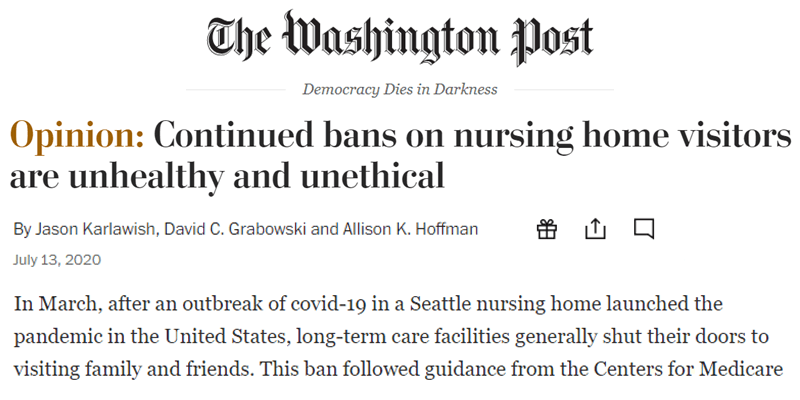
IMPACT Collaboratory featured in New York Times opinion piece on effects of COVID-19 on people living with dementia with quotes from Harrison, Karlawish, and Berry

The NIA IMPACT Collaboratory has been featured in a New York Times opinion piece about the effects of COVID-19 restrictions on people living with dementia and their caregivers. Jill Harrison, PhD, Executive Director of the IMPACT Collaboratory, and Jason Karlawish, MD, the leader of the Ethics & Regulation Core are quoted, as is Sarah Berry, MD, MPH, the multiple PI of IMPACT-C, a COVID-19 supplement to the IMPACT Collaboratory. Dr. Harrison’s quote “We are Going to Keep you Safe, Even if It Kills Your Spirit” serves as the title.

“Dr. Karlawish thinks that blanket bans on dementia caregivers are akin to taking away a wheelchair from a person with physical disabilities. ‘And that’s a brutal metaphor,’ he said. ‘But all of a sudden, the people who would come there and help their minds function were taken away.’ Some geriatricians describe this separation as unfortunate and damaging, but necessary. Others believe that we should have allowed for a gentler nursing home quarantine, one that recognizes caregivers as ‘essential’ parts of dementia health care.

Jill Harrison, an executive director of the National Institute on Aging’s IMPACT Collaboratory, thinks the instinct to lock everything down reflects a broader tendency in dementia care to prioritize physical safety above all else… ‘I always call it surplus safety,’ Dr. Harrison told me. ‘It’s essentially like, we are going to keep you safe, even if it kills your spirit.’”

Read the full piece here.

IMPACT Ethics and Regulation Core

The Ethics and Regulation Core (previously known as the Regulation and Ethics Core) focuses on clarifying the balance among the competing priorities of conducting ePCTs in people living with dementia (PLWD) and their care partners, protecting the interests of participants, and assuring health care systems that regulatory issues are addressed. Learn more about the core's work from Core Leader Jason Karlawish, MD.


The IMPACT Collaboratory Regulation and Ethics Core from NIA IMPACT Collaboratory on Vimeo.


Modifications and Waivers of Informed Consent in Pragmatic Clinical Trials

February 2020 – In Grand Rounds 4, Dr. Karlawish discusses waivers and alterations of written informed consent in pragmatic clinical trials (ePCTs). He provides two case studies of ePCTs to determine whether or not it is appropriate to permit a modification or a waiver of research informed consent.

Speaker

Jason Karlawish, MD

Jason Karlawish, MD
Core Leader, Ethics & Regulation Core

Professor of Medicine, Medical Ethics and Health Policy, and Neurology
Co-Director, Penn Memory Center, University of Pennsylvania

Learning Objectives

  • Identify how consideration of ethical and regulatory issues in the design phase of an ePCT with PLWD can help make the study more pragmatic.
  • Review the regulatory requirements for a waiver or alteration of informed consent and discuss related ethical considerations.
  • Apply what we’ve covered to two case studies.


Additional Resources

  • 45 CFR 46 – Protection of Human Subjects
  • Scott Kim and Frank Miller. “Waivers and alterations to consent in pragmatic clinical trials: Respecting the principle of respect for persons.” IRB: Ethics and Human Research. January-February 2016, Vol 38, issue 1.
  • January 31, 2008 SACHRP letter to HHS Secretary: Recommendations related to waiver of informed consent and interpretation of “minimal risk,” available at https://hhs.gov/ohrp/sachrp-committee/recommendations/2008-january-31-letter/index.html