

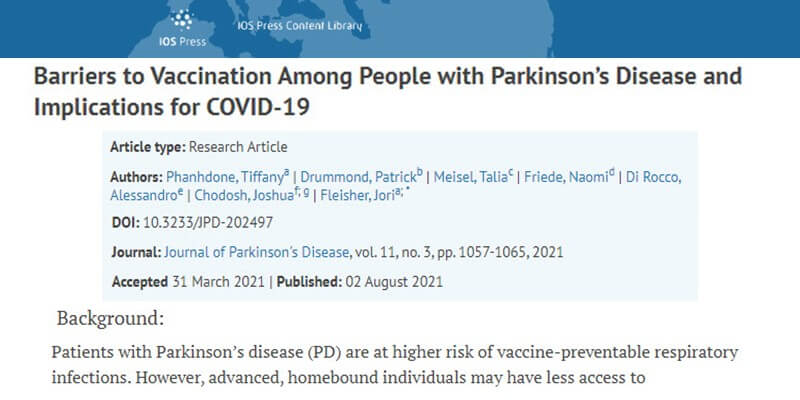
Barriers to Vaccination Among People with Parkinson’s Disease and Implications for COVID-19
August 2, 2021
The NIA IMPACT Collaboratory plans to publish a Request for Applications (RFA) for Pilot Grants on August 16, 2021 with Letters of Intent due September 17, 2021.
IMPACT funds several one-year awards of pilot pragmatic clinical trials (ePCTs) that test non-pharmacological interventions embedded in health care system(s) for people living with Alzheimer’s Disease (AD) and AD-related dementias (ADRD) and their care partners. Under this mechanism, interventions must be linked to the needs of a health care system. For more information, please see our Pilot Grants page.
All applications will be considered with priority given to applications for interventions in this population that aim to:
The goal of the pilot projects is to generate the preliminary data necessary to design and conduct a future full-scale Stage IV effectiveness ePCT (based on the NIH Stage Model). The IMPACT Collaboratory will give preference to applications that address dementia care for populations traditionally marginalized or underrepresented in clinical trials and those that promote health equity. It is anticipated that Pilot Projects will be funded for up to $175,000 in direct costs for a maximum of 12-months.
Stay tuned for updates regarding the release of the RFA, an informational webinar and application deadline. If you have questions related to this funding opportunity, please contact IMPACTcollaboratory@hsl.harvard.edu.
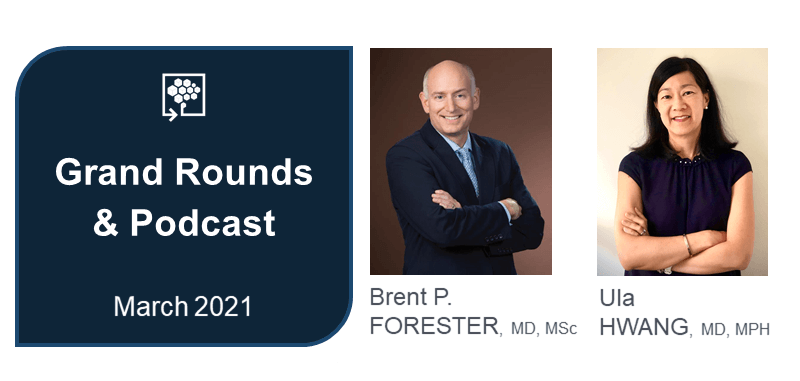
March 2021 – In Grand Rounds 15, Drs. Forester and Hwang share experiences as Pilot Cycle 1 awardees and provide updates to their funded pilot studies.
Brent P. Forester, MD, MSc on his pilot: Implementation of the Care Ecosystem training model for individuals with dementia in a high risk, integrated care management program
Ula Hwang, MD, MPH on her pilot: Pathway to Detection & Differentiation of Delirium & Dementia in the Emergency Department

Brent P. Forester, MD, MSc
Chief, Center of Excellence in Geriatric Psychiatry, McLean Hospital Medical
Director, Behavioral Health Integration, Quality, and Patient Experience, Mass General Brigham

Ula Hwang, MD, MPH
Professor, Vice Chair for Research, Department of Emergency Medicine
Yale School of Medicine
Dr. Forester:
Dr. Hwang:
The NIA IMPACT Collaboratory is happy to announce the recipients of its second cycle (2A) of the IMPACT Pilot Grant award program. Recipients were selected from an impressive group of competitive applications.
Joan Carpenter, PhD, CRNP, University of Maryland School of Nursing
Implementation of a Telehealth Palliative Care Model for Persons with Dementia
Richard Fortinsky, PhD, University of Connecticut Health Center
Pilot Pragmatic Clinical Trial to Embed Tele-Savvy into Health Care Systems
Jennifer Gabbard, MD, Wake Forest School of Medicine
Using Telemedicine to Improve Engagement in Advance Care Planning in Patients with Cognitive Impairment or Unrecognized Dementia
Ariel Green, MD, MPH, PhD, Johns Hopkins University School of Medicine
ALIGN: Aligning Medications with What Matters Most
Additional details on these recipients and their pilot studies can be found on Pilot Grants Awardees Page at this link.
The IMPACT Collaboratory funds several one-year pilot studies annually, which are meant to generate the preliminary data necessary to design and conduct future full-scale, stage 4 effectiveness ePCTs funded through other grant mechanisms. Awards are for single Principal Investigator applications for one year and are non-renewable. In response to the coronavirus disease (COVID-2019) outbreak, in this award cycle, the IMPACT Collaboratory prioritized applications proposing pilot ePCTs of telemedicine, telehealth, and remote technologies interventions aimed at improving the health care, unmet needs, quality of life, and/or health outcomes for people living with AD/ADRD and their care partners. The IMPACT Collaboratory encourages applications that address dementia care for people of all backgrounds and promote health equity.
Award applications for the current awards cycle opened February 1, 2021. The application process is a 2-step competitive process. The first step, a mandatory LOI, is due no later than Friday, March 5, 2021. Selected investigators will be invited to submit a full application.
The NIA IMPACT Collaboratory is pleased to announce three new funding opportunities; Pilot Grants Cycle 3A, and funding opportunities for two new programs, Demonstration Projects and Health Care Systems (HCS) Scholars . These three funding opportunities will support research and training aimed at increasing the nation’s capacity to conduct pragmatic clinical trials (ePCTs) of non-pharmacological interventions within health care systems to improve the care of people living with Alzheimer's disease and related dementias (AD/ADRD) and their care partners.
The IMPACT Collaboratory will fund up to two Demonstration Projects (maximum duration 24 months) designed as full-scale, Stage IV effectiveness ePCT (based on the NIH Stage Model) that test non-pharmacological interventions for people living with AD/ADRD and their care partners embedded within and linked to the needs of a health care system. The goal of the Demonstration Projects is to generate evidence on effective care delivery practices that can be expanded and/or implemented in other systems. Interventions must be linked to the needs of a health care system. The intervention will typically encompass relatively simple system changes or direct patient outreach, or successfully piloted programs ready for testing at scale. Preference will be given to applications for Demonstration Projects that address dementia care for populations traditionally marginalized or underrepresented in clinical trials and those that promote health equity.
The new Health Care Systems (HCS) Embedded Research Scholars Program offers junior and senior investigators an opportunity to work directly with health care systems interested in improving the care provided to people living with dementia (PLWD) and their care partners. The goals of the HCS Scholars Program are to embed investigators in health care systems to:
The IMPACT Collaboratory funds several one-year pilot studies annually; these are meant to generate the preliminary data necessary to design and conduct a future full-scale Stage IV effectiveness ePCT (based on the NIH Stage Model) funded through other grant mechanisms (National Institutes of Health or other sources). The IMPACT Collaboratory will consider applications for pilot ePCTs that test non-pharmacological interventions embedded in health care system(s) for people living with AD/ADRD and their care partners. All applications should make a convincing case that the pilot ePCT proposed can be scaled up to a full-scale, Stage IV effectiveness ePCT as the next step.
Please check upcoming events for webinars for each opportunity, as well as the IMPACT Twitter feed and mailing list for additional updates.
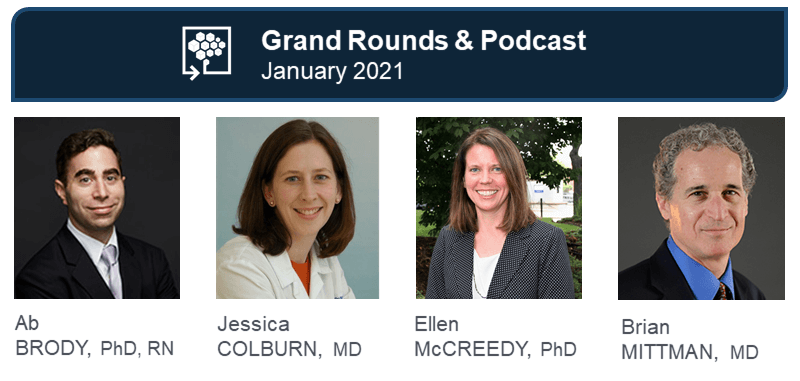
January 2021 – Ground Rounds 13, features Drs. Brody, McCreedy, and Colburn providing examples of ongoing implementation of ePCTs within health care systems for people with AD/ADRD followed by a response from Dr. Mittman, a prominent scientist with expertise in implementation of complex interventions in health care systems.
The National Institute on Aging (NIA) IMbedded Pragmatic Alzheimer’s disease (AD) and AD-Related Dementias (AD/ADRD) Clinical Trials (IMPACT) Collaboratory has released a new funding opportunity available for investigators interested in developing embedded pragmatic clinical trials (ePCTs) in dementia research.
Detailed information about the program as well as timelines, eligibility, and other requirements are provided below and in the request for applications (RFAs). Updates will be posted to IMPACT Pilot Grant Program webpage.
Pilot Grant Program RFA Cycle 2B
The IMPACT Collaboratory is soliciting letters of intent for several 1-year pilot awards for up to $175,000 in direct costs. The goal of these awards is to support pilot studies to generate the preliminary data necessary to design and conduct future full-scale ePCTs of non-pharmacologic interventions in health care systems for people living with AD/ADRD and/or their care partners. The mandatory letter of intent is due September 18, 2020.
The IMPACT Collaboratory will consider applications for pilot ePCTs testing non-pharmacological interventions in people living with AD/ADRD and their care partners. In this grant cycle, the IMPACT Collaboratory will consider all applications that propose pilot ePCTs for people living with AD/ADRD and their care partners but will prioritize those in the following areas:
The IMPACT Collaboratory will fund up to five 1-year, non-renewable pilot grant awards for up to $175,000 in direct costs. Letters of intent are required and due September 18, 2020. Full proposal applications are by invitation only and will be due January 8, 2021. For further details, please see the on the IMPACT Pilot Grant Program webpage.
Two optional informational webinars will provide investigators with an overview of application details and support that the IMPACT Collaboratory can provide to assist with proposal development (e.g., trial design, measurement, data extraction, etc.). Investigators will have the opportunity to ask questions. Pre-registration is required using the links below.
Registrants will receive a confirmation email containing information to join the webinar.
The IMPACT Collaboratory encourages all eligible researchers to take advantage of this important funding opportunity, which has the potential to advance care for people living with dementia and/or their care partners in real-world settings. For more information about the IMPACT Collaboratory, please visit impactcollaboratory.org.
The NIA IMPACT Collaboratory is supported through funding from the National Institute on Aging (U54AG063546).
May 11, 2020
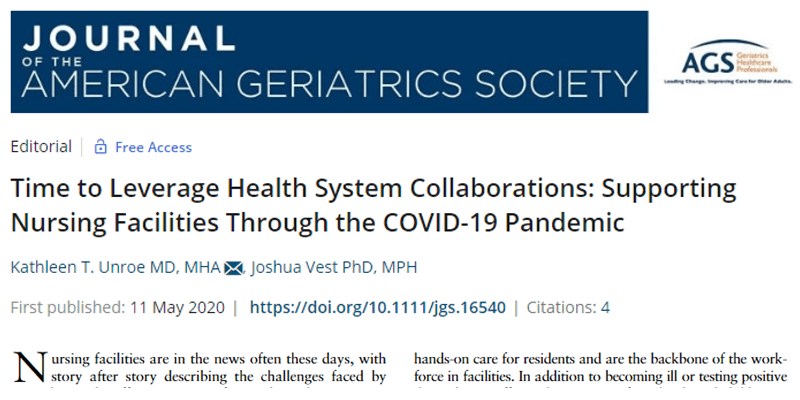
 Kathleen Unroe, MD, MHA from the IMPACT Pilot Studies Core recently co-authored an editorial published in the Journal of the American Geriatrics Society. In it, they stated the benefits of collaboration between health systems and nursing facilities.
The editorial, "Time to Leverage Health System Collaborations: Supporting Nursing Facilities Through the COVID-19 Pandemic," was written in response to a paper published by a research team from the University of Washington. Dr. Unroe and her colleague Joshua Vest, PhD, MPH praise the work, which leveraged an existing university health system infrastructure to provide solutions and support to nursing homes during the outbreak. They believe the University of Washington's model demonstrates what is possible when investments are made in partnerships.
Read more about Dr. Unroe's editorial here.
The National Institute on Aging (NIA) Imbedded Pragmatic Alzheimer’s Disease (AD) and AD-Related Dementias (AD/ADRD) Clinical Trials (IMPACT) Collaboratory is happy to announce the recipients of its inaugural cycle of the IMPACT Pilot Grant award program. Recipients were selected from an impressive group of competitive applications.
Brent Forester, MD, MSc, Mass General Brigham
Implementation of the Care Ecosystem training model for individuals with dementia in a high risk, integrated care management program
Ula Hwang, MD, MPH, Icahn School of Medicine at Mount Sinai
Pathway to Detection & Differentiation of Delirium & Dementia in the Emergency Department
The IMPACT Collaboratory was established in 2019 to meet the urgent public health need to deliver high quality, evidence-based care to people living with dementia (PLWD) and their care partners within the healthcare systems (HCS) that serve them. The IMPACT Collaboratory accomplishes this mission by building the nation’s capacity to conduct embedded pragmatic clinical trials (ePCTs) among people living with dementia and their care partners through building investigator capacity, funding and supporting the design and conduct of ePCTs, and ensuring the research includes culturally-tailored interventions and people from diverse and under-represented backgrounds.
The IMPACT Collaboratory brings together multidisciplinary experts from across the nation organized into 10 Working Cores Groups and Teams. The cores and teams partner with health care system leaders and key stakeholders to support the IMPACT mission. The IMPACT Collaboratory hosts monthly Grand Rounds and podcasts open to everyone to provide insight into conducting ePCTs for PLWD and their care partners. Learn more on our website, Twitter and LinkedIn.
The IMPACT Collaboratory funds several one-year pilot studies annually, which are meant to generate the preliminary data necessary to design and conduct future full-scale, stage 4 effectiveness ePCTs funded through other grant mechanisms. Awards are for single Principal Investigator applications for one year and are non-renewable. The IMPACT Collaboratory encourages applications that address dementia care for people of all backgrounds and promote health equity.
Award applications for the current awards cycle opened April 28, 2020. The application process is a 2-step competitive process. The first step, a mandatory LOI, is due no later than May 29, 2020. Selected investigators will be invited to submit a full application.
In response to the coronavirus disease (COVID-2019) outbreak, in this award cycle, the IMPACT Collaboratory will prioritize applications proposing pilot ePCTs of telemedicine, telehealth, and remote technologies interventions aimed at improving the health care, unmet needs, quality of life and/or health outcomes for people living with AD/ADRD and their care partners. Applications for pilot ePCTs testing other types of non-pharmacological interventions in this population will also be considered.
Please join our mailing list to receive news and invitations to events and Grand Rounds.
The National Institute on Aging (NIA) IMbedded Pragmatic Alzheimer’s disease (AD) and AD-Related Dementias (AD/ADRD) Clinical Trials (IMPACT) Collaboratory has released two new funding opportunities available for investigators interested in developing embedded pragmatic clinical trials in dementia research. In support of our mission, the IMPACT Collaboratory is requesting applications for the Pilot Grant Award and Career Development Award (CDA) Programs.
Pilot Grant Awards are 1-year non-renewable awards to generate the preliminary data necessary to design and conduct future full-scale embedded pragmatic clinical trials (ePCTs) of non-pharmacological interventions in healthcare systems for people living with AD/ADRD and/or their care partners.
Career Development Awards are 2-year mentored research awards to support the development of early-stage MD, PhD, or equivalent researchers who seek careers conducting ePCTs for people living with AD/ADRD and/or their care partners.
The IMPACT Collaboratory will hold informational webinars for each grant program in the coming weeks. Detailed information about these programs as well as timelines, eligibility, and other requirements are provided below and in the request for applications (RFAs). Updates will be posted to impactcollaboratory.org.
The IMPACT Collaboratory will fund up to five 1-year non-renewable pilot grant awards for up to $175,000 in direct costs. Letters of intent are required and due May 29, 2020. Full proposal applications are by invitation only and will be due September 4, 2020. For further details, please see the on the IMPACT Pilot Grant Program webpage.
In response to the coronavirus disease (COVID-2019) outbreak, the IMPACT Collaboratory will prioritize applications proposing pilot ePCTs of telemedicine, telehealth, and remote technologies interventions aimed at improving health care, unmet needs, quality of life and/or health outcomes for people living with dementia and/or their care partners for this award cycle. Applications for pilot ePCTs testing other types of non-pharmacological interventions in this population will also be considered.
Two optional informational webinars will be held to provide additional information and answer questions from potential applicants. Registration is required and can be completed through the links below:
Registrants will receive a confirmation email containing information to join the webinar.
Career Development Award (CDA) RFA
The IMPACT Collaboratory will fund two to three, 2-year Career Development Awards (CDAs) to support the development of early-stage MD, PhD, or equivalent researchers who seek careers conducting embedded pragmatic clinical trials (ePCTs) for people living with dementia and their care partners. CDAs provide support for up to $100,000 per year in direct costs and candidates are required to devote a minimum of 75% effort toward the goals of the CDA. The IMPACT Collaboratory will prioritize applications that address dementia care for people of all backgrounds and promote health equity.
Full Applications are due July 15, 2020. There is no letter of intent. For further details, go to the IMPACT CDA Program webpage.
Two optional informational webinars will be held to provide additional information and answer questions from potential applicants. Registration is required and can be completed through the links below:
Registrants will receive a confirmation email containing information to join the webinar.
The IMPACT Collaboratory encourages all eligible researchers to take advantage these important funding opportunities, which have the potential to advance care for people living with dementia and/or their care partners in real-world settings. For more information about the IMPACT Collaboratory, please visit impactcollaboratory.org.
The NIA IMPACT Collaboratory is supported through funding from the National Institute on Aging (U54AG063546).