

Stakeholder Perspectives: Engaging and Working Effectively with Individuals Living with Dementia as Stakeholder Advisors and Research Partners

September 28, 2021

Louise Phillips (Left) and Brenda Nicholson (Right)

Members of the Executive Committee for the IMPACT Engaging Partners Team have collaborated to create a guide for researchers seeking stakeholder advisors living with dementia.

Brenda Nicholson, MD , and Louise Phillips, MD, MBA, are retired physicians who are living with dementia. Both have participated as stakeholder advisors and research partners for important research-related initiatives on dementia care and services. They collaborated with Katie Maslow, MSW, to create the perspective piece entitled, Engaging and Working Effectively with Individuals Living with Dementia as Stakeholder Advisors and Research Partners.

Dr. Nicholson and Dr. Phillips provided three reasons why they participate as stakeholder advisors and research partners in dementia care research:

  • They hope to encourage more research on topics that are important and relevant for the well-being of people living with dementia and their families
  • They hope their participation will help convince researchers that it is valuable to include people living with dementia as research partners in their dementia care studies; so, in a sense, to “break through the glass ceiling” in this research area
  • They hope their involvement as research partners will be a clear and present reminder to research team members of the real human needs of people living with dementia, which are sometimes lost in the strong focus on research procedures and challenges.

Dr. Nicholson and Dr. Phillips drew on their own experiences to offer tips to researchers, but also emphasized that each person living with dementia has their own unique needs and circumstances to consider. Their tips suggest the importance of considering the needs of stakeholder advisors throughout the engagement process; from planning the meeting format and time commitment, through post-meeting follow-up.  They stress the importance of providing multiple opportunities for advisors to share their ideas and have their voices heard. The full perspective piece can be found at this link.
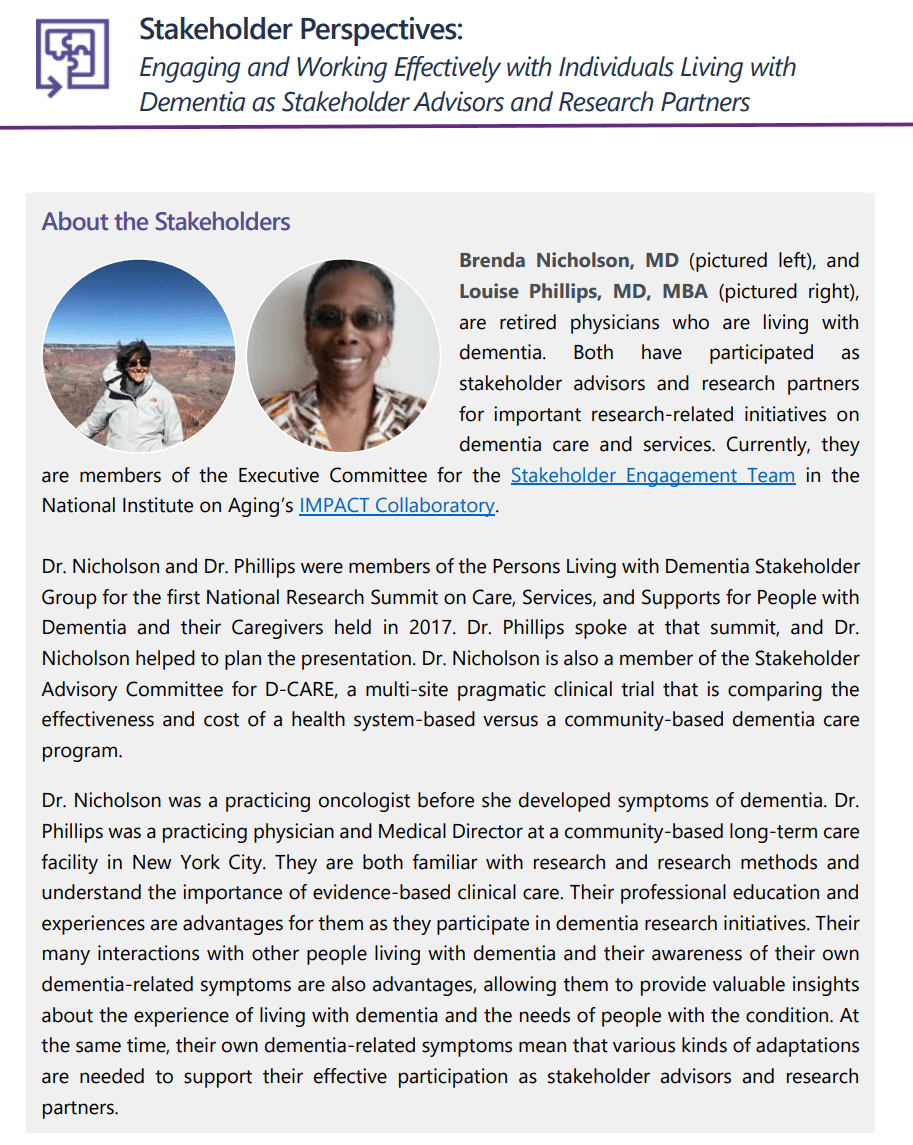
Citation: Stakeholder Perspectives: Engaging and Working Effectively with Individuals Living with Dementia as Stakeholder Advisors and Research Partners. NIA IMPACT Collaboratory; 2021. doi: doi.org/10.58234/32478403
Click to view Stakeholder Perspectives

Challenges Implementing Innovative Programs in Long Term Care: Examples from Pragmatic Trials

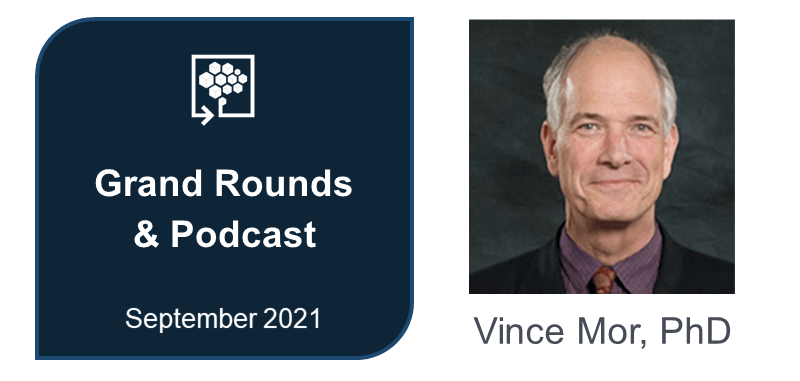
September 2021 – In Grand Rounds 19, Dr. Mor discusses the complexities of making changes in health care systems through four examples of embedded pragmatic clinical trials.


Speaker

Vincent Mor, PhD

Vincent Mor, PhD
Florence Grant Pirce Professor of Community Health
Brown University School of Public Health

                     Download Webinar Slides

Learning Objectives

  • Understand the complexities of Making Changes in Health Care Systems
  • Understand the kinds of Implementation Challenges that arise in conducting ePCTs in nursing homes
  • Understand the Implications of how difficult it is to Change Care Practices to improve Dementia care

Results from TRAIN-AD study published in JAMA Internal Medicine

A study team led by IMPACT’s Multiple Principal Investigator Susan Mitchell, PhD, MPH recently published results of a Trial to Reduce Antimicrobial Use in Nursing Home Residents with Alzheimer’s Disease and Other Dementias (TRAIN-AD).   The journal article and an accompanying editorial were published in JAMA Internal Medicine on July 12th.

Mitchell and colleagues conducted a cluster randomized clinical trial of a multicomponent intervention designed to improve management of suspected urinary tract infections (UTIs) and lower respiratory infections (LRIs) for nursing home residents with advanced dementia.  The trial was conducted at 28 Boston-area nursing homes (14 per arm).  The intervention, which targeted nursing home care providers, integrated best practices from infection diseases and palliative care for management of suspected UTIs and LRIs in residents with advanced dementia. Researchers observed a clinically significant 33% reduction in antimicrobial courses for suspected lower respiratory infections (LRIs) and urinary tract infections (UTIs) among participants living in facilities assigned to the intervention. Although this result was underpowered to show a statistically significant reduction, the TRAIN-AD study was unique in that it completed a rigorous evaluation of an intervention to reduce antibiotics in people with advanced dementia.

The study team found that despite a comprehensive training approach that included an in-person seminar, online course, management algorithms, communication tips, and feedback reports and a high adherence to the training, the intervention did not significantly reduce antimicrobial use among nursing home residents with advanced dementia. However, both Mitchell’s team and the commentary authors noted the potential of the intervention to yield more significant results when scaled up and applied to a broader range of nursing home settings.

The study results were accompanied by an invited commentary from Shiwei Zhou, MD and Pretti N. Malani, MD, noting these strengths and describing the study as a “a low-cost, low risk, scalable intervention that is associated with a reduction in inappropriate antibiotic prescriptions is worthy of replication” from a stewardship perspective.

Read the full article here and commentary here.

Citation: Mitchell SL, D’Agata EMC, Hanson LC, et al. The trial to reduce antimicrobial use in nursing home residents with Alzheimer disease and other dementias (TRAIN-AD): a cluster randomized clinical trial. JAMA Intern Med. Published online July 12, 2021. doi:10.1001/jamainternmed.2021.3098

Mor and team share results of IMPACT supplement award study evaluating impact of SARS-CoV-2 vaccine among nursing home residents

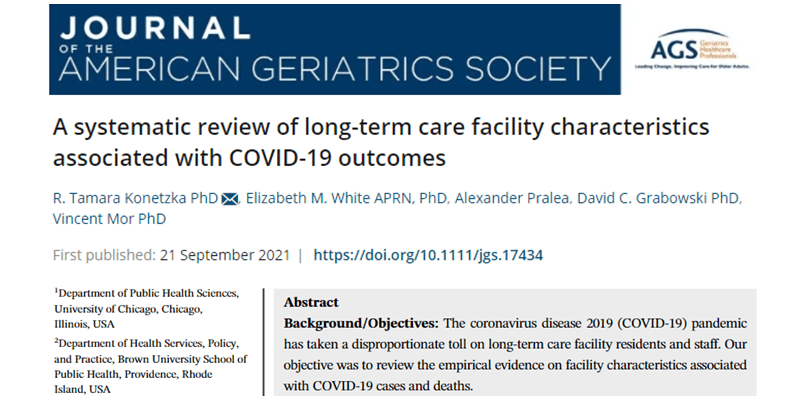
Vince Mor, PhD, one of IMPACT Collaboratory’s two Principal Investigators, and team recently shared results from their investigation into the impact of SARS-CoV-2 vaccine among nursing home residents from 280 nursing homes in 21 states.  Results were published in the Journal of the American Geriatrics Society on April 16th.

Researchers partnered with Genesis Healthcare, the largest long-term care provider in the country, for the study, which was a supplement award through the IMPACT Collaboratory.  They monitored the impact of the SARS-CoV-2 vaccine rollout among nursing home residents in 280 nursing homes within 21 states.  Both the Moderna and Pfizer-BioNTech vaccines were included in the study. Researchers created two groups of participating facilities based on the date of their initial vaccine clinic and conducted a matched pair analysis of outcomes.

One week after their initial vaccine clinics, nursing homes with earlier clinics had 2.5 fewer new SARS‐CoV‐2 infections per 100 at‐risk residents than expected based on the experiences of matched facilities with later clinics. Cumulatively over 7 weeks, earlier vaccinated facilities had 5.2 fewer infections per 100 at‐risk residents and 5 fewer hospitalizations and/or deaths per 100 infected residents than expected without vaccinations. These results indicate that the vaccine led to a reduction in incident infections, morbidity, and mortality in this large multi-state nursing home population.

The researchers also suggested the findings support efforts to begin resuming family visitation and lessen other restrictions in nursing homes.

Read the full article at this link.

Vince Mor Featured in New JHF Documentary on ‘What COVID-19 Exposed in Long-Term Care’

IMPACT Principal Investigator Vince Mor, PhD is among the experts interviewed for a new documentary from the Jewish Healthcare Foundation (JHF) which explores the reasons theCOVID-19 pandemic has so severely impacted long-term care (LTC) and nursing facilities across the United States. What COVID-19 Exposed in Long-Term Care analyzes the challenges LTC facilities have faced since the pandemic swept the world early this year, including the blame placed on individual long term care facilities and front-line healthcare workers amidst so many systemic shortcomings.

The 20-minute documentary features commentary from public health professionals from across the United States, including Mor. Public health officials interviewed in the documentary attribute the virus’s severe impact on LTC facilities to the vulnerable health of the residents coupled with years of inadequate funding, lack of infection management resources, and the limited response from health systems and public health authorities.

Increased understanding about how this virus and pandemic impacts LTC facilities, underscore the importance for researchers and healthcare workers to find long-term solutions to the disparities that impact this population. Watch the documentary here to learn more about how this public health crisis is affecting older populations and LTC facilities, and how to help find solutions for the inequities within these populations.