
Evaluation of a State-wide Effort to Improve COVID-19 Infection Control in Massachusetts Nursing Homes

Principal Investigator
Lewis Lipsitz, MD Marcus Institute for Aging Research, Hebrew SeniorLife


It is important to evaluate the state-wide effort to reduce COVID-19 infections in MA nursing homes to determine what worked and in whom, so it can serve as a model for other states tackling this disease.


Lewis Lipsitz, MD is the Director of the Hinda and Arthur Marcus Institute for Aging Research at Hebrew SeniorLife, Chief of the Division of Gerontology at Beth Israel Deaconess Medical Center (BIDMC), and Professor of Medicine at HMS. His research is focused on age-related alterations in blood pressure and cerebral blood flow regulation and their relation to falls, syncope, and cognitive dysfunction. Dr. Lipsitz has served as Principal Investigator of an NIA-funded Program Project Grant for 26 years, an Older American Independence Center Grant for 15 years, and a Hartford Foundation Center of Excellence in Geriatric Medicine for 15 years. In these roles he has assembled multidisciplinary teams from multiple academic institutions and laboratories to study the mechanisms and management of several important clinical geriatric syndromes, including falls, syncope, dementia, delirium, and frailty. He is was Principal Investigator of an NIA Merit Award to study the physiologic mechanisms of frailty in old age, which led to his current NIA-funded clinical trial that examines the effect of Tai Chi exercises on physical function and health care costs in frail elderly residents of subsidized senior housing facilities. He is also Principal Investigator of an R01 from the NIA to study cerebrovascular mechanisms of falls. His recent translational research includes demonstrations that Tai Chi exercise can improve physical function and balance control in frail elderly people, vibrating insoles based on the principal of stochastic resonance can improve gait and balance in older people, and the treatment of hypertension with ACE inhibitors can improve cerebral blood flow and executive function.


RATIONALE: In April 2020, Massachusetts’ (MA) nursing homes (NH) became a national hotspot for COVID-19 infections with over 10,000 confirmed cases. More than half of the state’s COVID-19 deaths occurred among residents and staff of these facilities, particularly residents with Alzheimer’s disease and related dementias (ADRD). MA made $130 million of funding available for 2 months to NHs to improve infection control contingent on compliance with a new set of care criteria.

OBJECTIVE: Evaluate strategies to minimize spread of COVID-19 among older adults and their care providers within NHs, including mandatory testing of all residents and staff, a 28-point infection control check-list, and adherence to personal protective equipment (PPE) and resident cohorting requirements.

SETTING: NH facilities across Massachusetts compared to those in Connecticut, Rhode Island, New Hampshire, and Vermont.

POPULATION: All NH residents, including older adults with ADRD and/or Black race who are at greatest risk of morbidity and mortality from COVID-19.

DESIGN: Descriptive study using merged data from 4 MA NH audits (inspections); data sent by all MA NHs to the Massachusetts Center for Health Information Analysis (CHIA) regarding COVID infection rates, mortality, staffing, PPE, and hospitalizations; CHIA data on COVID-19 test results; and MDS data provided by Brown University's Gerontology Center. Compare rates of COVID-19 positive residents between NHs in Mass and other New England state settings stratified by the cumulative prevalence of SARS-CoV-2 in the area in which each facility is located, and by the facility distributions of ADRD diagnoses or Black race.

OUTCOMES: Primary outcomes will include changes in the weekly rates of new COVID-19 cases among facility residents and staff, and resident mortality rates associated with the infection over the 2-month intervention period.

IMPACT: The information garnered from this robust state-wide effort to manage COVID-19 in MA NHs could serve as a model for other states and health care systems. We will disseminate the MA experience through various modalities and national organizations, and ultimately leverage what is learned to help protect the millions of American nursing home residents, including those most vulnerable with ADRD and Black race.
Improved Vaccine Uptake in Skilled Nursing Facilities: IMPACT-C


Sarah Berry, MD, MPH
Marcus Institute for Aging Research, Hebrew SeniorLife

Vince Mor, PhD
Brown University School of Public Health

IMPACT-C will establish the infrastructure and expertise to develop and evaluate SARS-CoV-2 vaccination strategies for SNFs that are compassionate and culturally sensitive, but at the same time, are nimble enough to respond to rapid advances in testing modalities and vaccine development.


Sarah Berry, MD, MPH, is a geriatrician and clinical researcher with expertise in falls and fractures, particularly in frail older adults. Her current funding includes an NIA award to conduct a large, observational study to determine the safest drugs to treat older adults with hypertension and diabetes. She is presently involved in several clinical trials including a pilot study to develop and implement an effective program to prevent injurious falls in the nursing home, a pragmatic trial of a multipronged intervention to improve COVID-19 vaccine uptake among nursing home residents and staff, and a multisite clinical trial of testosterone and exercise in older women following a hip fracture.

Vincent Mor, PhD, is a professor of health services, policy & practice and Florence Pirce Grant Professor in the Brown University School of Public Health, and has been principal investigator of 40+ NIH-funded grants focusing on use of health services and outcomes of frail and chronically ill people. He has evaluated the impact of programs and policies including Medicare funding of hospice, changes in Medicare nursing home payment, and the introduction of nursing home quality measures. He co-authored the Congressionally-mandated Minimum Data Set (MDS) and was architect of an integrated Medicare claims and clinical assessment data structure used for policy analysis, pharmaco-epidemiology and population outcome measurement. Dr. Mor developed summary measures using MDS data to characterize residents’ physical, cognitive and psycho-social functioning. These data resources are the heart of Dr. Mor’s NIA- funded Program Project Grant, “Changing Long Term Care in America,” which examines the impact of Medicaid and Medicare policies on long-term care. These data are also at the core of a series of large, pragmatic cluster randomized trials of novel nursing home-based interventions led by Dr. Mor.


RATIONALE: COVID-19 has disproportionately affected skilled nursing facilities’ (SNF) residents and workers, and is the biggest challenge U.S. SNFs have faced in decades. COVID-19 has magnified long-standing health disparities in the quality and outcomes of care among minority SNF residents. Equitable, universal testing and vaccination strategies that include SNF residents and workers is essential to containing viral spread in this setting.

OBJECTIVE: Our goal is to leverage the foundation of the NIA IMPACT Collaboratory to establish IMPACT-COVID-19 (IMPACT-C), which will be dedicated to developing and evaluating SARS-CoV-2 testing and vaccination strategies among highly vulnerable SNF residents and workers.

AIMS: 1) Describe disparities in SARS-CoV-2 testing, and identify resident, facility and policy characteristics associated with COVID-19 outbreaks and outcomes; 2) Engage key stakeholders to develop culturally sensitive SARS-CoV-2 testing and vaccination strategies; and 3) Design and conduct a cluster randomized clinical trial (RCT) of a “high touch” SARS-CoV-2 vaccination intervention embedded in SNF heath systems.

POPULATION: SNF residents and healthcare workers.

DESIGN: The organizational, administrative, and expertise components for IMPACT-C will include: leadership, regulatory structures, dissemination, and investigators. We will leverage IMPACT Collaboratory’s Data Sharing Collaborative that includes 11 national companies with >1,000 SNFs. We have established the infrastructure to securely and regularly receive daily EMR and COVID-19 data from this consortium and link it to Medicare claims and Minimum Data Set assessments. Using this rich and representative database, we will conduct a series of models to inform policies on SARS-CoV-2 testing and vaccination and to forecast outbreaks. We have additionally designed a cluster RCT of ~160 facilities to compare the effect of a “high touch” vaccination intervention versus enhanced usual care on the uptake COVID-19 vaccinations among residents and staff. Data will be shared with the RADx-UP Coordination and Data Collection Center.

OUTCOMES: Leverage IMPACT’s resources to develop a diverse and engaged group of stakeholders who will identify barriers to SARS-CoV-2 testing and vaccination in SNFs, develop solutions, and inform the development of future  vaccination strategies to be evaluated in a cluster RCT.

IMPACT: IMPACT-C will establish the infrastructure and expertise to develop and evaluate SARS-CoV-2 testing and vaccination strategies for SNFs that are compassionate and culturally sensitive, but at the same time, are nimble enough to respond to rapid advances in testing modalities and vaccine development. Ultimately, IMPACT-C will be well-poised to inform future vaccination strategies across SNFs aimed at equitable uptake for residents and staff.

IMPACT Collaboratory funds two career development awards

The National Institute on Aging (NIA) Imbedded Pragmatic AD/ADRD Clinical Trials (IMPACT) Collaboratory is pleased to announce the recipients of its inaugural cycle of the IMPACT Career Development Award Program. Recipients were selected from an impressive group of competitive applications.

2020 IMPACT Career Development Award Recipients

Jennifer Gabbard, MD, Wake Forest School of Medicine
Use of a dementia-specific portal-based tool for advance care planning engagement

Tina Sadarangani, PhD, RN, ANP-BC, GNP-BC, NYU Rory Meyers College of Nursing
Leveraging mHealth to reduce avoidable utilization by people with dementia in day centers

About the NIA IMPACT Career Development Award Program

NIA IMPACT Collaboratory funds two to three career development awards annually. These career development awards will support the development of early-stage MD, PhD, or equivalent researchers who seek careers conducting ePCTs for people living with AD/ADRD and their care partners. The IMPACT Collaboratory prioritizes applications that address dementia care for people of all backgrounds and promote health equity.

Conducting ePCTs in AD/ADRD within healthcare systems requires unique research skills, yet the field is relatively nascent. The number of investigators capable of rigorously designing and executing ePCTs in partnership with healthcare systems and other key stakeholders remains limited, and those that have intersecting expertise in AD/ADRD populations are even fewer. Thus, the career development award advances the IMPACT Collaboratory’s mission to build the nation’s capacity to conduct impactful ePCTs in AD/ADRD by training a workforce of investigators prepared to carry on this work well into the future.

Please join our mailing list to receive news and invitations to IMPACT events, Grand Rounds, and pragmatic trials training modules.

Learn more about the IMPACT Collaboratory on our website, Twitter and LinkedIn.

Jennifer Gabbard, MD

Wake Forest School of Medicine

Use of a Dementia-Specific Portal-Based Tool for Advance Care Planning Engagement

Dr. Gabbard is an assistant professor in the Department of Internal Medicine. She is triple boarded in Internal Medicine, Geriatrics, and Hospice and Palliative Medicine. She trained at the University of Arizona and then completed a clinician-educator fellowship at Johns Hopkins University. Her clinical interests include integration of early palliative care in patients with serious illnesses, clinical care of comorbid chronically ill and frail older adults, and promotion of healthy aging. These interests translate into both educational and research settings. Dr. Gabbard serves as the Palliative Care Research Director and Associate Program Director of the Hospice and Palliative Medicine Fellowship Program at Wake Forest School of Medicine. She is a physician-scholar and educator seeking to develop her strong interests in implementation science, clinical informatics, and pragmatic clinical trial design.

People living with dementia and those with cognitive frailty (i.e., mild cognitive impairment plus frailty) often experience high symptom burden affecting their quality of life and that of their care partners, with many receiving burdensome interventions that may be of limited benefit and that do not promote comfort. Because decision making capacity is often compromised as dementia progresses, it is important to have advance care planning (ACP) discussions early in the disease course to ensure goal concordant care. The Career Development Award will provide Dr. Gabbard with the necessary experience and training in implementation science, clinical informatics, and pragmatic clinical trial design to become an independent clinician-investigator conducting embedded pragmatic clinical trials to improve ACP and other care innovations among people living with dementia or cognitive frailty cared for within health care systems. This training will support the following Specific Aims: (1) To develop a dementia-specific, health care system patient portal-based ACP Tool for patients living with dementia or cognitive frailty and engage end-users in its design, and (2) To pilot test feasibility and preliminary effectiveness of linking the dementia-specific ACP tool to the patient portal to improve ACP engagement and documentation within the electronic health record.

Tina Sadarangani, PhD, RN, ANP-BC, GNP-BC

NYU Rory Meyers College of Nursing

Leveraging mHealth to reduce avoidable utilization by people with dementia in day centers

Dr. Sadarangani is an assistant professor at NYU Rory Meyers College of Nursing and a board-certified nurse practitioner. She is committed to improving the health of older adults in diverse communities by leveraging the strengths of community-based organizations. Her current research focuses on using mobile health mechanisms to integrate health and social services provided to persons with dementia within adult day centers with primary care settings in order to reduce avoidable healthcare utilization. Dr. Sadarangani is a Fellow of the Hartford Institute for Geriatric Nursing and a Senior Fellow of the NYU Aging Incubator. She is a leading member of the National Adult Day Services Association Research Committee and is committed to using community-based participatory action research methods to enhance stakeholder engagement in the research process.

People living with dementia (PLWD) in the community are highly susceptible to experiencing emergency department visits and hospitalizations that are potentially avoidable. Adult day service centers (ADCs) provide community-based care to a growing number of racial/ethnically diverse people with dementia. Daily assessment by ADC staff (e.g., registered nurses, social workers) supports early detection of clinical problems such that timely notification of acute changes in health care to primary care providers could potentially prevent minor health issues from escalating into medical emergencies. Mobile health (mHealth) interventions improve communication across a variety of health care settings but have not been designed for ADCs. The Career Development Award will provide Dr. Sadarangani with necessary training in stakeholder engaged approaches to developing mHeath technology and embedded pragmatic trial design to lead independent research that integrates care from ADCs and primary care physicians using mHealth. This training will support the following Specific Aims: (1) To identify key domains of an mHealth application intended to support communication between ADCs, primary care physicians, and informal care partners regarding people with dementia and (2) To design an mHealth application intervention intended to support communication between ADCs, primary care physicians, and informal care partners. This study innovatively leverages ADCs’ strengths and stakeholders’ perspectives to inform the development of a pragmatic user-centered mHealth application. Findings from this study will provide a basis for reducing costly and traumatic outcomes affecting vulnerable PLWD cared for in ADC networks.

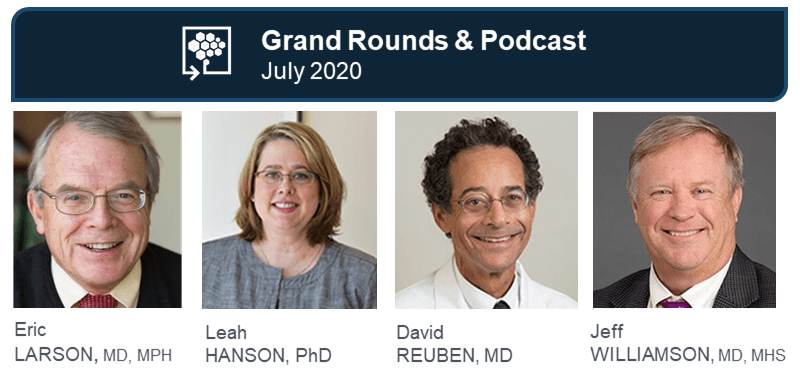
Grand Rounds July 2020

Breaking the Cycle: Health Care Systems Interactions for Impactful Results

July 2020 – Grand Rounds 8, Members of the IMPACT Health Care Systems Core share how embedded pragmatic trials can benefit both health care systems and the research community.

Download webinar slides.

Eric Larson, MD, MPHEric Larson, MD, MPH

Core Leader, Health Care Systems Core
Member, Steering Committee

Vice President, Research and Health Care Innovation, Kaiser Foundation Health Plan of Washington
Executive Director and Senior Investigator, Kaiser Washington Health Research Institute

Leah Hanson, PhD

Leah Hanson, PhD

Associate Core Leader, Health Care Systems Core

Senior Research Investigator, Senior Director of Research at HealthPartners Neuroscience Center, HealthPartners Institute
Co-Director of Research, HealthPartners Center for Memory & Aging

Jeff Williamson, MD, MHS

Jeff Williamson, MD, MHS

Executive Committee, Health Care Systems (HCS) Core
Steering Committee Member

Professor, Chief of Geriatric Medicine, and Director for Center for Healthcare Innovation, Wake Forest School of Medicine

David Reuben, MD

David Reuben, MD

Executive Committee, Health Care Systems (HCS) Core

Archstone Professor of Medicine, Director, UCLA Multicampus Program in Geriatric Medicine and Gerontology, David Geffen School of Medicine at UCLA

Learning Objectives

  • Communicate the need and promise for improvement of dementia care with embedded pragmatic trials within dynamic health care settings.
  • Review what we have found to be key components of ePCT trial design and conduct for ensuring that study results are implementable.
  • Provide learnings of two ePCT trialists from The Dementia Care Study: A Pragmatic Clinical Trial of Health System-Based Versus Community-Based Dementia Care (D-CARE)


Mitchell and Mor share results of PROVEN trial on advance care planning

IMPACT’s Multiple Principal Investigators Susan Mitchell, MD, MPH and Vincent Mor, PhD, together with Angelo Volandes, MD, recently published results of The Pragmatic Trial of Video Education in Nursing Homes (PROVEN) trial, a demonstration project under the NIH Health Care Systems Collaboratory.

PROVEN was among the first large-scale embedded pragmatic clinical trials conducted in nursing homes. The trial was conducted between February 1, 2016 and May 31, 2019 in 360 nursing homes (119 intervention and 241 control) owned by two for-profit corporations in 32 states. PROVEN tested the effectiveness of an advance care planning (ACP) video intervention, intended to help nursing home residents understand and chose their preferred goal of care. A suite of 5 different ACP videos were made available on tablet devices and online and offered to residents and their proxies at time of admission to the nursing home and then again every 6 months. Control nursing homes used usual advance care planning practices. The primary outcome was hospital transfers among long-stay (> 100 days) residents with advanced illness. Secondary outcomes included the proportion of those residents experiencing one or more hospital transfers, burdensome treatments, and hospice enrollment. Twelve month outcomes were measured for each resident. Data sources included Centers for Medicare & Medicaid Services Medicare claims and nursing homes’ electronic health records.

In this pragmatic cluster randomized trial, the PROVEN video intervention did not significantly reduce hospital transfers and burdensome treatments or increase hospice enrollment over 12 months among residents with advanced illness.

Overall intervention fidelity was low and highly variable across nursing homes, which may be one explanation of the negative findings. The low fidelity to the intervention highlights the challenge of implementing interventions in the nursing home environment and the need to ensure the highest level of engagement from key stakeholders, including front-line providers, when conducting pragmatic trials in this setting.

See the NIH HCS Collaboratory’s June 12, 2020, Grand Rounds webinar for a presentation of the PROVEN results: A Cluster Randomized Pragmatic Trial of an Advance Care Planning Video Intervention in Long-Stay Nursing Home Residents: Main Findings from the PROVEN Trial (Susan Mitchell, MD, MPH).

Mitchell and Mor were panelists for NASEM workshop

IMPACT Multiple Principal Investigators Susan Mitchell, MD, MPH and Vince Mor, PhD were panelists in the “Workshop on Nursing Home, Hospice, and Palliative Care for Individuals with Later-Stage Dementia: Making Health Systems More Responsive to Dementia.”

Workshop Details: https://www.nationalacademies.org/event/07-08-2020/meeting-3-decadal-survey-of-behavioral-and-social-science-research-on-alzheimers-disease-and-alzheimers-disease-related-dementias-and-workshop-4