

Providers’ Perspectives on High-Quality Dementia Care in Long-Term Care
September 2, 2022
The National Institute on Aging (NIA) Imbedded Pragmatic Alzheimer’s Disease (AD) and AD-Related Dementias (AD/ADRD) Clinical Trials (IMPACT) Collaboratory is happy to announce a Request for Applications for two separate funding opportunities: Pilot Grant Program and Demonstration Projects Program. These opportunities support research and training to increase the nation’s capacity to conduct pragmatic clinical trials (ePCTs) of non-pharmacological interventions within healthcare systems to improve care for people living with Alzheimer’s disease (AD) and AD-related dementias(AD/ADRD) and their care partners.
Two NIA IMPACT Funding Opportunities
| Pilot Grants RFA | Demonstration Projects RFA |
|---|---|
| Informational Webinar August 30, 2022 @ 3pm ET. Registration closed. |
Informational Webinar August 8, 2022 To be posted online. |
| Letters of Intent Due September 15, 2022 @ 5pm ET |
Letters of Intent (by Email) September 16, 2022 @ 5pm ET |
| Full Proposals Due January 20, 2023 @ 5pm ET |
Full Proposals Due December 21, 2022 @ 5pm ET |
Pilot Grants Program
IMPACT will fund up to five 1-year awards for pilot pragmatic clinical trials (ePCTs) that test non-pharmacological interventions embedded in health care system(s) for people living with Alzheimer’s Disease (AD) and AD-related dementias (ADRD) and their care partners. The goal of these pilot studies is to generate the preliminary data necessary to design and conduct a future full-scale Stage IV effectiveness ePCT (based on the NIH Stage Model) funded through other grant mechanisms.
This grant cycle will prioritize applications for non-pharmacological interventions that aim to:
Learn more about previous Pilot Grant Awardees here. If you have questions about the Pilot Grant Program please visit the Frequently Asked Questions webpage or email IMPACTcollaboratory@hsl.harvard.edu.
Demonstration Projects Program
IMPACT will fund up to two 18-month Demonstration Projects designed as full-scale, Stage IV effectiveness ePCTs (based on the NIH Stage Model) that test, measure and evaluate the effect of a care delivery intervention program in health care systems for people living with AD/ADRD and their care partners. The goal of these Demonstration Projects is to generate evidence on effective care delivery practices that can be expanded and/or implemented in other systems.
Under this mechanism, the interventions must be linked to the needs of the health care system. Suitable intervention typically encompass relatively simple system changes or direct patient outreach, or successfully piloted programs ready for testing at scale. Demonstration Projects allow health care systems and investigators to gain real-world experience integrating pragmatic non-pharmacological interventions into usual clinical workflow and health care delivery practices in a controlled manner that provides clear information on the impact of the intervention program.
Learn more about previous Demonstration Project Awardees here. If you have questions about the Demonstration Project Program, please visit the Frequently Asked Questions webpage or email IMPACTcollaboratory@hsl.harvard.edu.
Learn more about the IMPACT Collaboratory on our website. Keep up-to-date on these and future opportunities by joining our mailing list and following us on social media at IMPACT Twitter IMPACT LinkedIn.
Please help to publicize the IMPACT funding and training opportunities and encourage investigators and colleagues to apply.
The IMPACT Collaboratory is pleased to announce plans to publish new Requests for Applications (RFA) for Pilot Grants and Demonstration Projects on August 1, 2022*. Letters of Intent for both opportunities are due mid-September 2022.
*August 1st is the new RFA release date. This date has been modified from the original date, which was August 15th.
Pilot Grants Program
IMPACT funds one-year awards of pilot pragmatic clinical trials (ePCTs) that test non-pharmacological interventions embedded in health care system(s) for people living with Alzheimer’s Disease (AD) and AD-related dementias (ADRD) and their care partners. The goal of these pilot studies is to generate the preliminary data necessary to design and conduct a future full-scale Stage IV effectiveness ePCT (based on the NIH Stage Model). Learn more about previous awardees at this link.
In this cycle, priority will be given to applications for interventions in this population that aim to:
• Reduce inequities in health care
• Reduce potentially inappropriate medications through de-prescribing
• Improve care in the emergency department
Demonstration Projects Program
IMPACT funds 18-month Demonstration Projects designed as full-scale, Stage IV effectiveness ePCTs (based on the NIH Stage Model) that test, measure and evaluate the effect of a care delivery intervention program in health care systems for people living with ADRD and their care partners. The goal of these Demonstration Projects is to generate evidence on effective care delivery practices that can be expanded and/or implemented in other systems. The intervention will typically encompass relatively simple system changes or direct patient outreach, or successfully piloted programs ready for testing at scale. Demonstration Projects allow health care systems and investigators to gain real-world experience integrating pragmatic non-pharmacologic interventions into usual clinical workflow and health care delivery practices in a controlled manner that provides clear information on the impact of the intervention program. Learn more about previous awardees at this link.
Updates on these two RFAs will be posted on the Grants and Training Programs page.
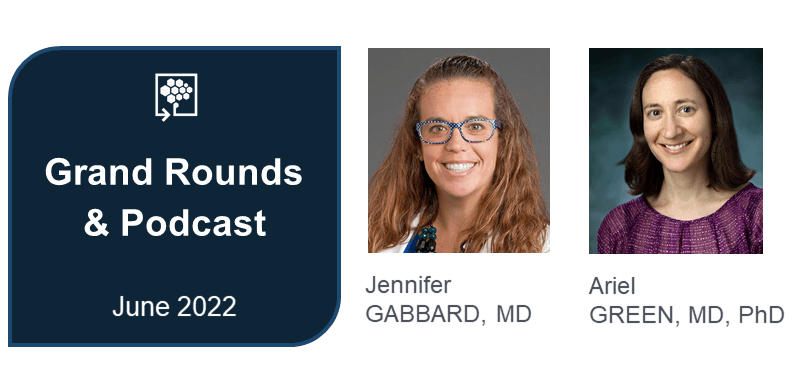
June 2022 – In Grand Rounds 28, Drs. Jennifer Gabbard and Ariel Green share research updates and experiences on IMPACT Cycle 2A Pilot Studies.
Jennifer Gabbard, MD on her pilot: Using Telemedicine to Improve Engagement in Advance Care Planning in Patients with Cognitive Impairment or Unrecognized Dementia
Ariel Green, MD, MPH, PhD on her pilot: ALIGN: Aligning Medications with What Matters Most
 Jennifer Gabbard, MD
Assistant Professor
Geriatrics and Palliative Medicine
Wake Forest School of Medicine
 Ariel Green, MD, MPH, PhD
Associate Professor
Geriatrics Medicine and Gerontology
Johns Hopkins University School of Medicine
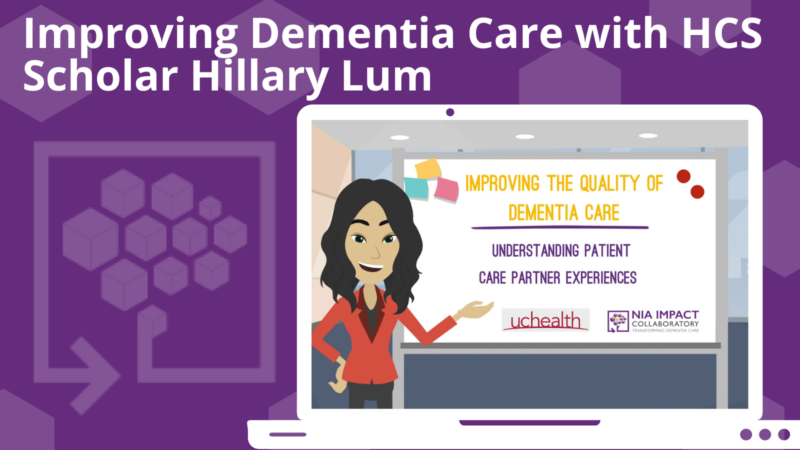
Hillary Lum, MD, PhD, IMPACT Health Care System Scholar, has created a brief video sharing the story of her 1-year journey with The University of Colorado UC Health preparing to conduct real world research to improve dementia care.
The brief video describes the goals and progress over the last year as Dr. Lum and her colleagues developed a program to improve dementia care by improving communication and care communication in dementia care by using health information tools such as patient portals.
Dr. Hillary Lum Shares Her Experience Developing a Program to Conduct Real-World Research in People Living with Dementia from NIA IMPACT Collaboratory on Vimeo.
The IMPACT Collaboratory is pleased to announce the 2022 IMPACT Faculty Scholars.
This program aims to enhance the career development of investigators in the design and conduct of embedded pragmatic clinical trials for people living with dementia and their care partners by integrating them into the activities of our Cores and Teams. Faculty Scholars attend monthly Core meetings, are mentored by an IMPACT executive committee member, engage in scholarly projects to enrich career development, and attend Collaboratory-wide events including Training Workshops and the Annual Business Meeting and Scientific Conference. Throughout the year, faculty participate in monthly Grand Rounds and quarterly Research-in-Progress seminars in addition to other opportunities for career development, training, and networking. Faculty Scholars are nominated by IMPACT members.
The 2022-2023 IMPACT Faculty Scholars:
The National Institute on Aging (NIA) Imbedded Pragmatic Alzheimer’s Disease (AD) and AD-Related Dementias (AD/ADRD) Clinical Trials (IMPACT) Collaboratory (U54AG063546) is pleased to announce the 2022 Health Care Systems (HCS) Scholars Program awardees.
This program offers investigators an opportunity to work directly with health care systems interested in improving the care provided to people living with dementia (PLWD) and their care partners. The goals of the HCS Scholars Program are to embed investigators in health care systems to:
Recipients of this year’s HCS Scholar awards are:
Partnering with Providers to Understand the Individualized Positive Psychosocial Intervention (IPPI) Outcomes of Interest for People Living with Dementia (PLWD)
Prioritizing End-of-Life Communication to Reduce Disparities among People Living with Dementia (PLWD) in Home Healthcare (HHC)
The National Institute on Aging (NIA) Imbedded Pragmatic Alzheimer’s Disease (AD) and AD-Related Dementias (AD/ADRD) Clinical Trials (IMPACT) Collaboratory (U54AG063546) is now accepting applications for the Career Development Award (CDA). These CDAs support the development of MD, PhD, or equivalent researchers who seek careers conducting embedded pragmatic clinical trials (ePCTs) for people living with AD/ADRD and their care partners.
The IMPACT Collaboratory will fund up to two 2-year CDAs, prioritizing applications that address dementia care for people of all backgrounds and promote health equity. Each award will provide up to $220,000 in direct costs over two years with an indirect cost rate capped at 8%. Awardees are required to devote a minimum of 75% effort toward the goals of the award.
Eligible applicants include MD, PhD, or equivalent researchers who seek careers conducting ePCTs for people living with AD/ADRD and their care partners. Applicants are typically within 7 years of their post-doctoral training program at the time of application. Exceptions will be made in this round of funding for investigators with more than 7 years who can demonstrate evidence of changing their career path to pursue research on ePCTs among PLWD. Such applicants must request prior approval.
Applications are due Thursday, September 15, 2022 by 5pm ET. An informational webinar (registration closed) will be hosted on Wednesday, June 29, 2022 at 2:00 PM ET to provide investigators with an overview of application details. Investigators will have the opportunity to ask questions.
A set of frequently asked questions (FAQ) regarding this award is available online at https://impactcollaboratory.org/CDA-grant-faq/. Additionally, please email IMPACTcollaboratory@hsl.harvard.edu with any questions.
Newest Career Development Awardees
Congratulations to the new IMPACT CDA Awardees!
These Awardees are supported by the IMPACT Cores and Teams to prepare them to develop and conduct ePCTs of non-pharmacological interventions within healthcare systems to improve care for people living with AD/ADRD and their care partners.
IMPACT Collaboratory Career Development Award Recipients
Additional details on these recipients and their career development goals can be found on the IMPACT Collaboratory website at https://impactcollaboratory.org/career-development-awardees/
The NIA IMPACT Collaboratory has launched a new online learning platform to give learners the opportunity to build their skills in embedded pragmatic clinical trials (ePCTs) in people living with dementia (PLWD). Learners can take individual courses or enroll in our new certificate program “Basic Principles of Conducting ePCTs in People Living with Dementia and Care Partners.”
The “Basic Principles of Conducting ePCTs in People Living with Dementia and Care Partners” certificate program includes 12 IMPACT courses with brief 2-question quizzes which provides a foundation in the principles of conducting ePCTs in health care systems for PLWD and their care partners. Access to the program and all courses within the new learning platform is free, but requires registration.
The platform houses all IMPACT training modules and gives learners control over when and how they engage with IMPACT training materials. The current training library includes 10-15 minute video courses designed for investigators, health systems leaders, research staff, and others who want to learn about the design and conduct of ePCTs. Topic areas include: design and statistics, stakeholder engagement, ethics and regulation, health equity in pragmatic trials, implementation, patient and caregiver relevant outcomes, and technical data considerations.
Training Materials are developed by content experts from IMPACT cores and teams and thought leaders from across the nation, collaborated by the IMPACT Training Core, led by Christopher Callahan, MD, MACP, and Alexia Torke, MD, MS. The development of educational materials is overseen by Training Core member and IMPACT Executive Director, Ellen McCarthy, PhD, MPH.
Learners can engage IMPACT training content by enrolling in either individual courses or Certificate Programs. Learn more by visiting the site and creating a free account!
The NIA IMPACT Collaboratory is pleased to announce the awardees of the Demonstration Projects Program Cycle 2 and the Pilot Grants Program Cycle 3B. Awardees of these opportunities will be supported by IMPACT’s Cores and Teams to conduct embedded pragmatic clinical trials (ePCTs) of non-pharmacological interventions within healthcare systems to improve care for people living with Alzheimer’s disease and Alzheimer’s disease related dementias (AD/ADRD) and their care partners. The IMPACT Collaboratory prioritizes applications that promote health equity and address dementia care for people of all backgrounds. Learn more about IMPACT Collaboratory funding opportunities and general information on the website. Read more about these opportunities and our newest awardees below.
The Demonstration Projects Program is a funding mechanism developed to support full-scale, Stage IV effectiveness ePCTs (based on the NIH Stage Model) that test non-pharmacological interventions for people living with AD/ADRD and their care partners embedded within and linked to the needs of a health care system. The goal of Demonstration Projects is to generate evidence on effective care delivery practices that can be expanded and/or implemented in other systems. The intervention typically includes relatively simple system changes, direct patient outreach, or successfully piloted programs ready for testing at scale.
Cycle 2 recipients are:
The Pilot Grant Program funds several one-year pilots for ePCTs that test non-pharmacological interventions embedded in health care system(s) to improve care for people living with AD/ADRD and their care partners. Pilot studies are conducted to generate the preliminary data necessary to design and conduct future full-scale Stage IV effectiveness ePCT (based on the NIH Stage Model) that will be funded through other grant mechanisms (National Institutes of Health or other sources).
Cycle 3B recipients are: