Mor and team share results of IMPACT supplement award study evaluating impact of SARS-CoV-2 vaccine among nursing home residents

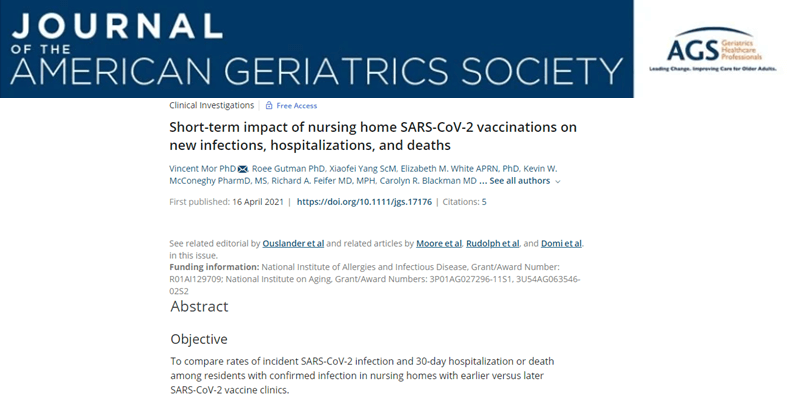
Vince Mor, PhD, one of IMPACT Collaboratory’s two Principal Investigators, and team recently shared results from their investigation into the impact of SARS-CoV-2 vaccine among nursing home residents from 280 nursing homes in 21 states.  Results were published in the Journal of the American Geriatrics Society on April 16th.

Researchers partnered with Genesis Healthcare, the largest long-term care provider in the country, for the study, which was a supplement award through the IMPACT Collaboratory.  They monitored the impact of the SARS-CoV-2 vaccine rollout among nursing home residents in 280 nursing homes within 21 states.  Both the Moderna and Pfizer-BioNTech vaccines were included in the study. Researchers created two groups of participating facilities based on the date of their initial vaccine clinic and conducted a matched pair analysis of outcomes.

One week after their initial vaccine clinics, nursing homes with earlier clinics had 2.5 fewer new SARS‐CoV‐2 infections per 100 at‐risk residents than expected based on the experiences of matched facilities with later clinics. Cumulatively over 7 weeks, earlier vaccinated facilities had 5.2 fewer infections per 100 at‐risk residents and 5 fewer hospitalizations and/or deaths per 100 infected residents than expected without vaccinations. These results indicate that the vaccine led to a reduction in incident infections, morbidity, and mortality in this large multi-state nursing home population.

The researchers also suggested the findings support efforts to begin resuming family visitation and lessen other restrictions in nursing homes.

Read the full article at this link.

Mor receives highest faculty honor from Brown University

Vincent Mor, PhD,  IMPACT Multiple  Principal Investigator and longtime professor of health services, policy and practice at Brown University, was one of two recipients of the Susan Colver Rosenberger Medal of Honor during Brown’s graduation service on May 2nd.

Mor was recognized for the “stunning impact” of his service, leadership and research over four decades at Brown, as well as for his devotion to the health and well-being of individuals and to the public good.   Mor was just the 33rd person to receive this honor since its establishment in 1919.

A longtime advocate for vulnerable elders, Mor directed the Center for Gerontology and Health Care Research at Brown for 10 years, and he has been principal investigator of more than 40 National Institutes of Health-funded grants focused on the uses and outcomes of health services by frail and chronically ill people. During the COVID-19 pandemic, in recognition of the urgency of his research, Mor and his team have been awarded multiple supplemental grants related to COVID-19 testing and the adverse health impacts of COVID-19 vaccination in elderly nursing home residents.

Mor said before Sunday’s ceremony that he is deeply honored to receive the award with Julie Strandberg and hopes that their separate efforts at building significant programs at Brown will have lasting value: “What we’ve built, in our respective fields, lays the groundwork for future scholarship and societal improvement,” he said.

Read the full announcement from Brown University at this link.

Short-term impact of nursing home SARS-CoV-2 vaccinations on new infections, hospitalizations, and deaths

Mor contributes to publication providing evidence of COVID-19 vaccine effectiveness in a real-world nursing home setting

Short-term impact of nursing home SARS-CoV-2 vaccinations on new infections, hospitalizations, and deaths

April 16, 2021

Vince Mor, PhD, IMPACT multiple principal investigator, contributes to publication providing evidence of COVID-19 vaccine effectiveness in a real-world setting of vulnerable nursing homes.

Abstract

Objective

To compare rates of incident SARS-CoV-2 infection and 30-day hospitalization or death among residents with confirmed infection in nursing homes with earlier versus later SARS-CoV-2 vaccine clinics.

Design

Matched pairs analysis of nursing homes that had their initial vaccine clinics between December 18, 2020, and January 2, 2021, versus between January 3, 2021, and January 18, 2021. Matched facilities had their initial vaccine clinics between 12 and 16 days apart.

Setting and Participants

Two hundred and eighty nursing homes in 21 states owned and operated by the largest long-term care provider in the United States.

Measurements

Incident SARS-CoV-2 infections per 100 at-risk residents per week; hospital transfers and/or deaths per 100 residents with confirmed SARS-CoV-2 infection per day, averaged over a week.

Results

The early vaccinated group included 136 facilities with 12,157 residents; the late vaccinated group included 144 facilities with 13,221 residents. After 1 week, early vaccinated facilities had a predicted 2.5 fewer incident SARS-CoV-2 infections per 100 at-risk residents per week (95% CI: 1.2–4.0) compared with what would have been expected based on the experience of the late vaccinated facilities. The rates remained significantly lower for several weeks. Cumulatively over 5 weeks, the predicted reduction in new infections was 5.2 cases per 100 at-risk residents (95% CI: 3.2–7.3). By 5 to 8 weeks post-vaccine clinic, early vaccinated facilities had a predicted 1.1 to 3.8 fewer hospitalizations and/or deaths per 100 infected residents per day, averaged by week than expected based on late vaccinated facilities' experience for a cumulative on average difference of 5 events per 100 infected residents per day.

Conclusions

The SARS-CoV-2 vaccines seem to have accelerated the rate of decline of incident infections, morbidity, and mortality in this large multi-state nursing home population.

IMPACT-C team shares findings on study of vaccine hesitancy in frontline nursing home staff

The IMPACT-C supplement award recently shared the results of their “town hall” style discussions with frontline nursing home staff in a journal article and podcast.

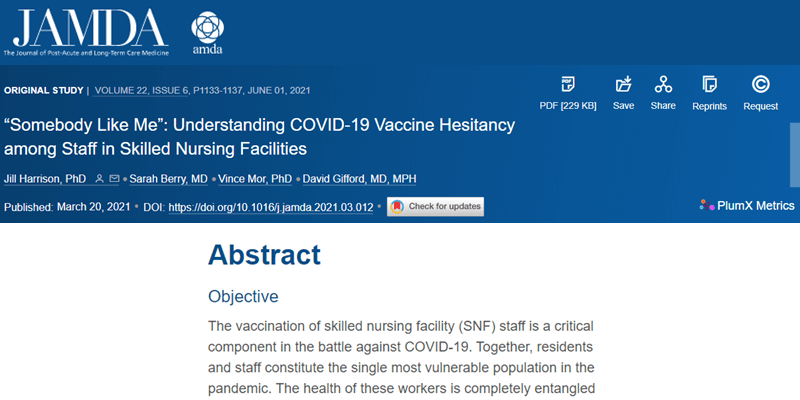
The findings were shared in the Journal of the American Geriatrics Society on March 25th. The study included one hundred and ninety three staff from 50 facilities who participated in 26 meetings between December 30, 2020 and January 15, 2021. Most staff reported getting information about the vaccine from friends or social media. Concerns about how rapidly the vaccines were developed and side effects, including infertility or pregnancy related concerns, were frequently raised. There were no differences in concerns raised by discipline. Questions about returning to prior activities after being vaccinated were common and offered the opportunity to build on positive emotions to reduce vaccine hesitancy.

IMPACT-C study team members Sarah Berry, Kimberly Johnson, and David Gifford also discussed the research on the March 25th GeriPal Podcast.  The podcast discussion was around the devastating impact of COVID on nursing homes and the effects and update rates of vaccine among patients and staff in nursing home.

Click here to read the full journal article.

Click here to listen to the podcast.

IMPACT Collaboratory featured in New York Times opinion piece on effects of COVID-19 on people living with dementia with quotes from Harrison, Karlawish, and Berry

The NIA IMPACT Collaboratory has been featured in a New York Times opinion piece about the effects of COVID-19 restrictions on people living with dementia and their caregivers. Jill Harrison, PhD, Executive Director of the IMPACT Collaboratory, and Jason Karlawish, MD, the leader of the Ethics & Regulation Core are quoted, as is Sarah Berry, MD, MPH, the multiple PI of IMPACT-C, a COVID-19 supplement to the IMPACT Collaboratory. Dr. Harrison’s quote “We are Going to Keep you Safe, Even if It Kills Your Spirit” serves as the title.

“Dr. Karlawish thinks that blanket bans on dementia caregivers are akin to taking away a wheelchair from a person with physical disabilities. ‘And that’s a brutal metaphor,’ he said. ‘But all of a sudden, the people who would come there and help their minds function were taken away.’ Some geriatricians describe this separation as unfortunate and damaging, but necessary. Others believe that we should have allowed for a gentler nursing home quarantine, one that recognizes caregivers as ‘essential’ parts of dementia health care.

Jill Harrison, an executive director of the National Institute on Aging’s IMPACT Collaboratory, thinks the instinct to lock everything down reflects a broader tendency in dementia care to prioritize physical safety above all else… ‘I always call it surplus safety,’ Dr. Harrison told me. ‘It’s essentially like, we are going to keep you safe, even if it kills your spirit.’”

Read the full piece here.

IMPACT Collaboratory announces three new funding opportunities

The NIA IMPACT Collaboratory is pleased to announce three new funding opportunities; Pilot Grants Cycle 3A, and funding opportunities for two new programs, Demonstration Projects and Health Care Systems (HCS) Scholars . These three funding opportunities will support research and training aimed at increasing the nation’s capacity to conduct pragmatic clinical trials (ePCTs) of non-pharmacological interventions within health care systems to improve the care of people living with Alzheimer's disease and related dementias (AD/ADRD) and their care partners.

Demonstration Projects Program

The IMPACT Collaboratory will fund up to two Demonstration Projects (maximum duration 24 months) designed as full-scale, Stage IV effectiveness ePCT (based on the NIH Stage Model) that test non-pharmacological interventions for people living with AD/ADRD and their care partners embedded within and linked to the needs of a health care system. The goal of the Demonstration Projects is to generate evidence on effective care delivery practices that can be expanded and/or implemented in other systems. Interventions must be linked to the needs of a health care system. The intervention will typically encompass relatively simple system changes or direct patient outreach, or successfully piloted programs ready for testing at scale. Preference will be given to applications for Demonstration Projects that address dementia care for populations traditionally marginalized or underrepresented in clinical trials and those that promote health equity.

HCS Scholars Program

The new Health Care Systems (HCS) Embedded Research Scholars Program offers junior and senior investigators an opportunity to work directly with health care systems interested in improving the care provided to people living with dementia (PLWD) and their care partners. The goals of the HCS Scholars Program are to embed investigators in health care systems to:

  • Establish mutually beneficial partnerships to improve the care of PLWD and care partners
  • Train investigators about health care settings needs and how new programs are successfully introduced at all levels of the organization
  • Engage HCS in learning more about what it means to conduct ePCTs and provide resources for understanding opportunities for improvement in dementia care or evaluation of related quality improvement projects
  • Strengthen collaborations between investigators and HCS that may lead to pilot studies or demonstration projects.

Pilot Grant Program –Cycle 3A

The IMPACT Collaboratory funds several one-year pilot studies annually; these are meant to generate the preliminary data necessary to design and conduct a future full-scale Stage IV effectiveness ePCT (based on the NIH Stage Model) funded through other grant mechanisms (National Institutes of Health or other sources). The IMPACT Collaboratory will consider applications for pilot ePCTs that test non-pharmacological interventions embedded in health care system(s) for people living with AD/ADRD and their care partners. All applications should make a convincing case that the pilot ePCT proposed can be scaled up to a full-scale, Stage IV effectiveness ePCT as the next step.

Please check upcoming events for webinars for each opportunity, as well as the IMPACT Twitter feed and mailing list for additional updates.

Grand Rounds 12- December 2020

Improving Serious Illness Care Through Large Pragmatic Trials

December 2020 – In Grand Rounds 12, Dr. Halpern discusses improving care through large pragmatic trials. Dr. Halpern reviews explanatory trials in serious illness care, informed consent, and many other approaches of pragmatic clinical trials to improve the palliative care for seriously ill, hospitalized patients.

Webinar Slides

Speaker

Scott Halpern, MD, PhD

Scott Halpern, MD, PhD

Member, Steering Committee

Professor of Medicine, Epidemiology, and Medical Ethics and Health Policy,
University of Pennsylvania

Webinar Recording

Learning Objectives

  • Participants will understand the importance of improving serious illness care and how it can be done through large pragmatic trials
  • Participants will understand the use of explanatory trials in serious illness care
  • Participants will understand how pragmatic trials can improve palliative care for hospitalized patients

Vince Mor Featured in New JHF Documentary on ‘What COVID-19 Exposed in Long-Term Care’

IMPACT Principal Investigator Vince Mor, PhD is among the experts interviewed for a new documentary from the Jewish Healthcare Foundation (JHF) which explores the reasons theCOVID-19 pandemic has so severely impacted long-term care (LTC) and nursing facilities across the United States. What COVID-19 Exposed in Long-Term Care analyzes the challenges LTC facilities have faced since the pandemic swept the world early this year, including the blame placed on individual long term care facilities and front-line healthcare workers amidst so many systemic shortcomings.

The 20-minute documentary features commentary from public health professionals from across the United States, including Mor. Public health officials interviewed in the documentary attribute the virus’s severe impact on LTC facilities to the vulnerable health of the residents coupled with years of inadequate funding, lack of infection management resources, and the limited response from health systems and public health authorities.

Increased understanding about how this virus and pandemic impacts LTC facilities, underscore the importance for researchers and healthcare workers to find long-term solutions to the disparities that impact this population. Watch the documentary here to learn more about how this public health crisis is affecting older populations and LTC facilities, and how to help find solutions for the inequities within these populations.

IMPACT Collaboratory receives supplement grant to develop adverse events monitoring system for nursing home populations following COVID-19 vaccination

IMPACT Collaboratory Principal Investigator Vincent Mor, PhD will lead a new supplement to the IMPACT funding to study adverse events in nursing home residents who receive the COVID-19 vaccination in real time.

The award to Brown University will be used to design an adverse event monitoring system to identify adverse health impacts after receipt of COVID-19 vaccination by elderly nursing home residents. While there are currently four vaccines in Phase 3 trials in the US, the vaccine trials have rarely included frail, aged subjects with multiple morbidities. For these reasons, and because there is considerable evidence that the immune systems of frail older people are not as responsive as those of the younger people on which vaccines are being tested, careful monitoring of their response to the vaccine will be required. Once a vaccine is approved, it is expected that frail older persons living in congregate settings are in the top priority group for distribution.

This new effort, provides funding for the School to work with Genesis HealthCare (Genesis), one of the nation’s largest post-acute care providers with more than 350 facilities across 25 states. Brown will monitor the occurrence of adverse events following nursing home residents’ receipt of a COVID-19 vaccine in facilities affiliated with Genesis. Since the beginning of the pandemic, Brown and Genesis have been working together to study data and uncover patterns that can be used to develop informed strategies to mitigate the impact of the pandemic in nursing homes.

Mor, lead investigator and professor of health service, policy and practice in the School of Public Health, said “Nursing home residents constitute about 40% of all deaths due to COVID in the nation, but make up less than one half of one percent of the US population. Residents are in desperate need of protection from the virus but no one as sick as a nursing home resident was enrolled in any of the vaccine trials.”

This work is part of the Centers for Disease Control’s effort to establish Vaccine Adverse Event Monitoring Systems, particularly focused on the frail elderly who were not included in the vaccine trials.

Mor added that “We don’t know how frail seniors will react to the vaccine and it will roll out quickly once distribution begins. Under normal circumstances, we would not know until most residents have been vaccinated if the rate of adverse events is higher than expected. Therefore, the ‘real time’ adverse event monitoring system we are establishing cooperatively with the CDC and Genesis is unique and critically important to understand how frail seniors will respond to the vaccines.”

Additional local collaborations in this work include the Rhode Island Quality Institute led by Dr. Neil Sarkar, Ph.D., president and chief executive officer, and associate professor of medical science at the Warren Alpert Medical School of Brown University.

The work is supported by the National Institute on Aging of the National Institutes of Health under Award No. U54AG063546. The content is solely the responsibility of the authors and does not necessarily represent the official views of the National Institutes of Health.

Modified from the Brown University School of Public Health announcement. Read the full text here.