


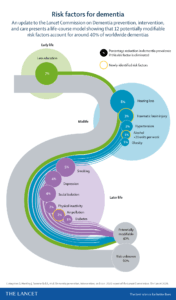
Larson and Gitlin contribute to Lancet Commission report with recommendations to help reduce dementia risk

The Lancet Commission on dementia prevention, intervention, and care published a report July 30, 2020 that highlights recommendations for policy makers and individuals to help reduce dementia risk worldwide.

Eric B. Larson, MD, MPH, core leader of the IMPACT Health Care Systems Core and Laura Gitlin, PhD, FGSA, FAAN, core leader of the Implementation Core are among 28 internationally recognized dementia experts who contributed to the comprehensive report.

The report expands the number of modifiable risk factors from nine to 12, to now include head injuries in mid-life, excessive alcohol consumption in mid-life, and exposure to air pollution in later life. The Commission estimates that 40% of dementia cases could be prevented or delayed by targeting these 12 modifiable risk factors. The 2020 Lancet Commission update calls for nations and individuals to be ambitious about preventing dementia, and lays out a set of policies and lifestyle changes to help. Read https://hubs.ly/H0s-vHK0  

Larson also answered questions from Kaiser Permanente Washington about the report. You can read the Q&A at this link.
AcademyHealth report identifies health systems’ priority research questions on COVID-19

AcademyHealth has developed a report focused on information needs of the health care and community organizations engaged in the COVID-19 response. The report is intended to inform decision-making of federal and foundation funders of health services research to guide investments in responsive research.

Read the full report and background information on the AcademyHealth website.

Gitlin’s Tailored Activity Program highlighted in Wall Street Journal

The Tailored Activity Plan (TAP),  a home-based occupational therapy intervention shown to reduce behavioral symptoms in people living with dementia and caregiver burden, was recently included in an article in the Wall Street Journal. The TAP program was developed by Laura Gitlin, PhD, FGSA, FAAN, Dean and distinguished professor at College of Nursing and Health Professions, at Drexel University and leader of the IMPACT Collaboratory Implementation Core and her colleagues. Read the full article at the Wall Street Journal at this link.

Are you ready for a pragmatic trial? The RAPT model and implementation considerations

November 2019 – Grand Rounds 1 focuses on using the Readiness Assessment for Pragmatic Trials (RAPT) model to assess an intervention’s readiness for an ePCT. RAPT includes 9 domains that reflect a range of considerations regarding the feasibility of successfully employing pragmatic methods and the prospect of an intervention’s widespread adoption, if proven effective.

Download Webinar Slides

Laura Gitlin, PhD, FGSA, FAAN

Laura Gitlin, PhD, FGSA, FAAN

Core Leader, Implementation Core

Dean, Distinguished Professor, Drexel University
Adjunct Professor, Johns Hopkins University

Joe Gaugler, PhD

Joe Gaugler, PhD

Associate Core Leader, Implementation Core

Robert L. Kane Endowed Chair in Long-Term Care and Aging, Professor, University of Minnesota

Rosa Baier, MPH

Rosa Baier, MPH

Executive Committee, Implementation & Health Care Systems (HCS) Cores

Director, Center for Long-Term Care Quality & Innovation
Associate Professor, Health Services, Policy & Practice, Brown University School of Public Health

Eric Jutkowitz, PhD

Eric Jutkowitz, PhD

Executive Committee, Implementation Core

Assistant Professor, Brown University School of Public Health

Learning Objectives

  • Understand how RAPT complements and differs from PRECIS-2
  • Understand RAPT's domains and their relevance for conducting an ePCT
  • Learn how RAPT results can inform decisions about and preparation for proceeding to an ePCT
  • Be prepared to apply RAPT to interventions and use results to guide team discussion