IMPACT-C to develop and evaluate equitable and compassionate COVID-19 testing strategies in skilled nursing facilities

The National Institutes of Health has awarded nearly $234 million to improve COVID-19 testing for underserved and vulnerable populations. A part of the Rapid Acceleration of Diagnostics (RADx) initiative, the RADx Underserved Populations (RADx-UP) program will support 32 institutions across the United States and will focus on populations disproportionately affected by the pandemic.

IMPACT Principal Investigator Vince Mor, PhD and  Sarah Berry, MD from Hebrew Senior Life received a RADx-UP award for Improved Testing for COVID-19 in Skilled Nursing Facilities. IMPACT-C is a collaborative initiative to develop and evaluate equitable and compassionate SARS-CoV-2 testing strategies in vulnerable patients and workers within skilled nursing facilities.

Read the announcement from the NIH here.

McKnight’s names Mor one of 40 notable newsmakers

As part of the 40th anniversary of McKnight’s, McKnight’s Senior Living and McKnight’s Long-Term Care News are recognizing 40 notable newsmakers. Each week, the brands will highlight a new, high-profile leader from the past four decades. On Monday, September 28, they included IMPACT Collaboratory Principal Investigator Vince Mor on the list.

“Numerous top-flight academic researchers delve into nursing home care and policy, but few, if any, approach the track record of Vince Mor,” said the authors of the article.

Moe is professor of health services, policy and practice and the Florence Pirce Grant University Professor in the Brown University School of Public Health, Mor has been the principal investigator of more than 40 National Institutes of Health-funded grants during his 40 years at the university. Read the full article here.

Previously published installments of the series are posted here.

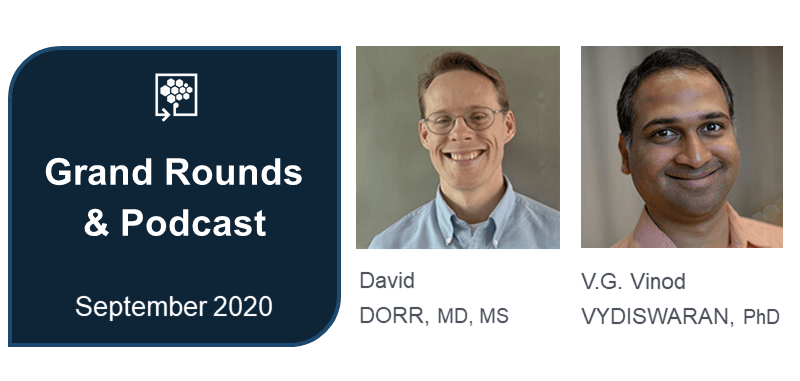
Grand Rounds September 2020

Not all approaches to data are equal: Data-related challenges for pragmatic trials involving PLWD

September 2020 – In Grand Rounds 9, Members of IMPACT's Technical Data Core (TDC) discuss how data algorithms from electronic health records (EHRs) are used to identify, characterize and capture relevant health outcomes of people living with dementia (PLWD) and their care partners.

Download webinar slides.


Speakers

David Dorr, MD, MS

David Dorr, MD, MS

Executive Committee, Technical Data Core
Professor and Vice Chair of Medical Informatics and Clinical Epidemiology
Professor of Medicine, Division of General Internal Medicine and Geriatrics
Chief Research Information Officer, Biomedical Informatics Graduate Program, Oregon Health & Science University School of Medicine

V.G. Vinod Vydiswaran, PhD

V.G. Vinod Vydiswaran, PhD

Executive Committee, Technical Data Core
Assistant Professor of Learning Health Sciences, University of Michigan

Learning Objectives

  • Understand key data-related steps involved in designing pragmatic trials and trade-offs
  • Identify data-driven approaches to identify people living with dementia and caregivers - focus on EHR
  • Identify challenges in validating approaches in different healthcare settings

New IMPACT Funding Opportunity: Pilot Grant Program RFA Cycle 2B

The National Institute on Aging (NIA) IMbedded Pragmatic Alzheimer’s disease (AD) and AD-Related Dementias (AD/ADRD) Clinical Trials (IMPACT) Collaboratory has released a new funding opportunity available for investigators interested in developing embedded pragmatic clinical trials (ePCTs) in dementia research.

Detailed information about the program as well as timelines, eligibility, and other requirements are provided below and in the request for applications (RFAs). Updates will be posted to IMPACT Pilot Grant Program webpage.

Pilot Grant Program RFA Cycle 2B

The IMPACT Collaboratory is soliciting letters of intent for several 1-year pilot awards for up to $175,000 in direct costs. The goal of these awards is to support pilot studies to generate the preliminary data necessary to design and conduct future full-scale ePCTs of non-pharmacologic interventions in health care systems for people living with AD/ADRD and/or their care partners. The mandatory letter of intent is due September 18, 2020.

The IMPACT Collaboratory will consider applications for pilot ePCTs testing non-pharmacological interventions in people living with AD/ADRD and their care partners. In this grant cycle, the IMPACT Collaboratory will consider all applications that propose pilot ePCTs for people living with AD/ADRD and their care partners but will prioritize those in the following areas:

  • Interventions that strive to reduce inequities in health care experienced by minority, underserved, or disadvantaged populations or in settings serving a disproportionate share of minority, underserved, or disadvantaged populations;
  • Interventions that strive to address social isolation and loneliness; and
  • Interventions that use telemedicine, telehealth, and remote technologies to improve health, unmet needs, quality of life and/or health outcomes.

The IMPACT Collaboratory will fund up to five 1-year, non-renewable pilot grant awards for up to $175,000 in direct costs. Letters of intent are required and due September 18, 2020Full proposal applications are by invitation only and will be due January 8, 2021. For further details, please see the on the IMPACT Pilot Grant Program webpage.

Two optional informational webinars will provide investigators with an overview of application details and support that the IMPACT Collaboratory can provide to assist with proposal development (e.g., trial design, measurement, data extraction, etc.). Investigators will have the opportunity to ask questions. Pre-registration is required using the links below. 

  •  Wednesday, August 26, 2020 at 2:00 pm ET: Registration closed.
  • Tuesday, September 8, 2020 at 4:00 pm ET: Registration closed.

Registrants will receive a confirmation email containing information to join the webinar.

The IMPACT Collaboratory encourages all eligible researchers to take advantage of this important funding opportunity, which has the potential to advance care for people living with dementia and/or their care partners in real-world settings. For more information about the IMPACT Collaboratory, please visit impactcollaboratory.org.

The NIA IMPACT Collaboratory is supported through funding from the National Institute on Aging (U54AG063546).


Goldfeld blog examines a hurdle model for COVID-19 infections in nursing homes

A hurdle model is a modified count model that also assumes a relatively high frequency of zeros, but is set up as a two-stage data generation process rather than as a mixture distribution. In his most recent blog post, Keith Goldfeld, DrPH, MS, MPA of the IMPACT Design and Statistics Core discusses using a hurdle model in the context of planning a new study to address COVID-19 infection rates in nursing homes using much more aggressive testing strategies. Read the full blog post here.

Larson and Gitlin contribute to Lancet Commission report with recommendations to help reduce dementia risk

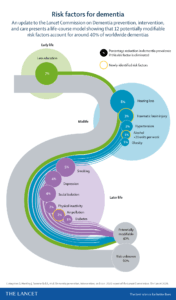
The Lancet Commission on dementia prevention, intervention, and care published a report July 30, 2020 that highlights recommendations for policy makers and individuals to help reduce dementia risk worldwide.
Eric B. Larson, MD, MPH, core leader of the IMPACT Health Care Systems Core and Laura Gitlin, PhD, FGSA, FAAN, core leader of the Implementation Core are among 28 internationally recognized dementia experts who contributed to the comprehensive report.

The report expands the number of modifiable risk factors from nine to 12, to now include head injuries in mid-life, excessive alcohol consumption in mid-life, and exposure to air pollution in later life. The Commission estimates that 40% of dementia cases could be prevented or delayed by targeting these 12 modifiable risk factors. The 2020 Lancet Commission update calls for nations and individuals to be ambitious about preventing dementia, and lays out a set of policies and lifestyle changes to help. Read https://hubs.ly/H0s-vHK0  

Larson also answered questions from Kaiser Permanente Washington about the report. You can read the Q&A at this link.