
IMPACT Collaboratory receives supplement grant to develop adverse events monitoring system for nursing home populations following COVID-19 vaccination

IMPACT Collaboratory Principal Investigator Vincent Mor, PhD will lead a new supplement to the IMPACT funding to study adverse events in nursing home residents who receive the COVID-19 vaccination in real time.

The award to Brown University will be used to design an adverse event monitoring system to identify adverse health impacts after receipt of COVID-19 vaccination by elderly nursing home residents. While there are currently four vaccines in Phase 3 trials in the US, the vaccine trials have rarely included frail, aged subjects with multiple morbidities. For these reasons, and because there is considerable evidence that the immune systems of frail older people are not as responsive as those of the younger people on which vaccines are being tested, careful monitoring of their response to the vaccine will be required. Once a vaccine is approved, it is expected that frail older persons living in congregate settings are in the top priority group for distribution.

This new effort, provides funding for the School to work with Genesis HealthCare (Genesis), one of the nation’s largest post-acute care providers with more than 350 facilities across 25 states. Brown will monitor the occurrence of adverse events following nursing home residents’ receipt of a COVID-19 vaccine in facilities affiliated with Genesis. Since the beginning of the pandemic, Brown and Genesis have been working together to study data and uncover patterns that can be used to develop informed strategies to mitigate the impact of the pandemic in nursing homes.

Mor, lead investigator and professor of health service, policy and practice in the School of Public Health, said “Nursing home residents constitute about 40% of all deaths due to COVID in the nation, but make up less than one half of one percent of the US population. Residents are in desperate need of protection from the virus but no one as sick as a nursing home resident was enrolled in any of the vaccine trials.”

This work is part of the Centers for Disease Control’s effort to establish Vaccine Adverse Event Monitoring Systems, particularly focused on the frail elderly who were not included in the vaccine trials.

Mor added that “We don’t know how frail seniors will react to the vaccine and it will roll out quickly once distribution begins. Under normal circumstances, we would not know until most residents have been vaccinated if the rate of adverse events is higher than expected. Therefore, the ‘real time’ adverse event monitoring system we are establishing cooperatively with the CDC and Genesis is unique and critically important to understand how frail seniors will respond to the vaccines.”

Additional local collaborations in this work include the Rhode Island Quality Institute led by Dr. Neil Sarkar, Ph.D., president and chief executive officer, and associate professor of medical science at the Warren Alpert Medical School of Brown University.

The work is supported by the National Institute on Aging of the National Institutes of Health under Award No. U54AG063546. The content is solely the responsibility of the authors and does not necessarily represent the official views of the National Institutes of Health.

Modified from the Brown University School of Public Health announcement. Read the full text here.
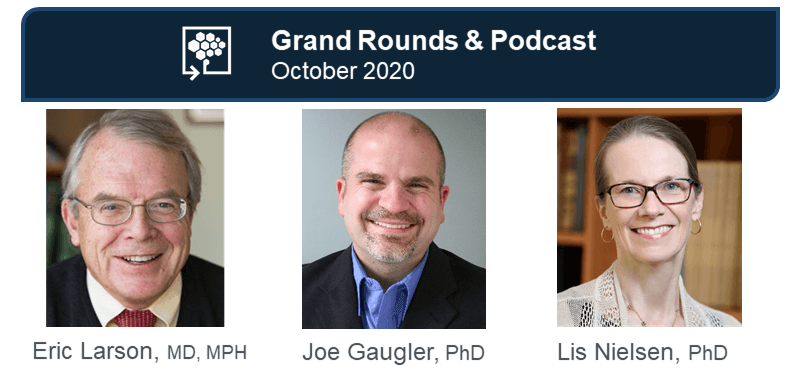

Grand Rounds 10 - October 2020

The AHRQ and Lancet Reports on Dementia Interventions: Interpretation and Implications for Embedded Pragmatic Trials

October 2020 – In Grand Rounds 10, Members of the IMPACT Health Care Systems Core and Implementation Core summarize the AHRQ and Lancet Reports on Dementia Interventions and their implications for pragmatic trials, with commentary from NIA representative Lis Nielsen, PhD, Director of the Division of Behavioral and Social Research (DBSR).

Download webinar slides.

Joe Gaugler, PhD

Joe Gaugler, PhD

Associate Core Leader, Implementation Core

Robert L. Kane Endowed Chair in Long-Term Care and Aging, Professor, University of Minnesota

Eric Larson, MD, MPH

Eric Larson, MD, MPH

Core Leader, Health Care Systems (HCS) Core
Member, Steering Committee

Vice President, Research and Health Care Innovation, Kaiser Foundation Health Plan of Washington
Executive Director and Senior Investigator, Kaiser Washington Health Research Institute

Lis Nielsen, PhD 

Lis Nielsen, PhD 

Director, Division of Behavioral and Social Research, National Institute on Aging

Call for Nominations to Serve on the Lived Experience Panel for People Living with Dementia and Their Family Members and Care Partners

The NIA IMPACT Collaboratory, in collaboration with the Alzheimer’s Association, is seeking nominations to establish a Lived Experience Panel. We are looking for people living with dementia  and those caring for people with dementia to share experiences to help inform the development and testing of interventions to improve dementia care. It is critical to include personal experiences of those living with dementia and care partners to help researchers, professionals, and other stakeholders better understand and prioritize the most urgent needs. Lived Experience Panel will meet quarterly to engage in discussions about methods and strategies for studying non-medication interventions and provide feedback to researchers to improve the quality of life of people living with dementia, their family members, and care partners.

A one-year commitment is requested. Participation will include:

1) training regarding the goals of the Lived Experience Panel

2) four 90-minute meetings (one every 3 months)

3) review of pre-meeting materials

4) evaluation of each meeting soon after it has completed. Meetings will take place over video and/or conference calls

Please share this opportunity with individuals you believe might be good candidates for this panel. To learn more, please visit the Lived Experience Panel page, the Frequently-Asked-Questions and complete the Nomination Form (self-nominations welcome).

Nominations are due by November 17, 2020. 

IMPACT Collaboratory receives 4 NIA COVID-19 Supplement Awards

The National Institute on Aging (NIA) Imbedded Pragmatic Alzheimer’s Disease (AD) and AD-Related Dementias (AD/ADRD) Clinical Trials (IMPACT) Collaboratory is pleased to announce that the IMPACT community has been awarded 4 NIA COVID-19 Supplements for research efforts in response to the urgent public health needs arising from COVID-19 and it’s devastating impact on people living with dementia, their families and care partners.

Effect of a COVID-Specific Advance Care Planning Intervention on Documentation of Advance Directives and Goals of Care
Principal Investigator: Ellen McCreedy, PhD, MPH, Brown University School of Public Health
Dr. McCreedy and her team will conduct a cluster randomized embedded pragmatic clinical trial (ePCT) by leveraging electronic health records of Bluestone Physician Services to test the effectiveness of a COVID-specific, advance care planning (ACP) intervention on documentation of care preferences among assisted living community (ALC) residents with AD/ADRD from 150 ALCs in 3 states.

Evaluation of a State-wide Effort to Improve COVID-19 Infection Control in Massachusetts Nursing Homes
Principal Investigator: Lewis Lipsitz, MD, Marcus Institute for Aging Research, Hebrew SeniorLife
Dr. Lipsitz and his team will evaluate the efficacy of a Massachusetts state-funded strategy to minimize the spread of COVID-19 among older adults and their care providers within Massachusetts NHs using multiple data sources. Efficacy will be measured over the 2-month intervention period among all residents in nursing homes (NHs) across Massachusetts compared to those in Connecticut, Rhode Island, New Hampshire, and Vermont.

COVID-19 Serologic Strategies for Skilled Nursing Facilities (CERO)
Principal Investigator: Joshua Chodosh, MD, MSHS, NYU Langone Health
Dr. Chodosh and his team will design and pilot test an intervention that leverages the COVID-19 antibody and PCR status of residents and staff to inform staff-residents care assignments to minimize COVID-19 transmission rates. The team will conduct the study in two New York City facilities with high minority and AD/ADRD representation and compare intervention units using this strategy with those that do not.

Improved Testing for COVID-19 in Skilled Nursing Facilities: IMPACT-C
Principal Investigators: Sarah Berry, MD, MPH, Marcus Institute for Aging Research, Hebrew Senior Life; Vince Mor, PhD, Brown University School of Public Health
Drs. Berry and Mor were awarded a supplement to improve COVID-19 testing for underserved and vulnerable populations as part of the Rapid Acceleration of Diagnostics (RADx) initiative, the RADx Underserved Populations (RADx-UP) program. This initiative will leverage the foundation of the IMPACT Collaboratory to establish IMPACT-COVID-19 (IMPACT-C), a collaborative dedicated to developing and evaluating SARS-CoV-2 testing strategies in highly vulnerable residents and health care workers of skilled nursing facilities. IMPACT-C will assemble the organizational, administrative, and expertise components necessary to swiftly conduct a rigorous vaccine trial, when available.


Bynum and Travison presentations from NIA ADRD Summit now available

Julie Bynum, MD, MPH, Core Leader of the IMPACT Technical Data Core and Thomas Travison, PhD, Associate Core Leader of the Design and Statistics Core, presented at the National Institute on Aging Summit Virtual Meeting Series: 2020 National Research Summit on Care, Services, and Supports for Persons with Dementia and Their Caregiver this summer. The slides and presentation videos are now available at: https://bit.ly/3nreloY.

IMPACT Collaboratory funds two career development awards

The National Institute on Aging (NIA) Imbedded Pragmatic AD/ADRD Clinical Trials (IMPACT) Collaboratory is pleased to announce the recipients of its inaugural cycle of the IMPACT Career Development Award Program. Recipients were selected from an impressive group of competitive applications.

2020 IMPACT Career Development Award Recipients

Jennifer Gabbard, MD, Wake Forest School of Medicine
Use of a dementia-specific portal-based tool for advance care planning engagement

Tina Sadarangani, PhD, RN, ANP-BC, GNP-BC, NYU Rory Meyers College of Nursing
Leveraging mHealth to reduce avoidable utilization by people with dementia in day centers

About the NIA IMPACT Career Development Award Program

NIA IMPACT Collaboratory funds two to three career development awards annually. These career development awards will support the development of early-stage MD, PhD, or equivalent researchers who seek careers conducting ePCTs for people living with AD/ADRD and their care partners. The IMPACT Collaboratory prioritizes applications that address dementia care for people of all backgrounds and promote health equity.

Conducting ePCTs in AD/ADRD within healthcare systems requires unique research skills, yet the field is relatively nascent. The number of investigators capable of rigorously designing and executing ePCTs in partnership with healthcare systems and other key stakeholders remains limited, and those that have intersecting expertise in AD/ADRD populations are even fewer. Thus, the career development award advances the IMPACT Collaboratory’s mission to build the nation’s capacity to conduct impactful ePCTs in AD/ADRD by training a workforce of investigators prepared to carry on this work well into the future.

Please join our mailing list to receive news and invitations to IMPACT events, Grand Rounds, and pragmatic trials training modules.

Learn more about the IMPACT Collaboratory on our website, Twitter and LinkedIn.