
Health Care Systems Core leaders discuss vision for the IMPACT Learning Health Network

The NIA IMPACT Health Care Systems Core recently launched its Learning Health Network, to connect health care practice and research for people living with dementia and their care partners. The Learning Health Network is a consortium of individuals, organized into 4 unique communities representing unique settings of care for people living with Alzheimer’s disease and related dementias and their care partners.  The goal is to bridge the gap between research and practice by facilitating relationship-building and information sharing between researchers and members of the various care settings.  The Learning Health Network is in its beginning phase, with current efforts aimed at building the 4 unique communities:

  • Long-term Care (nursing homes, assisted living, and other settings that provide around-the-clock care for persons living with dementia)
  • Healthcare Settings (Clinics, ACOs, MA Plans, Integrated Delivery Systems)
  • Hospitals/Emergency Departments
  • Community-based Organizations (Meals on Wheels, Hospice, Senior Centers, Adult Day Centers)

Health Care Systems Core Leaders Eric B. Larson, MD, MPH and  Leah Hanson, PhD are leading the efforts for the Learning Health Network, and recently shared their goals and vision for the network, describing the Learning Health Network as an opportunity to create a transformative and bi-directional relationship between stakeholders working to improve dementia care.

“The idea of a learning health network is foundational to health care systems,” said Larson. We need bi-directional communication, so that research informs practice, and practice informs research. It’s not just “we” educating “them”. We will educate each other about the settings and how we can work with them.”

Hanson recognized the importance of listening to each other as well. “If researchers are operating in a silo and conduct an amazing intervention and we roll out in real world, but it doesn’t work, then it doesn’t help,” she said. “We have to consider those factors in design of research studies. We believe this network is the way to bring people together.”

Larson and Hanson said they believe that groups like the Learning Health Network will prove to be especially helpful when dealing with crises like the COVID-19 pandemic.

“In our system, people are sharing and engaging with each other in ways they never have before,” said Hanson.  “We did a weekly call at our health care system when COVID first started, with large clinician engagement. People want to learn what is happening, and being set up to easily share information will help that process.”

Larson and Hanson said that their hope is that for a small investment of time, members of the Learning Health Network can gain access to thought leaders and experts while also educating researchers about how to improve care in real-world settings. Both core leaders recently presented with two other members of the Core for a Grand Rounds webinar and follow-up podcast about the Core and the Learning Health Network.
New IMPACT Funding Opportunity: 2021 Career Development Award

For scientists pursuing careers in embedded pragmatic clinical trials for people living with Alzheimer’s disease and Alzheimer’s disease-related dementias (AD/ADRD) and their care partners.

Informational Webinars
Tuesday, January 19, 2021 at 2:00 pm ET: Registration closed.
Wednesday, February 3, 2021 at 3:00 pm ET: Registration closed.

Application Period Opens
January 18, 2021

Proposals Due
April 2, 2021 @ 5pm ET

Read full Request for Applications (RFA)

The NIA IMPACT Collaboratory (U54AG063546) is pleased to announce the request for applications for the 2021 IMPACT Career Development Award. We encourage applications from early-stage investigators interested in a research career that includes conducting embedded pragmatic clinical trials (ePCTs) of non-pharmacologic interventions within healthcare systems (HCS) for people living with Alzheimer’s disease (AD) and AD-related dementias (ADRD) and their care partners. The recent $300 million increase in National Institutes of Health funding for AD/ADRD research, reflects the urgency and opportunities for investigators focused in this area.

Conducting ePCTs in AD/ADRD within HCS requires unique research skills, yet the field is relatively nascent. The number of investigators capable of rigorously designing and executing ePCTs in partnership with HCS and other key stakeholders remains limited, and those that have intersecting expertise in AD/ADRD populations are even fewer. Thus, a critical objective of the IMPACT Collaboratory is to build the nation’s capacity to conduct impactful ePCTs in AD/ADRD by training a workforce of investigators prepared to carry on this work well into the future.

The IMPACT Collaboratory funds up to four career development awards (CDAs) annually. These CDAs seek to support the development of early-stage MD, PhD, or equivalent researchers who seek careers conducting ePCTs for people living with AD/ADRD and their care partners. The IMPACT Collaboratory prioritizes applications that address dementia care for people of all backgrounds and promote health equity. CDAs are funded for two years. Each award will provide $100,000 annually in direct costs with an indirect cost rate capped at 8%. Awardees are required to devote a minimum of 75% effort toward the goals of the award.

A set of frequently asked questions (FAQ) regarding this award is available at https://impactcollaboratory.org/CDA-grant-faq/. Additionally, please email IMPACTcollaboratory@hsl.harvard.edu with any questions.

Goldfeld examines constrained randomization to evaulate the vaccine rollout in nursing homes

Keith Goldfeld, member of the Executive Committee of the IMPACT Design & Statistics Core (DSC), is part of the IMPACT Collaboratory study examining the rollout of COVID-19 vaccine in nursing homes. He recently authored a blog post describing the statistical approach to the study.

The effort involves a cluster randomized trial (CRT) to evaluate the effectiveness of a wide-ranging outreach program designed to encourage nursing home residents to get their shots. The focus is on facilities that have relatively high proportions of African-American and Latinx residents, because these facilities have been among the least successful in the past in convincing residents to get vaccinated. The outcome measure of the trial, which will be measured at the individual level, will be the probability of vaccination within 5 weeks of being available at the nursing home.

Read the full blog post at: https://www.rdatagen.net/post/2020-12-22-constrained-randomization-to-evaulate-the-vaccine-rollout-in-nursing-homes/ 

Zimmerman comments on impact of isolation on nursing home residents during COVID-19 pandemic

Sheryl Zimmerman, PhD, a member of the executive committee for the IMPACT Patient and Caregiver Relevant Outcomes Core, was recently quoted in a New York Times opinion piece about the impact of isolation on nursing home residents during the COVID-19 pandemic.

“We’ve lost part of the long-term care work force by restricting families,” said Zimmerman,  who is also co-director of the Program on Aging, Disability and Long-Term Care at the University of North Carolina at Chapel Hill and the School of Social Work. “Sure, the risk of spreading COVID-19 (or any other infectious disease) is less when visitors are restricted, but the consequence of social detachment may be greater, and this is a serious risk: we’ve known for more than 40 years that isolation increases death.”

Read the full piece at this link.

Grand Rounds 12- December 2020

Improving Serious Illness Care Through Large Pragmatic Trials

December 2020 – In Grand Rounds 12, Dr. Halpern discusses improving care through large pragmatic trials. Dr. Halpern reviews explanatory trials in serious illness care, informed consent, and many other approaches of pragmatic clinical trials to improve the palliative care for seriously ill, hospitalized patients.

Webinar Slides

Speaker

Scott Halpern, MD, PhD

Scott Halpern, MD, PhD

Member, Steering Committee

Professor of Medicine, Epidemiology, and Medical Ethics and Health Policy,
University of Pennsylvania

Webinar Recording

Learning Objectives

  • Participants will understand the importance of improving serious illness care and how it can be done through large pragmatic trials
  • Participants will understand the use of explanatory trials in serious illness care
  • Participants will understand how pragmatic trials can improve palliative care for hospitalized patients

Request for Applications to Attend the Annual IMPACT Training Workshop & Retreat (April 7-8, 2021)

The IMPACT Collaboratory will hold its first annual Training Workshop and Retreat, “Building Skills to Conduct Embedded Pragmatic Clinical Trials for People Living with Dementia (PLWD) and their Care Partners,” on April 7-8, 2021.

We are inviting applications from early to mid-career researchers who seek to develop competence in designing and conducting ePCTs of interventions to improve care for PWLD and their care partners. We anticipate accepting up to 25 participants to attend the workshop.

This virtual 1.5-day workshop and retreat will provide a foundation in practical aspects of designing and conducting ePCTs in AD/ADRD through a combination of panel discussions, small group sessions, and networking opportunities with experts in the field. Workshop modules will focus on healthcare systems, implementation science, and study design.

Participants will gain knowledge in ePCT design and method, problem-solve challenges faced in current or planned projects, and network and engage with the larger community of IMPACT investigators. Throughout the program, special attention will be paid to key considerations in design, implementation, and monitoring ePCTs of PLWD and care partners to ensure health equity.

Successful applicants will be expected to complete selected readings and online training prior to the workshop. Please note that all participants will be expected to attend and participate in the entire 1.5-day IMPACT Collaboratory Training Workshop and Retreat.

Please help to publicize this training program and encourage your investigators and colleagues to apply.

EVENT DETAILS (virtual):
Wednesday, April 7, 2021 from 1:30pm – 4:30pm ET
Thursday, April 8, 2021 from 10:00am – 4:30pm ET

TO APPLY:
For more information and to apply please visit:  https://impactcollaboratory.org/training-workshop

  • Deadline: Friday, January 15, 2021
  • Application: Please submit your online application and your NIH biosketch by January 15, 2021 through our application portal.

ELIGIBILITY CRITERIA: Applicants should have an MD, PhD, or equivalent research degree and hold a full-time position at an academic or research organization in the United States.  Although the primary audience is early-career investigators, mid-career applicants who are seeking to change their career path to pursue research on ePCTs in AD/ADRD will be considered. Individuals from underrepresented racial and ethnic groups as well as individuals with disabilities are encouraged to apply.

SELECTION CRITERIA: Applicants will be selected based on their demonstrated commitment to improving the care of people living with dementia and/or their caregivers through the conduct of ePCTs in health care systems and the potential impact of the workshop on promoting the applicant’s career in this area.

If you have any questions regarding this opportunity, please email IMPACTcollaboratory@hsl.harvard.edu

Vince Mor Featured in New JHF Documentary on ‘What COVID-19 Exposed in Long-Term Care’

IMPACT Principal Investigator Vince Mor, PhD is among the experts interviewed for a new documentary from the Jewish Healthcare Foundation (JHF) which explores the reasons theCOVID-19 pandemic has so severely impacted long-term care (LTC) and nursing facilities across the United States. What COVID-19 Exposed in Long-Term Care analyzes the challenges LTC facilities have faced since the pandemic swept the world early this year, including the blame placed on individual long term care facilities and front-line healthcare workers amidst so many systemic shortcomings.

The 20-minute documentary features commentary from public health professionals from across the United States, including Mor. Public health officials interviewed in the documentary attribute the virus’s severe impact on LTC facilities to the vulnerable health of the residents coupled with years of inadequate funding, lack of infection management resources, and the limited response from health systems and public health authorities.

Increased understanding about how this virus and pandemic impacts LTC facilities, underscore the importance for researchers and healthcare workers to find long-term solutions to the disparities that impact this population. Watch the documentary here to learn more about how this public health crisis is affecting older populations and LTC facilities, and how to help find solutions for the inequities within these populations.

Grand Rounds 11 November 2020

Implementation Outcomes: Their Role in Treatment Success

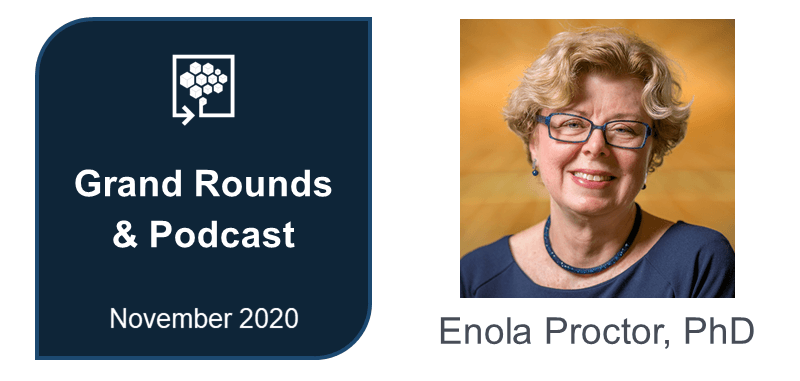
November 2020 – In Grand Rounds 11, Dr. Proctor presents on the role of implementation outcomes in implementation science, the current state of knowledge, conceptual and methodological challenges they pose, and directions for research to clarify how to effectively achieve implementation outcomes, understand their dynamic relationships to one another, and capture their effects in treatment effectiveness and public health impact.

Speaker

Enola Proctor, PhD

Enola Proctor, PhD

Professor
Brown School, Washington University in St. Louis

Learning Objectives

  • Participants will understand the importance of implementation outcomes
  • Participants will understand the conceptual and methodological challenge for studying implementation outcomes
  • Participants will know priorities for future research on implementation outcomes