

Finding Pragmatic and Relevant Outcomes for AD/ADRD ePCTs

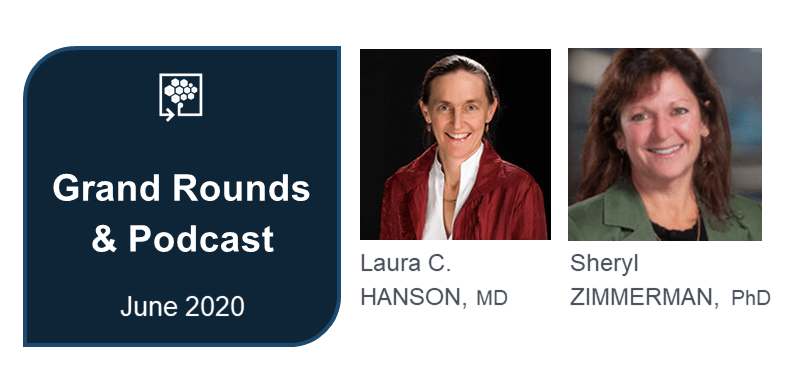
June 2020 – Grand Rounds 7, members of IMPACT's Patient Caregiver Relevant Outcomes Core describe person and caregiver-centered outcome measurement in AD/ADRD ePCTs, give an overview of how outcomes are mapped to care domains, and highlight the methodological challenges present in AD/ADRD and pragmatic research.

Download Webinar Slides

Speakers

Laura C. Hanson, MD, MPHLaura C. Hanson, MD, MPH
Core Leader, Patient/Caregiver Relevant Outcomes Core
Member, Steering Committee

Professor, Division of Geriatric Medicine
Director, UNC Palliative Care Program
University of North Carolina School of Medicine

Sheryl Zimmerman, PhDSheryl Zimmerman, PhD

Executive Committee, Patient/Caregiver Relevant Outcomes (PCRO) Core

University Distinguished Professor and Co-Director, Program on Aging, Disability, and Long-Term Care, Cecil G. Sheps Center for Health Services Research
University of North Carolina at Chapel Hill

Learning Objectives

  • Describe outcomes relevant for people living with dementia and their caregivers
  • Describe the application of the Alzheimer’s Association conceptual framework to link care interventions to outcomes
  • Describe considerations for selecting outcome measures for AD/ADRD ePCTs

Patient and Caregiver Relevant Outcome (PCRO) iLibraries

Patient and Caregiver Relevant Outcome (PCRO) iLibraries

Welcome to the IMPACT Patient and Caregiver Relevant Outcome (PCRO) iLibraries

The IMPACT PCRO iLibraries hold organized information on selected outcome measures for pragmatic trials enrolling people living with Alzheimer’s disease or related dementias (AD/ADRD). They are designed to support the overall goal of the IMPACT Collaboratory – to build capacity to conduct embedded pragmatic clinical trials (ePCTs) to improve outcomes for people living with dementia  (PLWD) and their care partners.

  • PCRO iLibrary – Administrative Sources is a resource of outcome assessments that can be found in existing data
  • PCRO iLibrary – Clinical Assessments contains patient-reported outcomes (PROs), caregiver-reported outcomes (CROs), observer-reported outcomes (ObsROs), performance outcomes (PerfOs), and clinician-reported outcomes (ClinROs) that have been used in pragmatic AD/ADRD trials

Click on one of the links above to learn more about either the Administrative Sources or Clinical Assessments iLibrary.


Learn more about the PCRO Core.

Health equity as foundational to the design of pragmatic trials

April 2020 – In Grand Rounds 5, Drs. Quiñones and Jackson discuss health equity issues have not yet been fully considered, assessed, or integrated into ePCT designs. Health disparities populations may not be well represented in ePCTs without special efforts to identify and successfully recruit sites of care that serve larger numbers of these populations.


Speakers

Ana Quiñones, PhD, MS

Ana Quiñones, PhD, MS

Team Leader, Health Equity Team (HET)

Associate Professor, Department of Family Medicine, OHSU-PSU School of Public Health, Oregon Health & Science University

Jonathan Jackson, PhD

Jonathan Jackson, PhD
Executive Committee, Health Equity Team (HET)

Instructor in Neurology, Massachusetts General Hospital
Instructor, Harvard Medical School

Learning Objectives

  • Understand the role and objectives of the Health Equity Team in the IMPACT Collaboratory.
  • Describe the conceptualization of health equity as it relates to ePCTs design.
  • Understand and describe important health equity considerations in the design of ePCTs.


AcademyHealth report identifies health systems’ priority research questions on COVID-19

AcademyHealth has developed a report focused on information needs of the health care and community organizations engaged in the COVID-19 response. The report is intended to inform decision-making of federal and foundation funders of health services research to guide investments in responsive research.

Read the full report and background information on the AcademyHealth website.

Modifications and Waivers of Informed Consent in Pragmatic Clinical Trials

February 2020 – In Grand Rounds 4, Dr. Karlawish discusses waivers and alterations of written informed consent in pragmatic clinical trials (ePCTs). He provides two case studies of ePCTs to determine whether or not it is appropriate to permit a modification or a waiver of research informed consent.

Speaker

Jason Karlawish, MD

Jason Karlawish, MD
Core Leader, Ethics & Regulation Core

Professor of Medicine, Medical Ethics and Health Policy, and Neurology
Co-Director, Penn Memory Center, University of Pennsylvania

Learning Objectives

  • Identify how consideration of ethical and regulatory issues in the design phase of an ePCT with PLWD can help make the study more pragmatic.
  • Review the regulatory requirements for a waiver or alteration of informed consent and discuss related ethical considerations.
  • Apply what we’ve covered to two case studies.


Additional Resources

  • 45 CFR 46 – Protection of Human Subjects
  • Scott Kim and Frank Miller. “Waivers and alterations to consent in pragmatic clinical trials: Respecting the principle of respect for persons.” IRB: Ethics and Human Research. January-February 2016, Vol 38, issue 1.
  • January 31, 2008 SACHRP letter to HHS Secretary: Recommendations related to waiver of informed consent and interpretation of “minimal risk,” available at https://hhs.gov/ohrp/sachrp-committee/recommendations/2008-january-31-letter/index.html

Stepped Wedge Cluster Randomized Trials: What, How, And When?

December 2019 – In Grand Rounds 2, Dr. Taljaard describes the use of stepped wedge design in cluster randomized trials (SW-CRT), a novel research design embraced by clinical researchers.

Speaker

Monica Taljaard, PhDMonica Taljaard, PhD

Executive Committee, Design & Statistics Core

Senior Scientist, Ottawa Hospital Research Institute
Associate Professor, University of Ottawa

Learning Objectives

  • Describe the key characteristics and main types of stepped wedge cluster randomized trials (SW-CRTs) with examples.
  • Explain the main approach to analysis and sample size calculation for SW-CRTs.
  • Discuss what is an appropriate justification for using a SW-CRTs.


Related Articles and Resources

  1. Kasza J1, Taljaard M2,3, Forbes AB1 Information content of stepped-wedge designs when treatment effect heterogeneity and/or implementation periods are present https://www.ncbi.nlm.nih.gov/pubmed/31321806
  2. Teerenstra S, Taljaard M, Haenen A, Huis A, Atsma F, Rodwell L, Hulscher M. Sample size calculation for stepped-wedge cluster-randomized trials with more than two levels of clustering. Clinical Trials. 2019; 16(3):225-236. doi: 10.1177/1740774519829053.
  3. R package ‘swCRTdesign’  http://faculty.washington.edu/jphughes/pubs.html
  4. R-Shiny (Hemming & Kasza) https://clusterrcts.shinyapps.io/rshinyapp/