
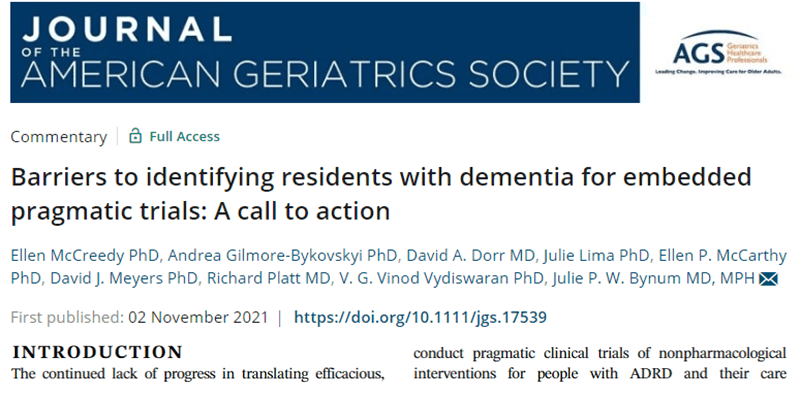
Barriers to identifying residents with dementia for embedded pragmatic trials: A call to action
November 2, 2021

October 2021 – In Grand Rounds 20, Dr. Lyons explains a dyadic approach to illness and care, as well as the role of theory and concepts, design and methodological considerations, and family and culture in dyadic research.
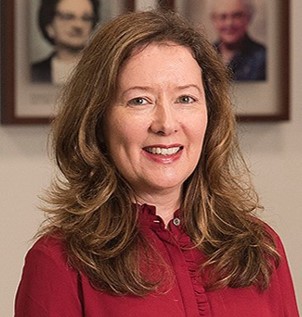
Karen S. Lyons, PhD, FGSA (she/hers)
Professor
Boston College
William F. Connell School of Nursing
@KSLCareDyads

September 28, 2021

Members of the Executive Committee for the IMPACT Engaging Partners Team have collaborated to create a guide for researchers seeking stakeholder advisors living with dementia.
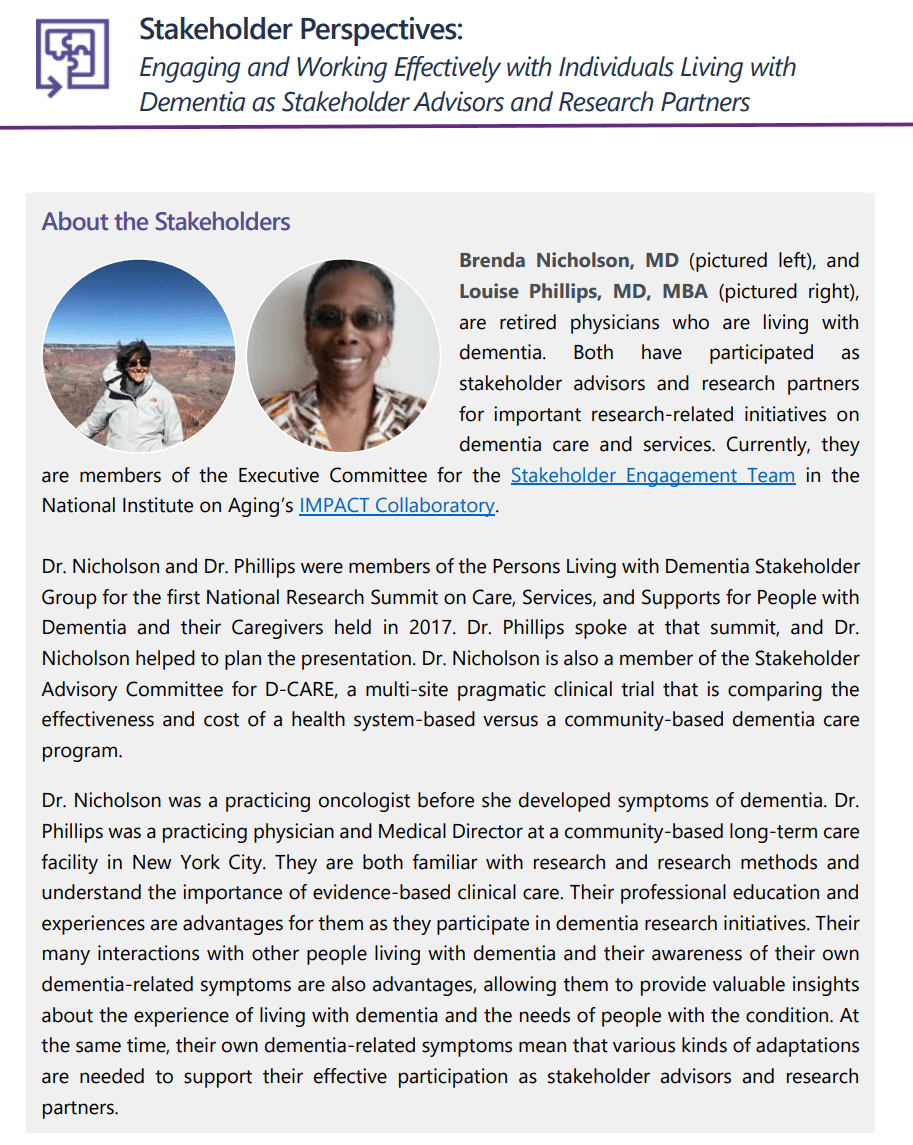
Brenda Nicholson, MD , and Louise Phillips, MD, MBA, are retired physicians who are living with dementia. Both have participated as stakeholder advisors and research partners for important research-related initiatives on dementia care and services. They collaborated with Katie Maslow, MSW, to create the perspective piece entitled, Engaging and Working Effectively with Individuals Living with Dementia as Stakeholder Advisors and Research Partners.
Dr. Nicholson and Dr. Phillips provided three reasons why they participate as stakeholder advisors and research partners in dementia care research:
Dr. Nicholson and Dr. Phillips drew on their own experiences to offer tips to researchers, but also emphasized that each person living with dementia has their own unique needs and circumstances to consider. Their tips suggest the importance of considering the needs of stakeholder advisors throughout the engagement process; from planning the meeting format and time commitment, through post-meeting follow-up. They stress the importance of providing multiple opportunities for advisors to share their ideas and have their voices heard. The full perspective piece can be found at this link.
Members of the IMPACT Collaboratory co-authored an editorial in the October edition of the Journal of the American Medical Directors Association (JAMDA) addressing the limitations of the linear model for development and testing on new interventions and the need for support for dissemination and implementation of dementia care interventions.
Joseph Gaugler, PhD, and Laura Gitlin, PhD from IMPACT’s Implementation Core, and Sheryl Zimmerman, PhD from the Patient Caregiver Relevant Outcomes Core collaborated in writing this commentary. They acknowledge the value of conducting early stage research of interventions within the linear NIH Stage Model, but argue that a more dynamic circular model of intervention development is important when developing an intervention for dementia care. The authors offer 3 guiding principles for considering readiness of dementia care interventions for dissemination and implementation: 1) The evidence base of dementia care interventions requires ongoing development; 2) The importance of incorporating implementation science principles throughout the life cycle of intervention development; and 3) The heterogeneous nature of intervention evidence is to be embraced, not shunned. Read more here.
Multiple NIA IMPACT members participated in the National Academies of Sciences, Engineering, and Medicine (NASEM) virtual workshop entitled, “Behavioral and Social Research and Clinical Practice Implications of Biomarkers and Other Preclinical Diagnostics of Alzheimer’s Disease (AD) and AD-Related Dementias” (AD/ADRD) on June 28 and 29, 2021.
The meeting addressed behavioral and social science research questions raised by the use of biomarkers and other measures (e.g., digital/sensor data) for pre-clinical AD/ADRD diagnosis, including the personal, social, ethical, legal, economic, health equity, and healthcare implications for patients and families, the impact of disclosure of preclinical diagnosis on identity and self-concept, study partners and interpersonal relationships, interactions with the healthcare system, participation in the workforce, and other outcomes. It also addressed the implications of preclinical diagnosis of AD/ADRD for the design and conduct of AD/ADRD prevention research.
IMPACT Collaboratory members who participated in the meeting include:
The format of the meeting was a series of panel presentations followed by reflections/discussions by other participants. Mor and Largent presented summaries of their research, and Jackson, Karlawish and Parker were respondents to panel discussions. The meeting summary report was recently released and includes descriptions of the studies presented by Mor and Largent, as well as responses from Jackson and Parker.
Mor discussed screening and disclosure of dementia diagnoses to give patients and families more information to make decisions and prepare for the future. He shared the results of the CARE (Caregivers’ Reactions and Experience) study, which is a supplemental study to the IDEAS (Imaging Dementia—Evidence for Amyloid Scanning) study. IDEAS uses amyloid PET scans to gather more information on patients with an unclear diagnosis, and CARE uses surveys and interviews to examine why these patients and their care partners sought a definitive diagnosis of cognitive defects, how they reacted to the results, and what impact the results had on their future plans.
Emily Largent, presented findings from her research, which used qualitative methods to look at the disclosure of AD biomarker results. Largent asserted that a diagnosis of Alzheimer’s disease before the onset of cognitive impairment will change the lived experience of Alzheimer’s disease for millions of adults. While not all of these people will progress to experiencing cognitive impairment, the diagnosis itself is a “clinical experience” and can change people’s perceptions of themselves as patients. Families are also affected, both because of what it may mean for their own risk, in addition to the risk of becoming a caregiver to their loved one.
Parker, was among the respondents to a panel presentation about issues related to health equity in studies of presymptomatic people. Jason Karlawish responded to the presentations related to implications of diagnosis disclosure.
The full meeting summary report can be found at this link.
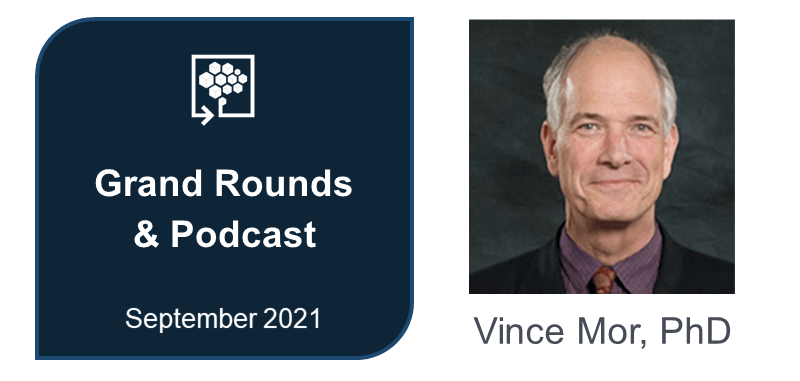
September 2021 – In Grand Rounds 19, Dr. Mor discusses the complexities of making changes in health care systems through four examples of embedded pragmatic clinical trials.

Vincent Mor, PhD
Florence Grant Pirce Professor of Community Health
Brown University School of Public Health