
December 29, 2021
Continue reading


December 2021 – Grand Rounds 22 features a panel of participants sharing their experiences in stakeholder engagement in ePCTs for people living with AD/ADRD and their care partners. Perspectives shared include that of a researcher, a stakeholder engagement expert and people living with dementia.

Gary Epstein-Lubow, MD
Team Leader, IMPACT Engaging Partners Team
Associate Professor of Psychiatry and Human Behavior
Associate Professor of Medical Science, Alpert Medical School of Brown University
Associate Professor of Health Services, Policy and Practice, Brown University School of Public Health
 Heidi Gil
Executive Committee Member,
IMPACT Engaging Partners Team
Chief Strategy Officer, LiveWell
Keith Goldfeld, DrPH, MS, MPA of the IMPACT Design and Statistics Core, recently published two blog posts examining whether it is possible to reduce the sample size requirements of a stepped wedge cluster randomized trial by collecting baseline information.
Goldfeld explains that reducing sample size requirements is possible for randomization at the individual level and in cluster randomized trails, but he and colleagues Monica Taljaard and Fan Li, also members of the IMPACT Design and Statics Core, are exploring the question for stepped wedge designs.
The first blog post focuses on work already done to derive design effects for parallel cluster randomized trials (CRTs) that collect baseline measurements, and the second addresses the questions for stepped wedge designs.
Posted on November 23, 2021
In the first blog Goldfeld lays the groundwork for future posts by focusing on work already done to derive “design effects” for parallel cluster randomized trials (CRTs) that collect baseline measurements. He shares a discussion about why baseline measurements may have impact and how they can be used to reduce required sample size in cluster randomized trials. Goldfeld cites a paper published in 2012 by Teerenstra et al, “A simple sample size formula for analysis of covariance in cluster randomized trials” as a great foundation to understand how baseline measurements can impact sample sizes in clustered designs. He provides examples and simulations, and describes the work being done by himself fellow researchers to expand this to stepped wedge cluster randomized trials in particular.
Posted on December 7, 2021
In this post, Goldfeld extends the simulations provided in the previous post to stepped wedge trials in an effort to identify and define design effects on stepped wedge designs in particular. He concludes by sharing the code to estimate statistical power of each model reviewed under a range of sample size assumptions.

November 2021 – In Grand Rounds 21, Drs. Penfold, Hanson, and Fortinsky, describe challenges from three pragmatic trials to share lessons learned and ideas for how to overcome these challenges in future research.

Robert Penfold, PhD
Senior Investigator, Kaiser Permanente
Washington Health Research Institute

Leah Hanson, PhD
Senior Research Investigator,
Health Partners Institute

Richard H. Fortinsky, PhD
Professor and Health Net, Inc. Endowed Chair in Geriatrics and Gerontology
UConn Center on Aging
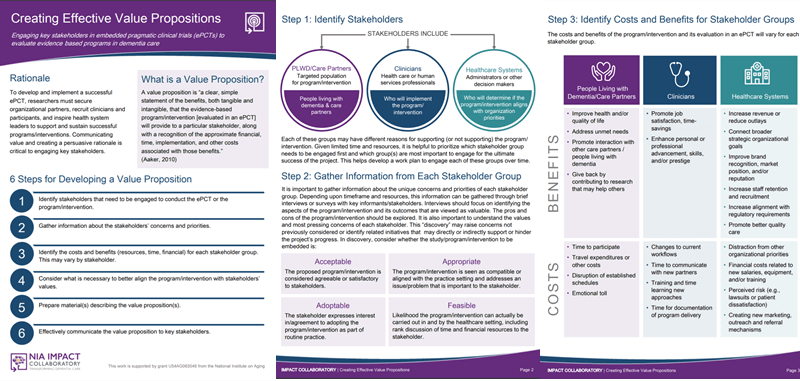
The NIA IMPACT Collaboratory Cores and Teams are creating a series of guidance documents to share important considerations and approaches to planning and conducting embedded pragmatic clinical trials (ePCTs) with people living with dementia (PLWD) and their care partners.
The first of these documents is, “Creating Effective Value Propositions” developed by the Implementation Core. The guide provides a definition and rationale for using value propositions to communicate value and address potential concerns of key stakeholders related to conducting ePCTs of programs/interventions in dementia care. Six steps for developing value propositions are described, and examples are shared.

IMPACT Collaboratory multiple principal investigator Vince Mor, PhD, and Brown University’s Center for Long-Term Care Quality & Innovation are partnering with the American Health Care Association/National Center for Assisted Living, Exponent, and other research partners in a powerful new initiative, funded by the National Institute on Aging, which enables public health surveillance of COVID-19 and other potential public health threats facing nursing homes.
The research partners are leveraging their capabilities to establish the Long Term Care Data Cooperative, which uses nursing home residents’ electronic medical records and associated data to create comprehensive resident electronic health records to help providers monitor their residents’ needs and outcomes. Additionally, the health records system will support public health reporting as well as allow researchers to generate real-world evidence on different treatments and care practices for the elderly and individuals with disabilities in nursing homes.
Mor and his colleagues at Brown University are working with, Exponent, an interdisciplinary and scientific consulting company, electronic health records (EHR) software firm MatrixCare, the AHCA to assemble the largest and most comprehensive health records database from geographically and structurally diverse nursing homes and residents.
This multi-year initiative will continue to characterize and monitor the immediate and long-term effects of COVID-19 and its vaccines among residents and contribute to better preparedness for future public health threats.