
IMPACT Members Publish Three Papers as Part of NIA Consensus Conference

Multiple IMPACT members participated in the National Institute on Aging (NIA) R13 consensus conference, Pragmatic Trials in Long-Term Care: A Consensus Conference, held virtually on March 10, 2021.  The event was funded by the NIA and led by editors of three leading geriatrics journals:  JAMDA (The Journal of Post-Acute and Long-Term Care Medicine), JAGS (The Journal of the American Geriatrics Society), and Geriatric Nursing.

The goal of the conference was to identify priorities and best practices for pragmatic trials in long-term care, with a focus on care for persons with dementia.  The target audience was providers, researchers, and policy makers who aim to promote better care in nursing homes, assisted living communities, and other residential settings that serve older adults. Speakers included internationally renowned research experts, directors of national long-term care organizations, and leaders of national associations and societies. IMPACT Member Participants include Joe Gaugler, PhD, David Gifford, MD, MPH, Laura Hanson, MD, MPH, Vince Mor, PhD, Kathleen Unroe, MD, MHA, Sheryl Zimmerman, PhD.

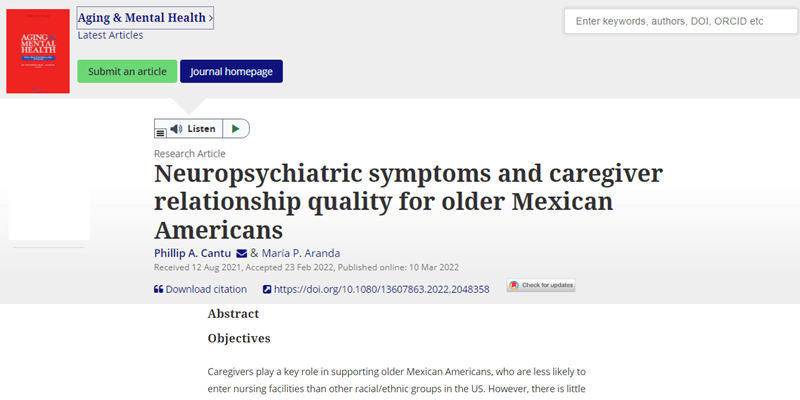
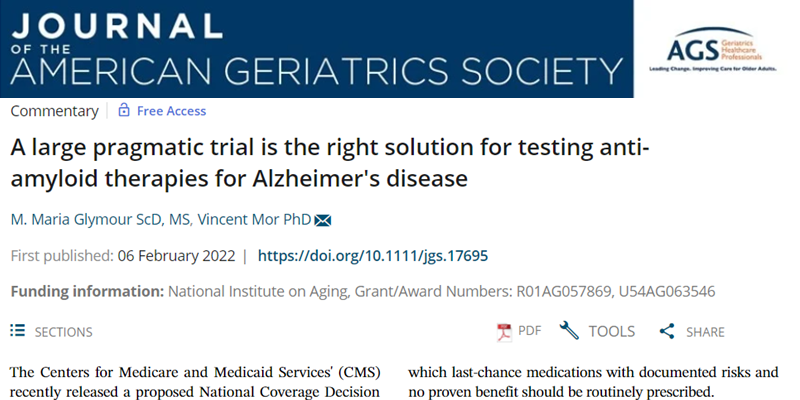
Three papers that resulted from the event are featured in the March 2022 edition of JAMDA.  Due to the importance of the topic and the fact that the conference was sponsored by three journals, the resulting papers are being published in JAMDA, JAGS, and Geriatric Nursing.

Best Practices for Integrating Health Equity into Embedded Pragmatic Clinical Trials for Dementia

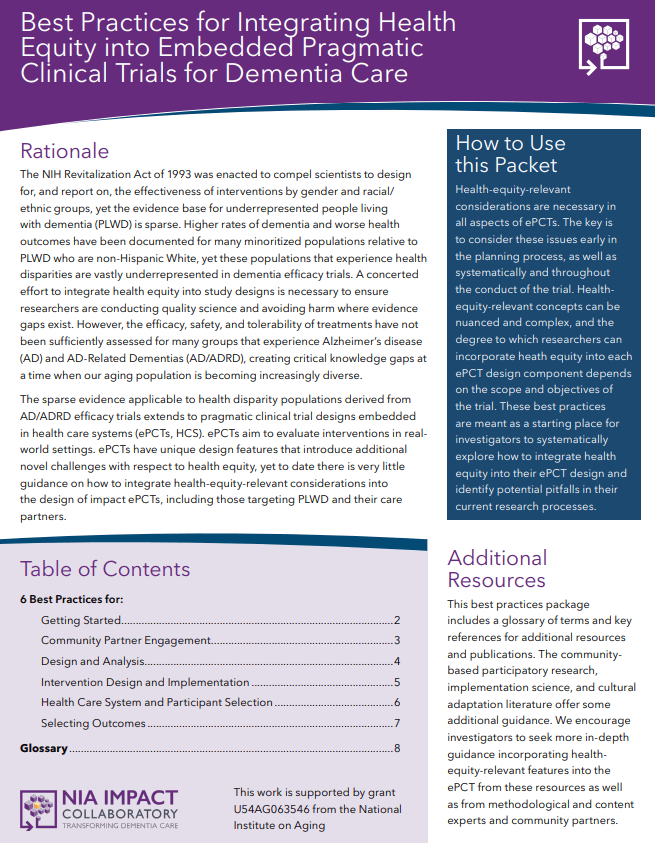
The IMPACT Collaboratory’s leadership and Health Equity Team have worked with experts from across the Collaboratory to create a set of best practices related to integrating health equity into the design and conduct of embedded pragmatic clinical trials for people living with dementia and their care partners.

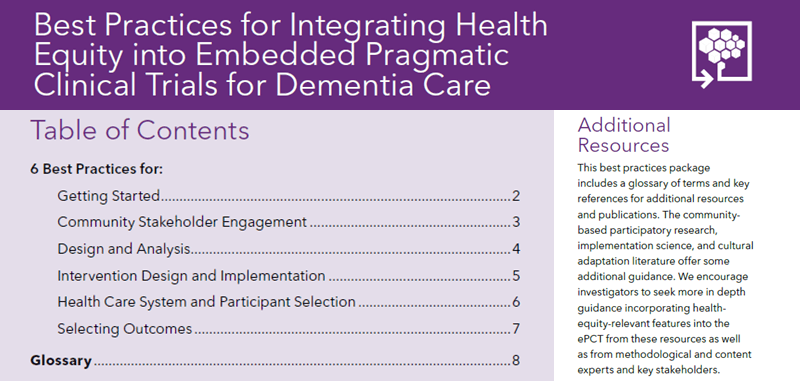
The guidance document includes a brief introduction, followed by best practices for six specific areas of concern including:

• Getting Started
• Community Partner Engagement
• Design and Analysis
• Intervention Design and Implementation
• Health Care System and Participant Selection
• Selecting Outcomes

Each of the focus areas includes best practices along with brief explanations for why these practices are important, and suggestions for their implementation.

In addition to the six separate focus area sheets, the document includes an extensive glossary of terms and key references for additional resources and key publications.

View the guidance document here.

Citation: Best Practices for Integrating Health Equity into Embedded Pragmatic Clinical Trials for Dementia Care. NIA IMPACT Collaboratory; 2022. doi: doi.org/10.58234/74152992
Open Health Equity Best Practices PDF

Lessons From the First Decade of the NIH Pragmatic Trials Collaboratory

February 2022 – In Grand Rounds 24, Drs. Hernandez, Curtis and Weinfurt, the Principal Investigators of the NIH Pragmatic Trials Collaboratory, describe how the Collaboratory began ten years ago, the current state of their research, and where they see the research going in the future.

Download Webinar Slides

Adrian Hernandez, MD, MHS

Adrian Hernandez, MD, MHS
Executive Director,
Duke Clinical Research Institute
Vice Dean, Duke University School of Medicine

Leslie Curtis, PhD

Leslie Curtis, PhD
Professor and Chair
Department of Population Health Sciences
Duke School of Medicine
Faculty member, Duke Clinical Research Institute

Kevin Weinfurt, PhD

Kevin Weinfurt, PhD
Professor and Vice Chair of Research
Department of Population Health Sciences
Duke University Medical Center
Faculty member, Duke Clinical Research Institute

Learning Objectives

  • Understand the goals of the NIH Pragmatic Trials Collaboratory
  • Describe the state of the science of pragmatic trials based on experiences from the Collaboratory’s first decade
  • Identify opportunities for advances in pragmatic trials methodology

Healthcare-Generated Data to Identify People Living with Dementia for Embedded Pragmatic Trials

January 2022 – In Grand Rounds 23, Dr. Bynum describes the use of data to identify people living with dementia as well as strengths, challenges and potential equity gaps when using a healthcare-generated data approach in pragmatic clinical trials.

Speaker

Julie Bynum, MD, MPH

Julie Bynum, MD, MPH

Margaret Terpenning Professor of Medicine

University of Michigan

                     Download webinar slides

Learning Objectives

  • Understand the use of data to achieve pragmatic study aims
  • Identify strengths & challenges when use Healthcare-generated data (billing or electronic health record data) for participant identification
  • Identify threats to Health Equity and Generalizability related to choices about data use.


IMPACT Collaboratory announces two funding opportunities

The NIA IMPACT Collaboratory is now offering two separate funding opportunities: Career Development Award and the Health Care Systems (HCS) Scholars Program.  These opportunities support research and training to increase the nation’s capacity to conduct pragmatic clinical trials (ePCTs) of non-pharmacological interventions within healthcare systems to improve care for people living with Alzheimer’s disease (AD) and AD-related  dementias(AD/ADRD) and their care partners.  IMPACT prioritizes applications that address dementia care for people of all backgrounds and promote health equity.

Career Development Award

The IMPACT Collaboratory funds up to four Career Development Awards (CDAs) annually. These two-year awards support the development of early-stage MD, PhD, or equivalent researchers who seek careers conducting ePCTs for people living with AD/ADRD and their care partners. Each award will provide $100,000 annually in direct costs with an indirect cost rate capped at 8%.

Applications are due by 5pm ET March 18, 2022.  An optional informational webinar will be hosted on Tuesday, February 1, 2022 at 2pm ET to provide investigators with an overview of application details (registration closed). Learn about previous Career Development Awardees.

Health Care Systems Scholars Program

The Health Care Systems (HCS) Scholars Program offers mid-level to senior researchers an opportunity to develop ePCTs with health care or systems interested in improving the care provided to people living with AD/ADRD and their care partners. These one year awards are for up to $120,000 in direct costs with an indirect cost rate capped at 8%.  The goals of the HCS Scholars Program are to embed a researcher in a health care organization or system to:

  1. Foster a mutually beneficial partnership between a researcher and health care organization or system with the aim of conducting future ePCT research to improve the care of PLWD and their care partners
  2. Train investigators about the complexities of conducting research in health care settings and obtain on-the-ground knowledge about how new research programs are successfully introduced at all levels of the organization (e.g., front-line providers to executive leaders)
  3. Engage health care settings in learning more about what it means to conduct ePCTs, to assist in identifying and prioritizing opportunities for improvement in dementia care, and potentially conducting an evaluation of related quality improvement projects

Letters of Intent are required and due by 5pm ET February 8, 2022 . An optional informational webinar about the program will be hosted on January 20, 2022 at 1:15pm ET to provide investigators with an overview of the program and application details (registration closed). Learn about previous HCS Scholar Awardees.

Learn more about the IMPACT Collaboratory on our website at https://impactcollaboratory.org/. Keep up-to-date on these and future opportunities by joining our mailing list and following us on social media at IMPACT Twitter IMPACT LinkedIn.