

The Center for Aging and Serious Illness (CASI) at Massachusetts General Hospital aims to improve the well-being of older adults and enhance the lived experience of those with advanced illnesses. By creating a pipeline of strong investigators, conducting applied clinical studies, and supporting a robust research community, CASI aims to engage aging populations in research, illuminate how to provide effective care for serious illnesses, and augment well-being for older adults and their care partners.
Training
Best Practice Caregiving | Guiding Organizations to Dementia Programs for Family Caregivers
Best Practice Caregiving is a free online database of proven dementia programs for family caregivers. It offers a searchable, interactive, national database of vetted, effective programs that offer much-needed information and support. The database is an invaluable tool for healthcare and community-based organizations, as well as funders and policy makers to discover and share high quality programs for caregivers.
LiveWell Dementia Specialists
LiveWell Dementia Specialists (formerly the Alzheimer’s Resource Center) is a nonprofit of care providers, researchers, and pioneers in dementia care. The organization is dedicated to providing support and education to people living with dementia, their caregivers, and care and research professionals through various resources, courses, training, and events.
NIH Pragmatic Trials Collaboratory and Living Textbook
The NIH Pragmatic Trials Collaboratory aims to improve the way clinical trials are conducted by creating a new infrastructure for collaborative research with healthcare systems, ultimately ensuring that healthcare providers and patients can make decisions based on the best available clinical evidence. The Collaboratory supports the design and rapid execution of pragmatic clinical trial Demonstration Projects to address questions of major public health importance and engage healthcare delivery systems in research partnerships. The Collaboratory also provides training resources on how to design, conduct, and disseminate embedded pragmatic clinical trials (ePCTs).
IMPACT offers new certificate program “Basic Principles of Conducting ePCTs in People Living with Dementia and Care Partners”
The NIA IMPACT Collaboratory has launched a new online learning platform to give learners the opportunity to build their skills in embedded pragmatic clinical trials (ePCTs) in people living with dementia (PLWD). Learners can take individual courses or enroll in our new certificate program “Basic Principles of Conducting ePCTs in People Living with Dementia and Care Partners.”
The “Basic Principles of Conducting ePCTs in People Living with Dementia and Care Partners” certificate program includes 12 IMPACT courses with brief 2-question quizzes which provides a foundation in the principles of conducting ePCTs in health care systems for PLWD and their care partners. Access to the program and all courses within the new learning platform is free, but requires registration.
The platform houses all IMPACT training modules and gives learners control over when and how they engage with IMPACT training materials. The current training library includes 10-15 minute video courses designed for investigators, health systems leaders, research staff, and others who want to learn about the design and conduct of ePCTs. Topic areas include: design and statistics, stakeholder engagement, ethics and regulation, health equity in pragmatic trials, implementation, patient and caregiver relevant outcomes, and technical data considerations.
Training Materials are developed by content experts from IMPACT cores and teams and thought leaders from across the nation, collaborated by the IMPACT Training Core, led by Christopher Callahan, MD, MACP, and Alexia Torke, MD, MS. The development of educational materials is overseen by Training Core member and IMPACT Executive Director, Ellen McCarthy, PhD, MPH.
Learners can engage IMPACT training content by enrolling in either individual courses or Certificate Programs. Learn more by visiting the site and creating a free account!
Notice of Intent: IMPACT Collaboratory plans to publish 2 new Requests for Applications on January 10, 2022.
We are pleased to announce that the IMPACT Collaboratory plans to publish two Requests for Applications (RFA) on January 10, 2022. Stay tuned for more details.
Career Development Award (CDA) Program
- CDA RFA Cycle 3
- $100k per year in direct costs for 2 years
- Goal: Mentored training grant for early-stage investigators to gain skills needed to conduct ePCTs for dementia care
- Informational Webinar: Tuesday, February 1, 2022 at 2pm ET. Registration closed.
- Learn more about CDA awardees
Health Care Systems (HCS) Scholars Program
- HCS Scholars RFA Cycle 2
- $120k in direct costs for 1 year
- Goal: Embed scholars in health care systems to strengthen research partnerships to conduct ePCTs to improve dementia care
- Informational Webinar: Thursday, January 20, 2022 at 1:15pm ET. Registration closed.
- Learn more about HCS Scholar awardees
New IMPACT Funding Opportunity: 2021 Career Development Award
For scientists pursuing careers in embedded pragmatic clinical trials for people living with Alzheimer’s disease and Alzheimer’s disease-related dementias (AD/ADRD) and their care partners.
Informational Webinars
Tuesday, January 19, 2021 at 2:00 pm ET: Registration closed.
Wednesday, February 3, 2021 at 3:00 pm ET: Registration closed.
Application Period Opens
January 18, 2021
Proposals Due
April 2, 2021 @ 5pm ET
Read full Request for Applications (RFA)
The NIA IMPACT Collaboratory (U54AG063546) is pleased to announce the request for applications for the 2021 IMPACT Career Development Award. We encourage applications from early-stage investigators interested in a research career that includes conducting embedded pragmatic clinical trials (ePCTs) of non-pharmacologic interventions within healthcare systems (HCS) for people living with Alzheimer’s disease (AD) and AD-related dementias (ADRD) and their care partners. The recent $300 million increase in National Institutes of Health funding for AD/ADRD research, reflects the urgency and opportunities for investigators focused in this area.
Conducting ePCTs in AD/ADRD within HCS requires unique research skills, yet the field is relatively nascent. The number of investigators capable of rigorously designing and executing ePCTs in partnership with HCS and other key stakeholders remains limited, and those that have intersecting expertise in AD/ADRD populations are even fewer. Thus, a critical objective of the IMPACT Collaboratory is to build the nation’s capacity to conduct impactful ePCTs in AD/ADRD by training a workforce of investigators prepared to carry on this work well into the future.
The IMPACT Collaboratory funds up to four career development awards (CDAs) annually. These CDAs seek to support the development of early-stage MD, PhD, or equivalent researchers who seek careers conducting ePCTs for people living with AD/ADRD and their care partners. The IMPACT Collaboratory prioritizes applications that address dementia care for people of all backgrounds and promote health equity. CDAs are funded for two years. Each award will provide $100,000 annually in direct costs with an indirect cost rate capped at 8%. Awardees are required to devote a minimum of 75% effort toward the goals of the award.
A set of frequently asked questions (FAQ) regarding this award is available at https://impactcollaboratory.org/CDA-grant-faq/. Additionally, please email IMPACTcollaboratory@hsl.harvard.edu with any questions.
Request for Applications to Attend the Annual IMPACT Training Workshop & Retreat (April 7-8, 2021)
The IMPACT Collaboratory will hold its first annual Training Workshop and Retreat, “Building Skills to Conduct Embedded Pragmatic Clinical Trials for People Living with Dementia (PLWD) and their Care Partners,” on April 7-8, 2021.
We are inviting applications from early to mid-career researchers who seek to develop competence in designing and conducting ePCTs of interventions to improve care for PWLD and their care partners. We anticipate accepting up to 25 participants to attend the workshop.
This virtual 1.5-day workshop and retreat will provide a foundation in practical aspects of designing and conducting ePCTs in AD/ADRD through a combination of panel discussions, small group sessions, and networking opportunities with experts in the field. Workshop modules will focus on healthcare systems, implementation science, and study design.
Participants will gain knowledge in ePCT design and method, problem-solve challenges faced in current or planned projects, and network and engage with the larger community of IMPACT investigators. Throughout the program, special attention will be paid to key considerations in design, implementation, and monitoring ePCTs of PLWD and care partners to ensure health equity.
Successful applicants will be expected to complete selected readings and online training prior to the workshop. Please note that all participants will be expected to attend and participate in the entire 1.5-day IMPACT Collaboratory Training Workshop and Retreat.
Please help to publicize this training program and encourage your investigators and colleagues to apply.
EVENT DETAILS (virtual):
Wednesday, April 7, 2021 from 1:30pm – 4:30pm ET
Thursday, April 8, 2021 from 10:00am – 4:30pm ET
TO APPLY:
For more information and to apply please visit: https://impactcollaboratory.org/training-workshop
- Deadline: Friday, January 15, 2021
- Application: Please submit your online application and your NIH biosketch by January 15, 2021 through our application portal.
ELIGIBILITY CRITERIA: Applicants should have an MD, PhD, or equivalent research degree and hold a full-time position at an academic or research organization in the United States. Although the primary audience is early-career investigators, mid-career applicants who are seeking to change their career path to pursue research on ePCTs in AD/ADRD will be considered. Individuals from underrepresented racial and ethnic groups as well as individuals with disabilities are encouraged to apply.
SELECTION CRITERIA: Applicants will be selected based on their demonstrated commitment to improving the care of people living with dementia and/or their caregivers through the conduct of ePCTs in health care systems and the potential impact of the workshop on promoting the applicant’s career in this area.
If you have any questions regarding this opportunity, please email IMPACTcollaboratory@hsl.harvard.edu
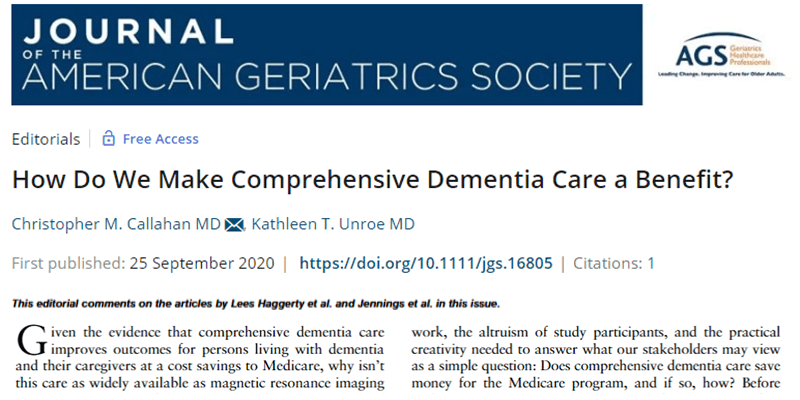
IMPACT members discuss the importance of comprehensive dementia care
Editorial: How Do We Make Comprehensive Dementia Care a Benefit?
September 25, 2020
IMPACT Collaboratory funds two career development awards
The National Institute on Aging (NIA) Imbedded Pragmatic AD/ADRD Clinical Trials (IMPACT) Collaboratory is pleased to announce the recipients of its inaugural cycle of the IMPACT Career Development Award Program. Recipients were selected from an impressive group of competitive applications.
2020 IMPACT Career Development Award Recipients
Jennifer Gabbard, MD, Wake Forest School of Medicine
Use of a dementia-specific portal-based tool for advance care planning engagement
Tina Sadarangani, PhD, RN, ANP-BC, GNP-BC, NYU Rory Meyers College of Nursing
Leveraging mHealth to reduce avoidable utilization by people with dementia in day centers
About the NIA IMPACT Career Development Award Program
NIA IMPACT Collaboratory funds two to three career development awards annually. These career development awards will support the development of early-stage MD, PhD, or equivalent researchers who seek careers conducting ePCTs for people living with AD/ADRD and their care partners. The IMPACT Collaboratory prioritizes applications that address dementia care for people of all backgrounds and promote health equity.
Conducting ePCTs in AD/ADRD within healthcare systems requires unique research skills, yet the field is relatively nascent. The number of investigators capable of rigorously designing and executing ePCTs in partnership with healthcare systems and other key stakeholders remains limited, and those that have intersecting expertise in AD/ADRD populations are even fewer. Thus, the career development award advances the IMPACT Collaboratory’s mission to build the nation’s capacity to conduct impactful ePCTs in AD/ADRD by training a workforce of investigators prepared to carry on this work well into the future.
Please join our mailing list to receive news and invitations to IMPACT events, Grand Rounds, and pragmatic trials training modules.
Learn more about the IMPACT Collaboratory on our website, Twitter and LinkedIn.