

IMPACT members Kathleen Unroe, MD, MHA, MS, Debra Saliba, MD, MPH, Sheryl Zimmerman, PhD and Jerry Gurwitz, MD, contribute commentary in the Journal of the American Geriatrics Society citing IMPACT and the Long Term Data Cooperative as National Institute on Aging (NIA) initiatives that provide foundational work addressing the identification and capture of important clinical outcomes, laying the groundwork for a nursing home clinical trials network. The commentary is based on the article Evaluation of medical therapies in the nursing home population: Gaps, challenges, and next steps.
Main Types

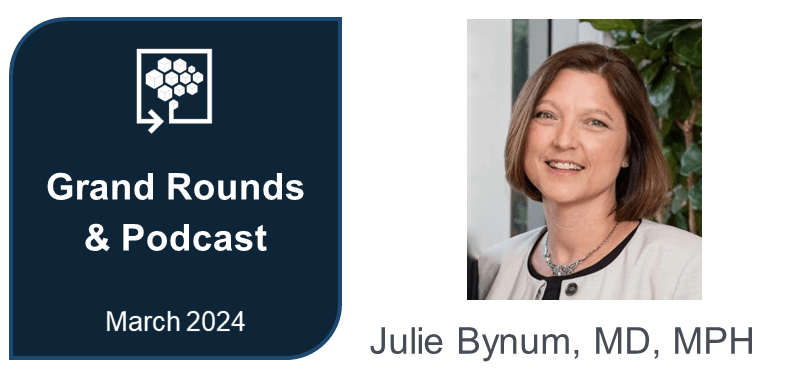
Diagnosed Dementia in Medicare: Benchmarking for Study Planning and Equity
March 2024 – In Grand Rounds 45, Dr. Bynum shares the pros and cons of using healthcare-generated data, such as Medicare Fee-for-Service and Medicare Advantage, to identify people living with Alzheimer's disease and related dementias (ADRD), as well as the use of population benchmarks in study planning and integrating health equity.
Speaker

Margaret Terpenning Collegiate Professor of Internal Medicine
Division of Geriatric & Palliative Medicine
University of Michigan
Learning Objectives
- Identify strengths & challenges when using Medicare data for participant identification
- Understand characteristics of diagnosed dementia cases across place
- Consider value of using population benchmarks for planning and equity

CAPRA Data Brief | health care use patterns among older adults with dementia
IMPACT’s Cameron Gettel, MD and Julie Bynum, MD, MPH are among the authors of the CAPRA Data Brief on health care use patterns among older adults with dementia. The brief was developed by the Center to Accelerate Population Research on Alzheimer’s (CAPRA) at the University of Michigan.
Authors demonstrated the use of Medicare claims to examine healthcare use patterns among older adults with ADRD using datasets provided by the Impact Collaboratory. The brief cites the increase in emergency care, hospitalization, and skilled nursing facility admissions for Medicare recipients and an increased need for planning and care for people with Alzheimer’s Disease and Related Dementias (ADRD) in the U.S.

Prevalence estimates are created using the Bynum 1-Year Standard Algorithm for identifying Alzheimer’s Disease and Related Dementias in Medicare Claims
Prevalence estimates are created using the Bynum 1-Year Standard Algorithm for identifying Alzheimer’s Disease and Related Dementias in Medicare Claims
Study shows how music can improve verbal agitation behaviors of nursing home residents with dementia
IMPACT multiple principal investigator Vince Mor, PhD, and members Roee Gutman, PhD, James Rudolph, MD, SM, Rosa Baier, MPH and executive committee member, Ellen McCreedy, PhD, are among authors sharing observed effects of music on nursing home residents with dementia. In a randomized controlled trial, patients were observed to express more pleasure and fewer signs of verbal agitation. The authors conclude that non-pharmacological interventions like personalized music exposure can temporarily relieve agitated behaviors of people living with dementia in a nursing home setting.
NIH Collaboratory workshop recordings on ePCT’s effects on healthcare systems now available
Multiple principal investigator Vince Mor, PhD was part of an NIH Collaboratory workshop entitled “Getting the Right Evidence to Decision-Makers Faster” held June 20-21, 2023. Mor was part of a panel of experts addressing “How Have Health Systems Made Decisions Based on Evidence Collected in PCTs?”
The 2-day workshop explored how researchers share evidence with healthcare system decision-makers to implement the findings of pragmatic clinical trials conducted within healthcare systems.
To access the workshop summary, materials and recordings, visit the NIH Collaboratory website.
CICADA RFA Penn’s Center for Improving Care Delivery for the Aging (CICADA) is seeking applications for the 2024-2025 cohort of CICADA Scientists.
Penn’s Center for Improving Care Delivery for the Aging (CICADA) is seeking applications for the 2024-2025 cohort of CICADA Scientists. In collaboration with Penn’s Leonard Davis Institute for Health Economics (LDI), CICADA seeks to enhance the diversity of the aging research workforce by mentoring promising scientists from under-represented backgrounds interested in a career focused on improving health equity and health care delivery for older adults.
The deadline for submitting applications is 8:00 a.m. ET on January 8, 2024.
To review the full request for applications, including available resources, review criteria, and the application timeline, please click here.
For application questions, please contact CICADA@pennmedicine.upenn.edu.
Observing the impact of personalized music on agitated behaviors in dementia patients
November 2, 2023
Authors, including IMPACT members, Roee Gutman, PhD, Vincent Mor, PhD, James Rudolph, MD, SM, Rosa Baier, MPH, and Ellen McCreedy, PhD, MPH explored whether implementation of a personalized music intervention decreased the frequency of agitated behaviors in nursing home residents with dementia. They measured impact by using structured observations conducted as part of a randomized controlled trial design.
The authors found that personalized music decreased the frequency of verbally agitated behaviors in residents randomized to receive the treatment compared to residents randomized to a usual care control. No effect of the intervention was found on physically agitated behaviors. The intervention also increased observed pleasure.
This study provides evidence for the effectiveness of a non-pharmacological intervention for temporary relief in verbal behaviors in nursing home residents with dementia.