
December 8, 2021
Continue reading

November 2021 – In Grand Rounds 21, Drs. Penfold, Hanson, and Fortinsky, describe challenges from three pragmatic trials to share lessons learned and ideas for how to overcome these challenges in future research.

Robert Penfold, PhD
Senior Investigator, Kaiser Permanente
Washington Health Research Institute

Leah Hanson, PhD
Senior Research Investigator,
Health Partners Institute

Richard H. Fortinsky, PhD
Professor and Health Net, Inc. Endowed Chair in Geriatrics and Gerontology
UConn Center on Aging
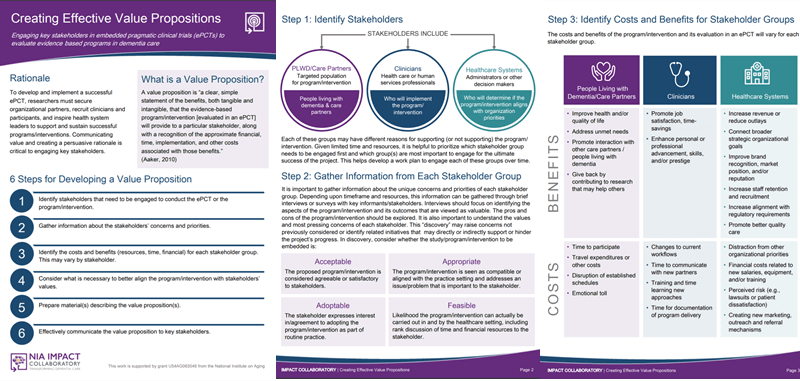
The NIA IMPACT Collaboratory Cores and Teams are creating a series of guidance documents to share important considerations and approaches to planning and conducting embedded pragmatic clinical trials (ePCTs) with people living with dementia (PLWD) and their care partners.
The first of these documents is, “Creating Effective Value Propositions” developed by the Implementation Core. The guide provides a definition and rationale for using value propositions to communicate value and address potential concerns of key stakeholders related to conducting ePCTs of programs/interventions in dementia care. Six steps for developing value propositions are described, and examples are shared.


October 2021 – In Grand Rounds 20, Dr. Lyons explains a dyadic approach to illness and care, as well as the role of theory and concepts, design and methodological considerations, and family and culture in dyadic research.
Karen S. Lyons, PhD, FGSA (she/hers)
Professor
Boston College
William F. Connell School of Nursing
@KSLCareDyads

September 28, 2021

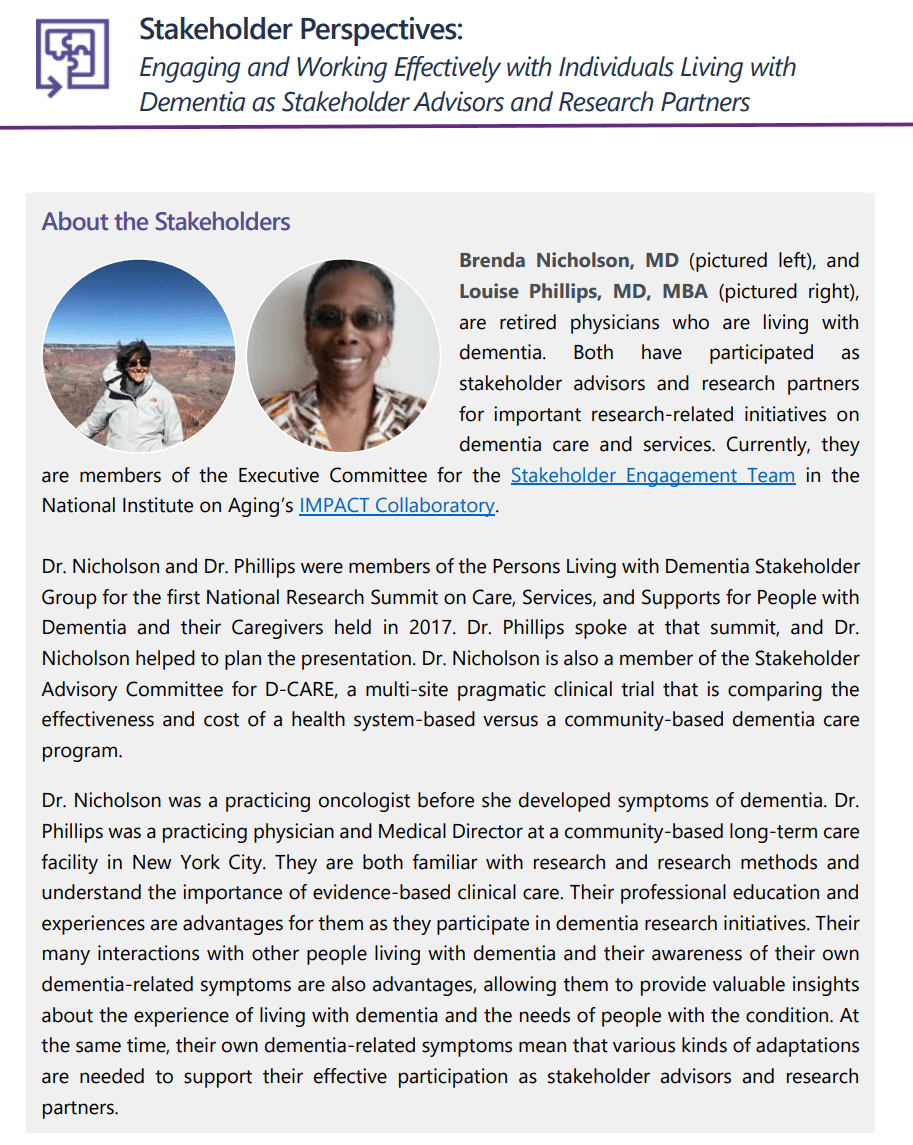
Members of the Executive Committee for the IMPACT Engaging Partners Team have collaborated to create a guide for researchers seeking stakeholder advisors living with dementia.
Brenda Nicholson, MD , and Louise Phillips, MD, MBA, are retired physicians who are living with dementia. Both have participated as stakeholder advisors and research partners for important research-related initiatives on dementia care and services. They collaborated with Katie Maslow, MSW, to create the perspective piece entitled, Engaging and Working Effectively with Individuals Living with Dementia as Stakeholder Advisors and Research Partners.
Dr. Nicholson and Dr. Phillips provided three reasons why they participate as stakeholder advisors and research partners in dementia care research:
Dr. Nicholson and Dr. Phillips drew on their own experiences to offer tips to researchers, but also emphasized that each person living with dementia has their own unique needs and circumstances to consider. Their tips suggest the importance of considering the needs of stakeholder advisors throughout the engagement process; from planning the meeting format and time commitment, through post-meeting follow-up. They stress the importance of providing multiple opportunities for advisors to share their ideas and have their voices heard. The full perspective piece can be found at this link.